
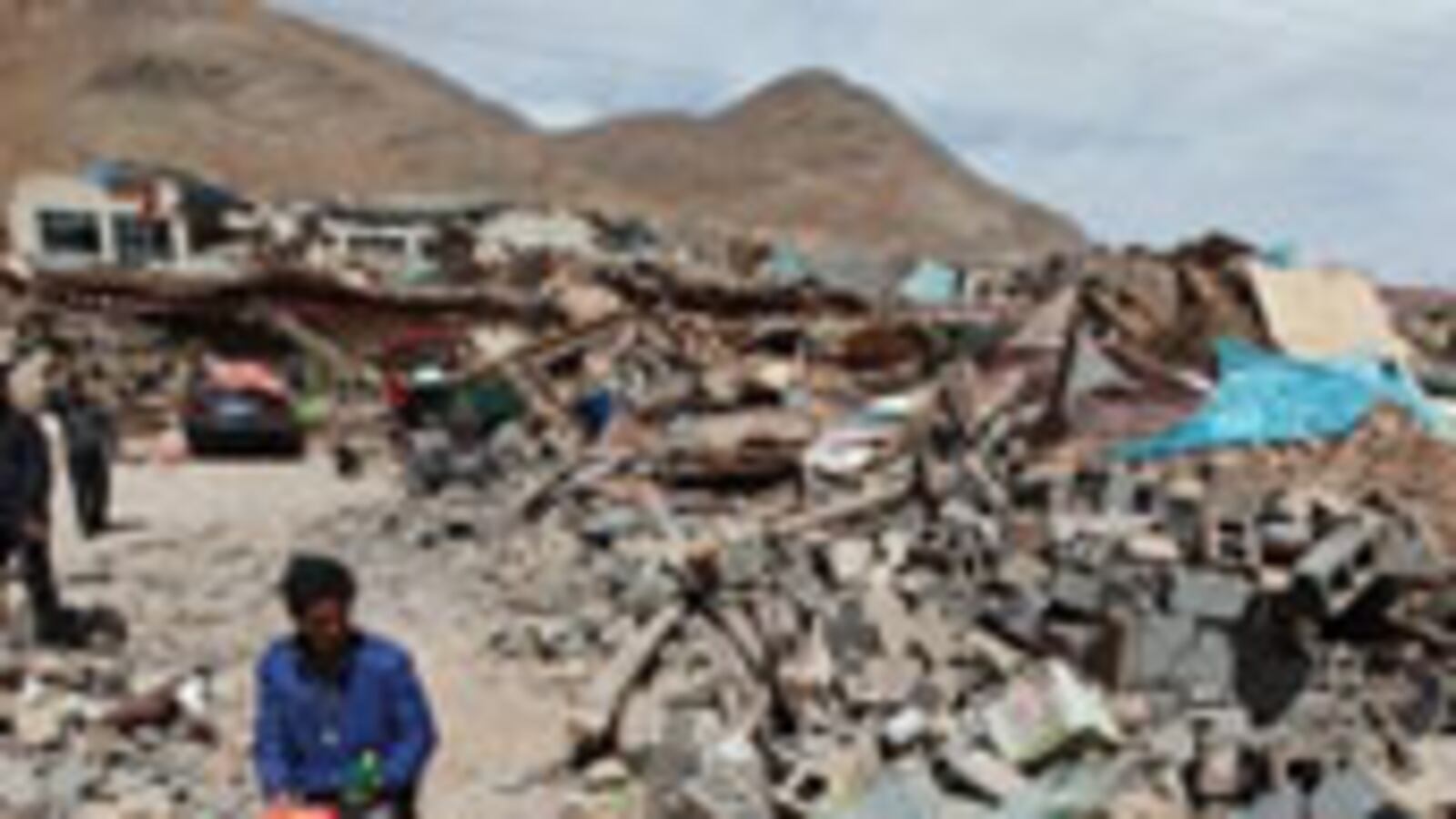

As news of China’s latest deadly earthquake hit, Chinese President Hu Jintao and Premier Wen Jiabao exhorted citizens to mobilize for “all-out efforts to save lives and provide assistance” to all of those affected by the catastrophe in Qinghai Province.
To be sure, we can expect to see an outpouring of domestic support akin to that following the May 2008 Sichuan earthquake. That event was considered something of a watershed of civic activism, in which thousands of volunteers helped raise money, deliver relief supplies, and attend to the survivors. Stories poured out for weeks after the quake about young, relatively affluent Chinese from the east coast driving cases of water and clothing to Sichuan, or organizing fundraising efforts within their companies or communities. Some—including some in the government—lauded these efforts as heralding a new and positive kind of activism.
The Chinese government—smarting from international criticism over its efforts to restrict journalists’ access to Tibet in March 2008, following protests in that region, and cover-ups of the SARS epidemic and other health scares—actually relaxed some of its controls around the earthquake zone for a brief period. This allowed relatively unprecedented coverage of the disaster inside China and around the world, leading to an extraordinary outpouring of support.
Where will the next quake strike? Click below to view our gallery.

Yet there were other responses to the May 2008 quake for which the Chinese government demonstrated only pure hostility—and similar cruelty should not be repeated in the coming days and weeks in Qinghai.
Many of the buildings that collapsed in the Sichuan quake were schools, leading to a disproportionate number of children’s deaths. Rather than conduct impartial investigations into allegations of shoddy construction, or provide a full accounting of those who died in the schools, national and local officials opted instead to persecute those who were asking the questions. Grieving parents were told not to try to take cases to court, or bought off in order to drop their complaints.
Some of those best poised to help those parents will not be available to help anyone in Qinghai who has similarly suffered. Two Chinese activists, Huang Qi and Tan Zuoren , who are well-known for their efforts to investigate allegations of corruption in school construction in Sichuan and compile a list of the children killed in the Sichuan quake, won’t be able to pester the government with similar questions about Qinghai. They can’t, because instead of being treated as the civic heroes they were, they’re serving sentences for “revealing state secrets” and “subversion” for criticizing the authorities. Artist Ai Weiwei, famous in and outside of China as a designer of the “Birds’ Nest” stadium for the 2008 Olympics, was even punched by Sichuan police who broke into his hotel room in August 2009, preventing him from giving evidence at Tan’s trial. Ai suffered a cerebral hemorrhage after the beating. Ai’s blog, on which he posted the names of the students who died, has also been shut down.
Within hours of the earthquake, the Central Publicity Department (formerly named the Propaganda Department in English) began to dictate to the Chinese press precisely how the disaster was to be covered.
In Qinghai, it is worth watching state propaganda efforts. Within hours of the Sichuan earthquake, the Central Publicity Department (formerly named the Propaganda Department in English) began to dictate to the Chinese press precisely how the disaster was to be covered. That coverage would “uphold unity and encourage stability” and stress “positive propaganda”; by late May, Chinese journalists were told to play down coverage of the collapsed schools.
The right way to respond to the Qinghai quake is undoubtedly to focus on the rescue of survivors and recovery of those who died. But essential to those goals are free access to information, regardless of whether it portrays the government in a good or bad light, and regardless of whether that information is sought by a Chinese activist or a foreign correspondent. Rather than suppress demands for accountability, the government should embrace them, partly because doing so might mitigate or prevent suffering when the next natural disaster strikes. And, ultimately, what better way is there to honor the lives lost in Qinghai today and Sichuan in 2008 than by freeing those imprisoned for trying to uncover the truth—and to allow the truth, however painful it may be to the government, to emerge, unfettered—and now?
Dr. Sophie Richardson is the advocacy director of Human Rights Watch's Asia Division and oversees the organization's work on China. A graduate of the University of Virginia, the Hopkins-Nanjing Program, and Oberlin College, Dr. Richardson is the author of numerous articles on domestic Chinese political reform, democratization, and human rights in Cambodia, China, Hong Kong, and the Philippines. She has testified before the European Parliament and the U.S. Senate and House of Representatives. Dr. Richardson is the author of China, Cambodia, and the Five Principles of Peaceful Coexistence (Columbia University Press, 2009), an in-depth examination of China's foreign policy since 1954's Geneva Conference.