Blogs and Stories

Jerry Adler

What's Your Green IQ?

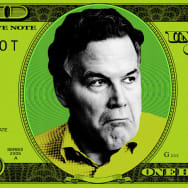
BS Top - Adler Green IQ Jim Esposito / Getty Images In Ecological Intelligence, Daniel Goleman questions the environmental impact of what we buy. You'll never answer "paper or plastic" the same way again.

We like a writer who asks big questions, and Daniel Goleman has been unafraid to tackle them ever since his 1995 bestseller, Emotional Intelligence, which investigated how people understand and communicate feelings. He followed this with Working With Emotional Intelligence, and Social Intelligence, and now, in Ecological Intelligence, he asks the biggest question of all, the existential dilemma that every American must confront at some time: Paper or plastic? Which is why it’s such a letdown when he answers, in three crisp syllables: “It depends.” Like we couldn’t have figured that out for ourselves.

I discovered that the ingredients in the national-brand shampoo I had been using for years posed a risk of cancer, organ damage, neurotoxicity, and numerous other unpleasant consequences.

If Goleman is right, though, this will soon be the least of our concerns. The awesome responsibility of solving the world’s most intractable environmental and social problems will fall on the shoulders of American consumers. Armed with gigabytes of data on every brand of chewing gum and shampoo on the market, they will be transformed into environmental vigilantes, enforcing demands for safer and more eco-friendly products that, as they filter up through the retail supply chain, manufacturers will rush to satisfy. The empowering tool for this is something called “life-cycle analysis,” a new discipline that, as Goleman explains, “measures in fine-grained detail the vast number of ecological impacts of every product—paper, plastic, cement, you name it—all along its life cycle, from the time it is made, through its use, until you dispose of it, and even after you toss it out.” Then that data can be downloaded onto a convenient hand-held scanner that the shopper will wave over any product on the supermarket shelf, and next thing you know, instead of discounts grocers will be offering half off the carbon footprint of a roll of paper towels if you buy two at the regular environmental cost.

Ecological Intelligence book cover Ecological Intelligence By Daniel Goleman 288 pages. Broadway Books. $26 That’s a joke, but it illustrates the magnitude of the change in consumer behavior Goleman anticipates, and the complexity of the calculations necessary to bring it about. If there were a simple answer to the paper-versus-plastic question we wouldn’t still be asking it. Plastic bags are made of nonrenewable petroleum and take hundreds of years to decompose, but paper bags take more energy and water to manufacture. The plastic-versus-paper riddle is actually a trick question. In fact, Goleman carries his own reusable fabric shopping bag to the store, as we all should do. But even that doesn’t free him from worries about pesticide residue in the field where the bag’s cotton was grown and whether the fabric mill used child labor, so maybe the safest thing is to buy only as much as you can carry back from the store in your hands.

That’s a joke. The real answer is, it depends. When Goleman attempted to apply the principles of what he calls “radical transparency” to the choice between a reusable stainless-steel water bottle and throwaway plastic ones, he consulted an “industrial ecologist” who measured the environmental and health impacts along dozens of parameters. The upshot was, the choice depends on what you choose to focus on. In terms of fossil-fuel depletion, the steel bottle was the equivalent of just eight plastic bottles—a few days’ worth for many people—while on the scale of “ecotoxicity on freshwater” you’d have to buy 900 plastic bottles before their impact equaled the steel.

So it’s not just a matter of having the right information, but deciding in advance which specific environmental values are important to you. And this was for a simple choice between two different containers whose contents—water—were the same. What about something really complicated, like a frozen waffle? Or, to take a product that Goleman seems particularly partial to, shampoo? Goleman introduced me to the Environmental Working Group’s cosmetics-safety Web site, Skin Deep. Here I discovered that the ingredients in the national-brand shampoo I had been using for years posed a risk of cancer, organ damage, neurotoxicity, and numerous other unpleasant consequences. That’s without even considering the environmental effects of the bottle it comes in, or the ink used to print the label.

Back to Top
April 22, 2009 | 6:49am
Comments ()
thirdcoastkites

It is true that the puritanical approach to "green" says more about the individual than the idea of living in a sustainable, ecologically aware way. Green is more science than spirit, and with science there are trade-offs. With every benefit, there is a consequence. The right way to look at this may be, and pardon the injection of religion, is biblical..."in all things, moderation." I support renewable energy and promote that through kiting:

http://www.thirdcoastkites.com

but I must except the fact that each kite's manufacture has a carbon footprint, but so does every shovel. One hopes that in the aggregate, each kite inspires awareness to wind power and nature that outweighs the impact of it's creation just as each shovel leads to a greater amount of carbon dioxide loving gardens than it's own carbon footprint.

|
|
Reply
3:28 pm, Nov 16, 2009
Leave a Comment
Leave a comment

Thank you.
As a first time user, your comment has been submitted for review. It can take anywhere from a few hours to a day or two for your comment to be reviewed, depending on the time of week and the volume of comments we receive.

View Comments
Leave a comment

Please log in to leave comments.

What's Your Green IQ?

by Jerry Adler

Info
RSS
Jerry Adler
Emails
|
print
Single Page
|
text
-
+
Facebook
 | 
Twitter
 | 
Digg
 |