
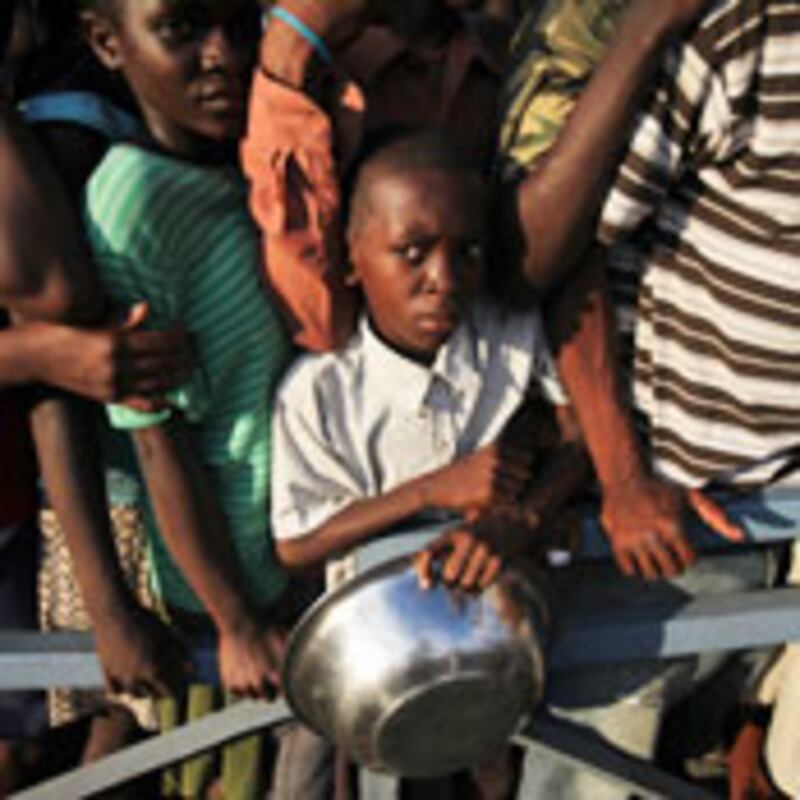
Late last week, as the extent of the apocalypse in Haiti was just becoming clear, the financial journalist and blogger Felix Salmon wrote a much-discussed blog post headlined “Don’t Give Money to Haiti.” Too much generosity, he argued, could do more harm than good: “The problem is that Haiti, if it wasn’t a failed state before the earthquake, is almost certainly a failed state now—and one of the lessons we’ve learned from trying to rebuild failed states elsewhere in the world is that throwing money at the issue is very likely to backfire.”
It’s way too early to start worrying about too much money—those working on the ground remain worried about having too little.
Soon, other skeptical voices piped up. On Tuesday, The Wall Street Journal ran an op-ed entitled, “To Help Haiti, End Foreign Aid.” Bret Stephens wrote, “For actual Haitians… just about every conceivable aid scheme beyond immediate humanitarian relief will lead to more poverty, more corruption, and less institutional capacity.” On the Aid Watch blog, which is run out of New York University’s Development Research Institute, Laura Freschi made tentative comparisons to the aftermath of the Asian tsunami in 2004, where, she argued , giving outpaced need. “The global outpouring of support for people affected by the South Asia earthquake and tsunamis of 2004 added up to more than $14 billion,” she wrote. “One notable fact about this $14 billion is that it represents the most generous international response to a natural disaster on record. Another is that it exceeded the total estimated cost of damages from the storm by some $4 billion, or about 30 percent.”
• Michelle Goldberg: How Partners in Health Gives Haiti a Ray of Hope • The Daily Beast’s full Haiti coverage• Sir Harold Evans: CNN’s Haiti Triumph Meanwhile, Yéle Haiti, the NGO founded by musician Wyclef Jean, came under attack for financial mismanagement, with The Smoking Gun reporting that Yéle failed to file tax returns and spent $410,000 in personal payments to Jean for rent, production services, and a benefit conference. Yet Yéle Haiti remains one of five charities selected to receive proceeds from the celebrity-packed telethon that George Clooney, Anderson Cooper, and Jean himself will host this Friday.
Reading all this, those who want to help might feel cynical and baffled, perhaps even guilty for trying to salve their consciences by giving cash. That’s unfortunate, because despite the aid backlash, Haiti still needs as much help as it can get.
“It’s absolutely pure sophistry to say that aid of this sort does more harm than good,” says Stewart Paperin, executive vice president of the Open Society Institute. Paperin has extensive experience in Haiti, and believes in market-based solutions to poverty; before the quake, he was involved in building a free-trade zone outside of Port-au-Prince. But he has no patience for the argument that Haiti is facing an aid glut. “It’s something that somebody says who’s never been in the center of one these situations.”
To be sure, most people in the foreign-aid world agree with Salmon that, when making donations, it’s far better not to earmark them for a specific disasters. Instead, gifts should be given to organizations’ general funds. “The last time there was a disaster on this scale was the Asian tsunami, five years ago,” wrote Salmon. “And for all its best efforts, the Red Cross has still only spent 83 percent of its $3.21 billion tsunami budget—which means that it has over half a billion dollars left to spend. Not to put too fine a point on it, but that’s money which could be spent in Haiti, if it weren’t for the fact that it was earmarked.”
Indeed, the aftermath of the tsunami hangs over discussions about aid in Haiti. Saundra Schimmelpfennig, who co-founded the Disaster Tracking Recovery Assistance Center to help coordinate aid in Thailand, saw some of the unintended consequences of large-scale generosity up close. Since orphanages provide great photo-ops for donors, agencies built more than were needed, she says, wasting money that might have gone to reuniting children with relatives. Cash disbursements, especially irregular ones, created dependency—some people feared going work, lest they miss a handout. At times, she says, aid fostered “the destruction of trust or a sense of community, because some people will take advantage of the lack of coordination, some people will get far more than other people. Where people once trusted their village headman or school principal, that trust is broken down.”
But as Schimmelpfennig acknowledges, this is far from the whole picture. Despite the waste, messiness, and mistakes—which may be inevitable in such a huge, complicated undertaking—the post-tsunami rebuilding effort has had some remarkable successes. In late December, Time ran a piece about the astonishing turnaround in Indonesia’s Aceh province, where more than 150,000 people died. “A return to Aceh today is a heartening experience. Billions of dollars in reconstruction funds have poured into the province, and it shows,” Time reported. “[The city of] Banda Aceh, where the tsunami killed 60,000 people— a fifth of the population— is now bustling and prosperous.” Unlike Indonesia, Haiti doesn’t have a functioning government, so such a quick turnaround is unlikely. But that’s also why its need is so great. Even if there’s enough money right now for immediate rescue operations and emergency food supplies—and that remains an open question—there’s not nearly enough for long-term reconstruction. Fixing the damages caused by the earthquake is only the beginning.
The city of Port-au-Prince needs to be rebuilt, along with the country’s main port. Schools and hospitals have to be erected, and funding provided for their operation. Long-term medical consequences must be dealt with in a country that was already beset by public health crises—it’s estimated, for example, that 37,000 pregnant women are among the quake survivors. They and their babies are at extra-heightened risk.
In other words, it’s way too early to start worrying about too much money—those working on the ground remain worried about having too little. “It’s still critical to raise more funds for the short term and if possible for the long term,” says Donna Barry, advocacy and policy director for Partners in Health, perhaps the most admired NGO working in Haiti. “There’s a long way to go. There’s a really long way to go. There’s a huge resource need.” (Full disclosure: My husband, working pro-bono, recently helped design a new fundraising Web site for Partners in Health.)
Without a doubt, money will be wasted. There will be stories about fraud, turf wars, and perverse incentives. There might be too much money allocated for feel-good projects like orphanages and not enough for things like infrastructure and sewage. Much of the $100 million Obama has promised will end up back in the United States, paid to American consultants and contractors. If Haitians aren’t involved in planning for the rebuilding, outside organizations may waste money on building projects that defy the realities of Haitian life. But these aren’t reasons not to give. They’re reasons to give smarter, to organizations that are deeply rooted in Haiti, and will still be working there when the world turns its gaze somewhere else.
“I personally, if I were to give, I would be giving to the smaller organizations,” like Partners in Health and the Appropriate Infrastructure Development Group, says Laura Sampath, manager of the International Development Initiative at MIT. “Those two have many, many years of experience on the ground in Haiti. They have loads and loads of staff that are Haitian. They know where the needs are.” Those needs remain enormous. Americans should keep acting on their idealism, and their guilt.
Michelle Goldberg is the author of The Means of Reproduction: Sex, Power and the Future of the World and Kingdom Coming: The Rise of Christian Nationalism. She is a senior correspondent for The American Prospect, and her work has appeared in The New Republic, The Nation, the Los Angeles Times, Glamour, and many other publications.