China's Economic Takeover: The World's Next Superpower by 2016
Everyone knows that China's been gunning for superpower status for a while, but it will be the biggest economy in the world much sooner than we think.
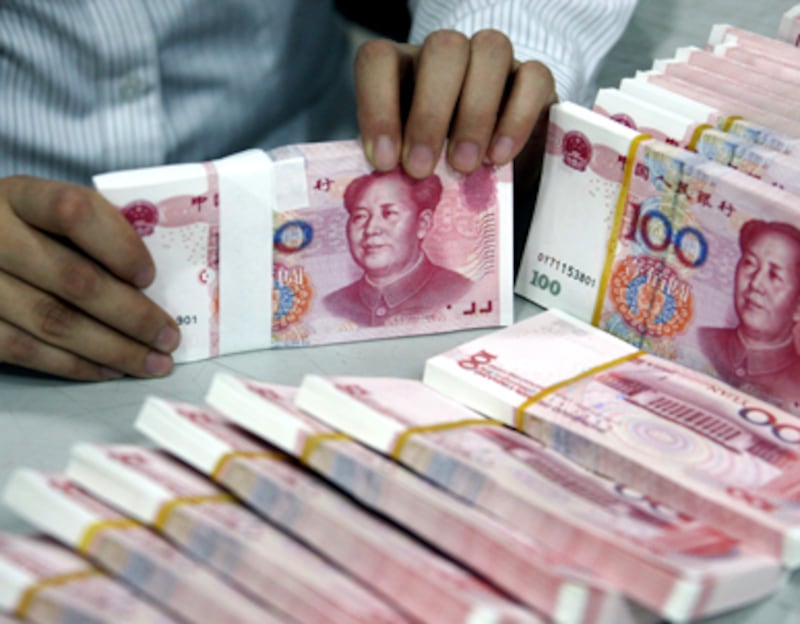
Imagechina / AP Photos
Get the Beast Digest newsletter delivered straight to your inbox
By clicking “SIGN UP” you agree to our Terms of Use and Privacy Policy.
In the days after the Fukushima disaster in Japan, scientists in China made a strange announcement. They said they had developed a different type of nuclear reactor, one that did not rely on the conventional fuel rods but instead thousands of billiard-ball-sized fuel elements, coated in graphite, each meant to do a fuel rod's work but also to ensure that in a nuclear emergency, there would be no nuclear meltdown. What was strange about all this was not only the announcement of such technology—because Germany, South Africa, and the United States had all tried, and failed, to do this before—but the confidence of the announcement. Fukushima had just happened, Germany was abandoning its nuclear ambitions, the rest of Europe worried over France's nuclear sites,the United States was in a full-on freak out over its nuclear plants, and yet here was China, saying that once the billiard-ball technology proved successful in two plants, the country's leaders would put them in more, a wave of 50 reactors in all to be built over the next five years.
This was a powerful, and, given the world's environmental concerns, responsible statement—but also an economic one. China invested more in clean energy than anyone else in the world last year, a record $54.4 billion. China is now the world's largest manufacturer of wind turbines, and solar energy units, GE recently invested $2 billion with China, in large part to develop even more clean-tech companies and jobs there.
Here's the point: All this clean-tech talk is just another example of China's pre-eminence as the world's superpower. We in the states like to think how China is ascending, but assume that ascent is still years off. We're wrong. China has ascended. It is not burdened, like many countries in Europe, by debt; in fact, it's buying Europe's debt, just as it buys ours. It is not, like us, strained by a divisive government and three wars, but expanding endlessly to its infrastructure, to the point where it is not only respected by other military powers, but feared. China's economy is already the world's second largest, but here's perhaps the most telling stat of all: The time before it's No. 1 is shrinking. Economists in the last couple years said that it would still be 10 to 15 years before China reigned. The International Monetary Fund now says that in 2016 China will be the world's largest economy. There is no doubt, in other words, that we have already entered the season of China's supremacy.
And the Chinese know it. Where before Chinese professionals left the country, they are now staying in droves. There is a reason China is the world's clean-tech leader, and it's the same reason it late last year built the world's fastest supercomputer, and this spring will debut the world's fastest train: Jobs, good jobs, the sort of R&D jobs that used to be offered only abroad, are now springing up at home. And those jobs and all others aren't just going to men. More Chinese women are in the work force than American women, and they're more ambitious than American women. A recent poll found that one-third more Chinese women want to reach executive ranks than their American counterparts.
There is no doubt that we have already entered the season of China's supremacy. And the Chinese know it.
For the United States, this is all humbling news. And there seem to be two ways forward. We can begrudge the new superpower, like we did in generations past with another Communist regime. Or we can befriend it. When President Obama met with Chinese President Hu Jintao in January, he was gracious and even deferential: the Chinese leader was treated to lavish dinners and 21-gun salutes.
But it was a small, not widely remarked upon moment from that visit that seemed to capture the changing times. Before a White House audience, a Chinese pianist played an anti-American ballad. Decorum might have kept the audience from protesting too much. But the tune, as the last notes were struck, also reminded everyone in attendance where the power now lies.
Paul Kix is a senior editor at Boston magazine and a contributing writer at ESPN: the Magazine. His work has appeared in, among other places, New York, Salon, and Men's Journal.
See more of our coverage in your search results.

Got a tip? Send it to The Daily Beast here.
Unlock a year of full access to The Daily Beast for $35.
Monthly
$1
First month then $5.99/month
Annual
$35
First year then $59.99/year
Premium
$79
First year then $119.99/year
*Substack access provided by the next business day, using your subscription email. Choosing the Premium plan constitutes your permission to share your subscription email with Substack and your agreement to Substack’s Privacy Policy.
Looks like you already have a subscription!
- Account (completed)
- Payment (completed)
- Confirmation (completed)
You're all set!
Thanks for subscribing.
- 1Account
- 2Payment
- 3Confirmation
Sign in or create an account
Register below to read this article for free or subscribe
to unlock unlimited access to The Daily Beast.
Monthly
$1
First month then $5.99/month
Annual
$35
First year then $59.99/year
Premium
$79
First year then $119.99/year
*Substack access provided by the next business day, using your subscription email. Choosing the Premium plan constitutes your permission to share your subscription email with Substack and your agreement to Substack’s Privacy Policy.
Already have an account? Sign In
Looks like you already have a subscription!
- Account (completed)
- Payment (completed)
- Confirmation (completed)
You're all set!
Thanks for subscribing.
- 1Account
- 2Payment
- 3Confirmation