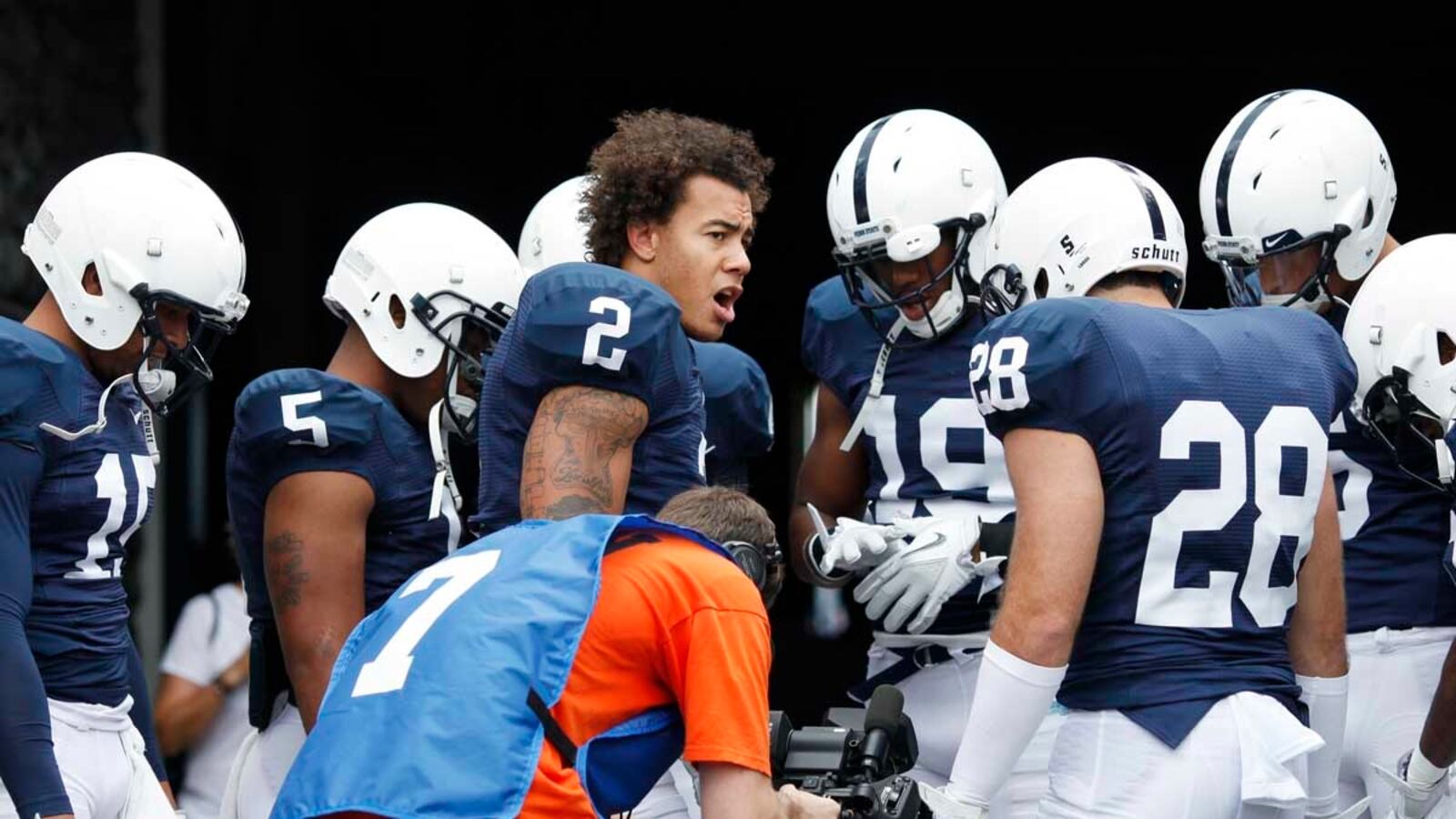
It was after a tough loss in 1991, during a particularly rough game against the University of Texas, that a reporter asked Penn State football god Joe Paterno what he was going to do next. “I’m going to go home and beat up my wife,” he joked to a roomful of stunned reporters.
It was another JoePa faux pax, as sportswriters put it—an all-too-common slip of the tongue by a man whose resignation was demanded, on several occasions, by the Pennsylvania chapter of the National Organization for Women (whose president is an alum).

Paterno didn’t apologize, but he later explained himself: it was a joke, he claimed, a bit of “harmless” “locker-room talk” that was, as he put it, “just part of the sports culture.”
At the time, the explanation easily satisfied JoePa supporters—who’d become used to this kind of banter. But in the wake of 40 counts of sexual assault against Paterno’s longtime defensive mastermind, Jerry Sandusky—and a slew of accusations that university officials, including Paterno, were complicit in its coverup—the toxicity of that testosterone-steeped sports culture, and the role it might have played in this scandal, isn’t very funny. The comparisons between Penn State and the Catholic Church may have become too many to count, but perhaps the biggest one is so obvious we don’t see it: Football, like the priesthood, is one of the few places in our culture where being a woman is actually more sacrilegious than saying you’re going to go home and beat one.
Where all of this leads? To whether women might have changed the outcome of this horrifying tale—and the role gender played in it from the start.
From Mike McQueary, the ginger-haired coaching assistant who told a grand jury that he walked in on a naked Sandusky allegedly raping a young boy in a shower—and chose to call his father instead of police—to the slew of male university officials (six of them in all) who are believed to have known about the incident but remained silent, the only female names we’ve seen associated with this case have been the ones exposing it: the mother who first called Sandusky to ask what the hell he was doing in a shower with her son; Linda Kelly, the attorney general who brought the charges against him; Sara Ganim, the Penn State grad who broke the story for the local paper, and has since been relentlessly covering it.
As one source close to Jerry Sandusky told The Daily Beast: “Had it been a woman who had walked in on that boy in the shower, I can guarantee it would not have resulted in anything other than a 911 call.”
“There’s a gender element to everything,” says Andrew Shubin, a central Pennsylvania civil-rights attorney who is representing a number of the victims. He notes that, even in an opposite situation—had somebody said they walked in on Sandusky raping a young girl, instead of a boy—“it might have been an easier thing to understand.”
There are other questions, too: Might the victims have been more willing to come forward had they been female, where, some might say, the idea of talking about a rape is less taboo? Had this not been football, where pats on the ass and lurid locker-room talk are routine—yet to be “gay” is roundly condemned—might these boys have recognized the abuse earlier? (As Naomi Mezey, a Georgetown law professor who studies cultural identity, puts it, “Sports is one of those places where male physicality with each other is allowable, yet is simultaneously deeply homophobic.”) And, lastly, would this horrifying narrative have turned out any differently had the culture surrounding it not been so chauvinistic?
“I don’t think we are going to see women coaches raping 10-year-olds any time soon, and if one did, I think she would be out on her ear in no time,” says journalist Katha Pollitt, a columnist at The Nation. “And female students leading a riot in defense of child molesters? I doubt it. This whole thing is just patriarchal from top to bottom.”
Whether or not we agree, it’s easy to make the argument that close-knit, insular groups of men have been known to do bad things (think: the Catholic Church). Studies show that dissenting voices are crucial to countering group think—especially in realms where pledging allegiance to a hierarchy are the norm. In the business world, companies with equal numbers of men and women on their boards are more successful. We’ll probably never know if that would be the case in football.
It is, however, well known among State College community members that Penn State’s athletic department is about as insular as they come: powerful, fraternal, and—until recently—seemingly untouchable. Like the Catholic Church, Penn State football was based on ritual and worship, loyalty and power. Joe Paterno was its God, blue and white its collective uniform. Simply having a woman in the room does not, of course, shield an institution from corruption, misogyny, or violence—but it might present a different perspective. As Nicole Rodgers in The American Prospect put it this week, is there something distinctly male about the type of behavior that allows one to prioritize loyalty to powerful institutions and friends over protecting children?
“Any institution where there’s no women around—like the Church, like football, like the Middle East, like fraternities—things go to shit,” Bill Maher declared on his HBO show last week, among a panel of all men. He later reiterated the stance among the ladies of The View. “When men are just among men, they do stupid things.”