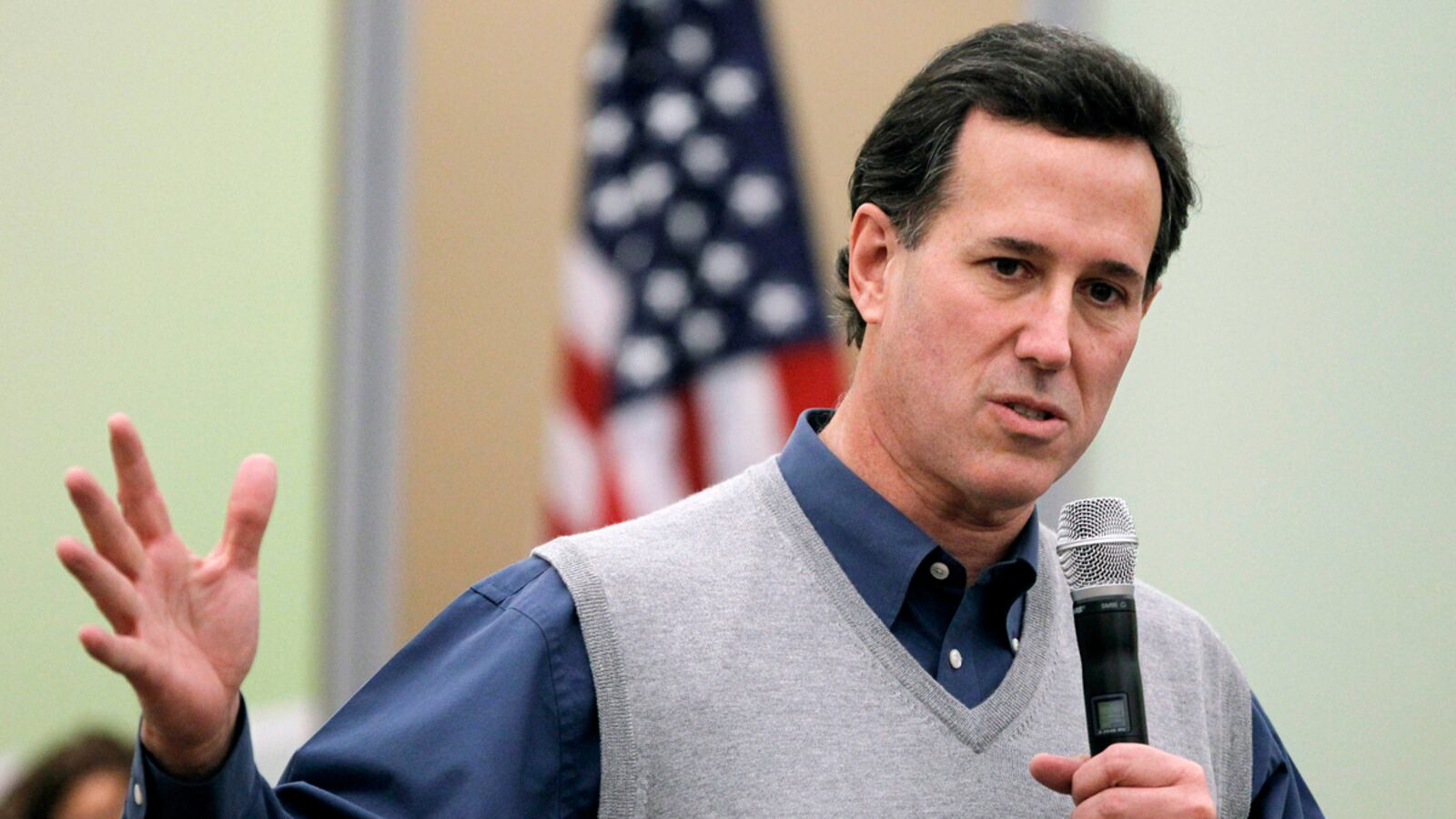
There’s a lot not to like about Rick Santorum on the social-issues front. He’s an anti-abortion absolutist, no fan of gay rights, and possesses politics so influenced by faith that even contraception remains controversial in his mind.
But Rick Santorum has at least one big idea that’s worth wider debate: eliminating the corporate income tax on manufacturing companies.
Almost alone among his Republican nomination-seekers, Santorum has been focused on the decline of manufacturing in the United States, speaking with empathy about the squeeze of the middle class and blue-collar workers who’ve been hurting since well before the Great Recession.
In his powerful Iowa caucus night speech, Santorum eloquently made a case for how traditional conservative policy priorities need to connect better to real-world concerns, like lifting people out of poverty. This has been too often treated like an inevitable effect of trickle-down economics rather than a worthy goal in its own right.
Criticisms of Santorum’s proposal can come from the left and right, pointing out that the blatant incentivization can have unintended effects and invite tax fraud, moving in the opposite direction of much-needed tax simplification. And I’d add that any complete tax elimination would get us deeper in our deficit hole.
But at least the man is making a bold proposal that attempts to address an issue that has helped destroy the jobs that used to enable families to get on the first rung of the ladder out of poverty. Rather than simply having products designed in the U.S.A. and then produced overseas, an added incentive to make things in America could help tip the scales back in favor of American manufacturing. It might help make a real dent in our half-trillion-dollar trade imbalance with China and other countries.
On a purely political level, such an argument could have real resonance in the former mill towns of South Carolina and New Hampshire. And it achieves that end without stooping toward protectionism sops to special interests.
Globalization unleashes massive changes that can’t be ignored, but those effects can be moderated by smart policies. Our country has lost an average of 50,000 jobs in manufacturing every month over the past decade. This can have a destabilizing effect on our society. In February of last year, the Office of the Director of National Intelligence even directed that the decline in manufacturing be included in future National Intelligence Estimates. Economics is intertwined with every aspect of a country’s life in a globalized world.
The point of policy debates in a presidential campaign is to shift the conversation in a certain direction. Primary campaigns can be particularly potent idea laboratories because the candidates are generally less risk-averse than general-election nominees. For example, Herman Cain’s 9-9-9 mantra/plan wasn’t serious in terms of actionable policy, but it moved the GOP debate—at least for a time—toward dueling flat-tax plans.
With President Obama brandishing “those three proud words: Made in America” at every campaign stop, it’s possible that Rick Santorum’s manufacturing policy initiative—or a wisely moderated version of it—could influence domestic policy beyond the GOP primary debates.