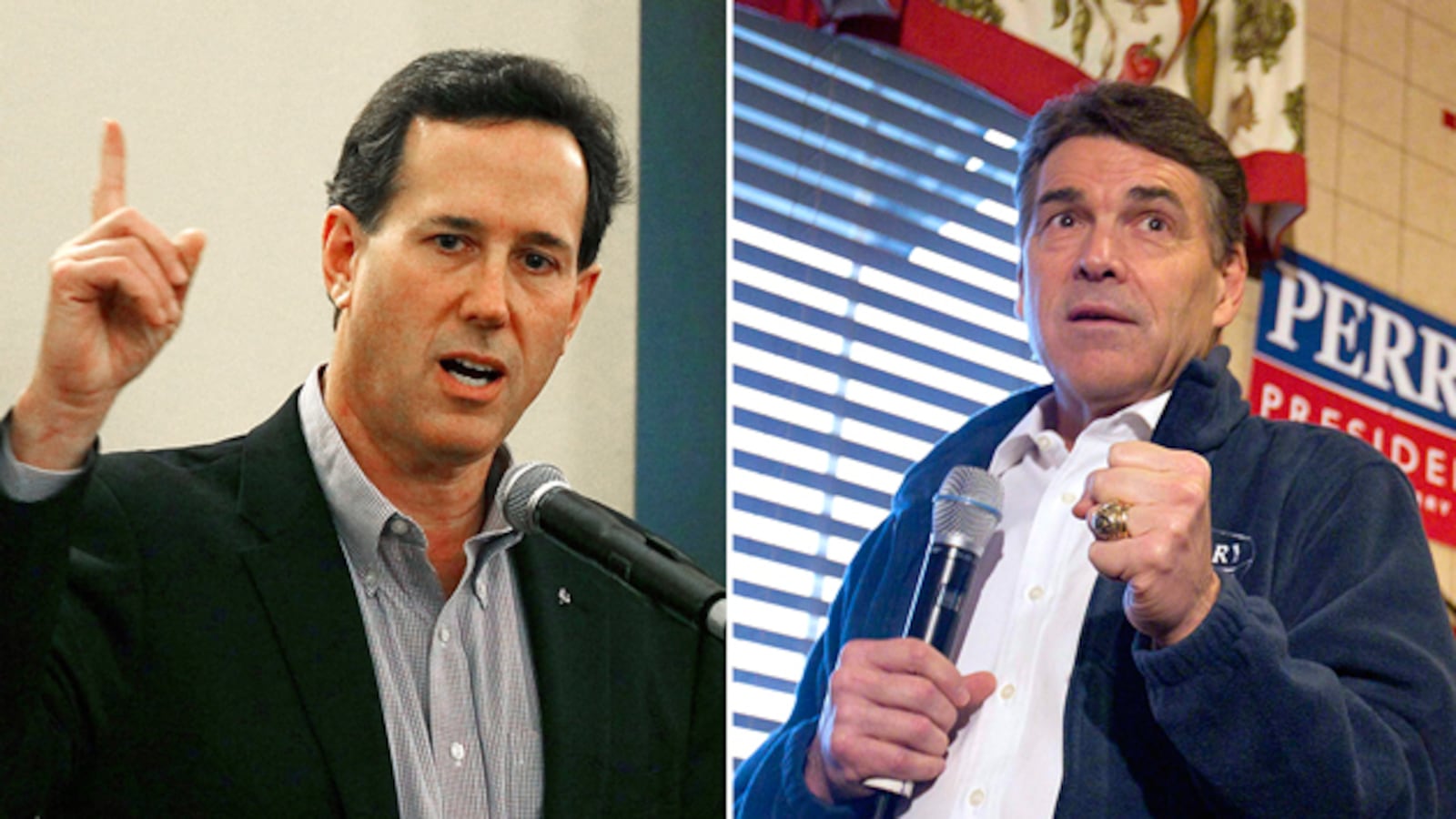
Two Mormons, two Catholics, and two Protestants walk into a South Carolina church asking for votes.

No, it’s not a bad joke—it’s the current state of play in the pivotal South Carolina Republican primary.
It’s an unprecedented situation and a positive sign of how far we have come as a nation.
In 1928, when Democrats nominated the first Catholic candidate for president, New York Governor Al Smith, it set off a firestorm of controversy—with the Ku Klux Klan attacking Smith as “un-American,” a direct threat to the separation of church and state with secret plans to build a trans-Atlantic tunnel to the Vatican so he could take orders from the pope.
John F. Kennedy confronted anti-Catholic bigotry in the 1960 campaign, much of it emanating from Southern churches. When JFK was president, the wingnuts of his time accused him of appointing “Anti-Christians to Federal office.” And the past chancellor of South Carolina’s evangelical Bob Jones University called the pope an “Archpriest of Satan, a deceiver and an anti-Christ.”
Today, two Catholic candidates, Rick Santorum and recent convert Newt Gingrich, are competing for the evangelical vote in the Palmetto State, stereotyped as a hotbed of social conservatism. This historical heresy has been greeted with little more than a collective shrug.
The two Protestants in the Republican primary race are Ron Paul—whose libertarian beliefs are anathema to many on the religious right—and Texas Governor Rick Perry, whose flailing campaign is struggling for top-tier status and betting on a big showing in South Carolina, or facing a likely fold in this game of Texas Hold ‘Em.
At least in terms of religion, this ain’t your father’s Republican Party, which has never had a non-Protestant presidential nominee.
That’s likely to change in 2012.
On Friday, Tea Party and evangelical leaders are scheduled to meet at a Texas ranch to decide whether they will rally around a single candidate as the Conservative Alternative to Mitt Romney, the conventional-wisdom frontrunner to date. The likeliest candidates—barring an unlikely new draft movement—are Santorum, Gingrich, or Perry.
Romney’s main problem isn’t his Mormon faith, but his 180-degree turn on virtually every social issue since he ran for governor of Massachusetts in 2002. Fellow Mormon Jon Huntsman is likewise regarded by many social conservatives as suspect despite his strong fiscal-conservative record as Utah governor—it is his support for civil unions, talk about bipartisanship, and service as President Obama’s ambassador to China that have their collective eyebrows raised.
But anti-Mormon bigotry remains at least a factor in the American electorate. A brand new national survey by the Pew Forum on Religion and Public Life found that 32 percent of non-Mormons do not view the religion as Christian, and the word most widely associated with the faith is “cult.” That corresponds with the views expounded by Bob Jones III, who holds the view that Mormonism is a cult—a view he mind-bogglingly maintained even when endorsing Mitt Romney for president in 2008.
Conservative populists traditionally have led the charge against non-Protestants in politics—dating back to at least the short-lived anti-Catholic, Know-Nothing Party in the 1850s. Read H.L. Mencken’s classic account of early resistance to evolution at the Scopes Monkey Trial to get a sense of the legacy of bullying group-think in American civic life posing as pious conservative populism.
But the modern conservative movement has made strides to overturn that tide of bigotry, reflected in the religious diversity of this presidential primary field. One of the great forces for the rapprochement was the godfather of the modern conservative movement, the faithful Catholic and National Review founder William F. Buckley, Jr. American traditionalism and the Catholic Church seemed like natural allies in his ebullient orbit.
Subsequent evangelical leaders active in the conservative movement—notably former Nixon aide turned priest Charles Colson and First Things editor Father Richard John Neuhaus—advocated building bridges between faith-based communities against a tide of unbelievers in secular society. “Today’s conservative evangelicals are on the whole much more politically and intellectually sophisticated than those of previous generations,” explained Damon Linker, author of The TheoCons (and a current Newsweek editor). “They have come to understand that their only hope of turning back the spread of secular liberalism is to work together with social conservatives in other religious communities."
The intersection of religion and politics is always tricky ground, especially when theological debates are reflected in partisan divisions. The conservative populist narrative that divides the nation into faith-based free-marketers versus secular socialists is as troubling as it is fundamentally false. But there nonetheless is something to cheer about the way in which many long-standing religious divisions—at least between branches of Christianity—are fading away within the Republican Party.
The fact that 56 percent of Americans now say that the USA is ready for a Mormon president—and that the prospect of another Catholic president seems literally unremarkable—are welcome signs of evolution as a nation, reflected however quietly in the current Republican presidential field of candidates. It is a moment to appreciate, a recognition that all these individuals are running for president, not pastor, of the United States.