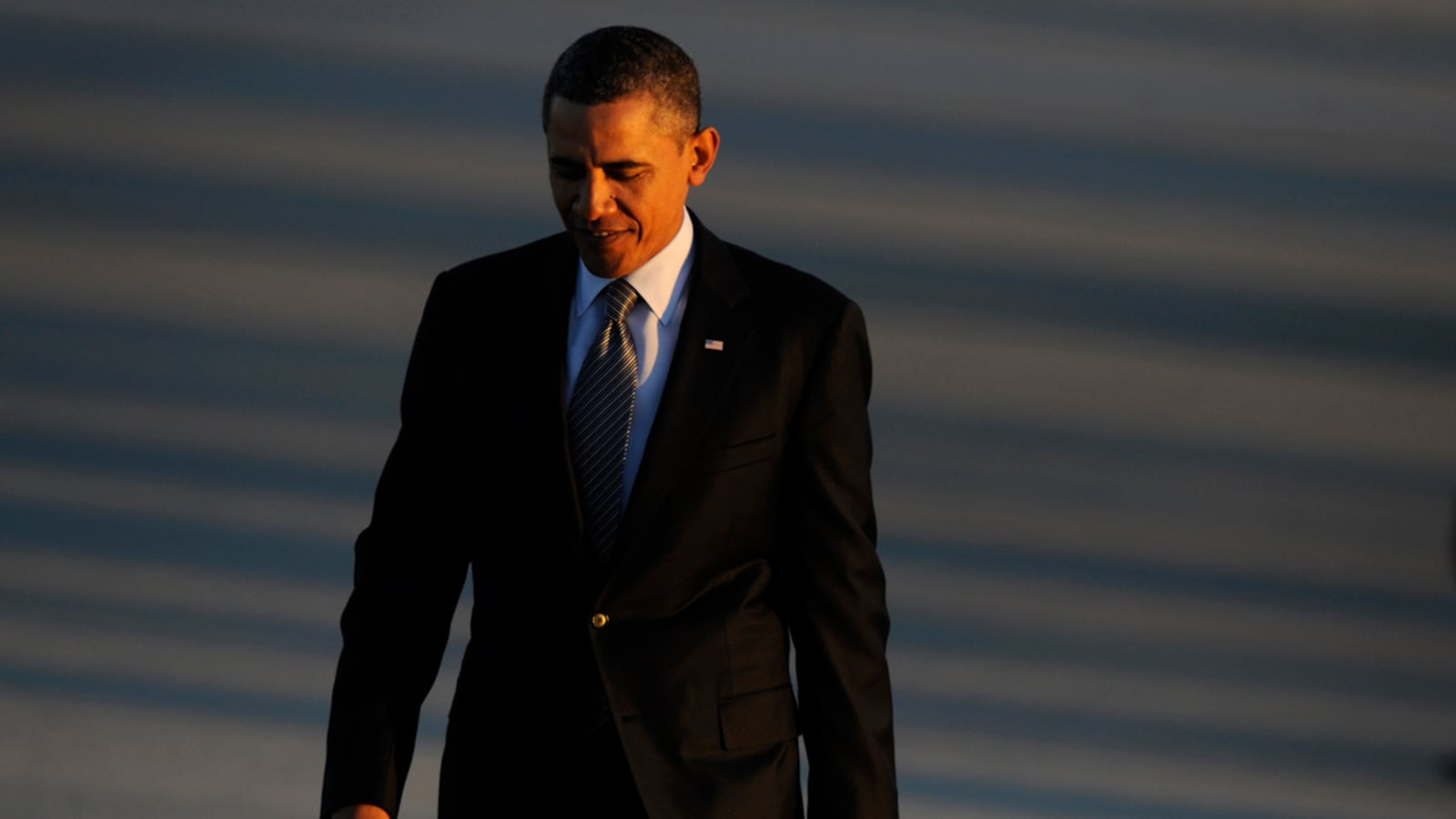
Wall Street Democrats aren't especially happy with the words coming out of Barack Obama's mouth, but most of them are biting their tongue—and still writing him checks.
On Friday morning, less than a week before the president visits New York to raise money at both the four-star restaurant Daniel—the last time he dropped by was in July—and Harlem's Apollo Theater, his reelection campaign echoed Newt Gingrich's recent populist attacks on Mitt Romney for his record as an investor and executive at Bain Capital. In a public memo, deputy campaign manager Stephanie Cutter called Romney a "corporate raider" who exploited the middle class before adding that President Obama would "level the playing field" and "restore fairness for consumers."

The language, coming as public concern about income inequality has reached record highs, strikes an already raw nerve. While the campaign has been raking in cash at a faster pace than his record-setting 2008 campaign—it announced last week that it raised $42 million in the fourth quarter of 2011—the enthusiasm has not spread to the bankers and investors who Democrats have relied on in recent decades to partially counter the historic alliance between the Republican Party and big business. "There's this deep-seated feeling that he really doesn't understand how business operates," said a financial executive who has remained a strong Obama supporter. "This talk about fairness sounds whiny—they need to talk about collective responsibility. 'Fairness' calls for rectifying injustice and businesspeople don't think of their calling as unjust."
The root of the discomfort predates Obama's recent push for higher taxes on the wealthy, and often seems more than just a policy disagreement. After all, many on the left point out, Obama didn't break up the big banks that were propped up by the government because they were too big fail. The Dodd-Frank financial reform bill of 2010, which placed limits on certain kinds of trading and created the Consumer Finance Protection Board, may have kicked up simmering anger, but the complaints—at conferences or in investor letters or in interviews—are often tinged with a sense of personal betrayal. (They also nearly always cite a December 2009 interview in which the president called out "fat cat" bankers.)
The most recent public example came in November, when private equity billionaire Leon Cooperman, who like many finance executives expressed support of the idea of higher taxes and a social safety net, wrote a scathing open letter to the president. “I can justifiably hold you accountable for your and your minions' role in setting the tenor of the rancorous debate now roiling us,” the private-equity billionaire wrote. “To frame the debate as one of rich-and-entitled versus poor-and-dispossessed is to both miss the point and further inflame an already incendiary environment.”
It's a striking departure from the last presidential cycle, when employees of Goldman Sachs donated more to the Obama campaign than any other company. In the spring and summer of 2007, Obama raised $7.7 million from the financial industry, while Romney brought in $5.1 million, according to the Center for Responsive Politics. Four years and one great recession later, they've basically switched places, with Romney raking in nearly $8 million and Obama—who has watched former supporters like Chicago hedge-fund billionaire Ken Griffin go back to support only Republicans—has seen his haul fall to $4.2 million. (Fourth-quarter-industry data is not yet available.)
Both donors and operatives, speaking to The Daily Beast on condition of anonymity because their universe is full of hushed personal rivalries and petty grudges, said that, for now, much of the money from the financial sector was rolling in out of a sense of obligation. “They're whining because Obama hurt their feelings,” said House Financial Services chairman Barney Frank (D-Mass.), who guided the financial reform bill through Wall Street and is grudgingly respected by Wall Street. “He’s not really interfered with their income.”
While Obama’s populist rhetoric—and his oft-noted inability to schmooze as well as Bill Clinton—might underwhelm Wall Street, the threat of a Republican Party gripped by the cultural conservatism of the Tea Party and the religious right still looms. In New York, where the financial community provided much of the support for Gov. Andrew Cuomo's successful push to legalize gay marriage, and other urban financial centers, the unanimous opposition by Republican candidates to abortion rights, opening up immigration, and gay marriage doesn't go over well. In a defense of Bain’s record published in Friday's Politico, Stephen Rattner, a former investment banker who was perhaps the most powerful Democratic fundraiser in Manhattan until he joined the Obama administration to oversee the rescue of the auto industry, made sure to go out of his way to mock Romney’s “come-lately embrace of hard-right conservatism.”
There’s no indication that the president will have trouble funding his reelection campaign, but to some degree it might be more important than ever for politicians to get the mega-rich excited. In Iowa and South Carolina, billionaires have taken advantage of recent changes in campaign finance laws and kept the primary campaigns of Newt Gingrich and Jon Huntsman alive by plowing millions of dollars into super PACs, organizations that aren’t bound by normal contribution limits and run as many attack ads as they can afford. Which means that the 70-plus fundraisers Obama attended last year could go a long way if he successfully assuaged the feelings of a few cranky men and women. “I've seen a 180-degree turn from where we were, even a year ago, in terms of support for the President,” said a source close to a wide range of major Democratic donors.
National Memo reporter Matt Taylor contributed to this report.