
What happened to the evangelical vote in South Carolina?
Just last week, Rick Santorum received a much-vaunted endorsement representing the collective wisdom of more than 100 conservative evangelical leaders ranging from Tony Perkins to James Dobson to Gary Bauer. Where their benediction fell, their flocks were sure to go—or that was the idea.
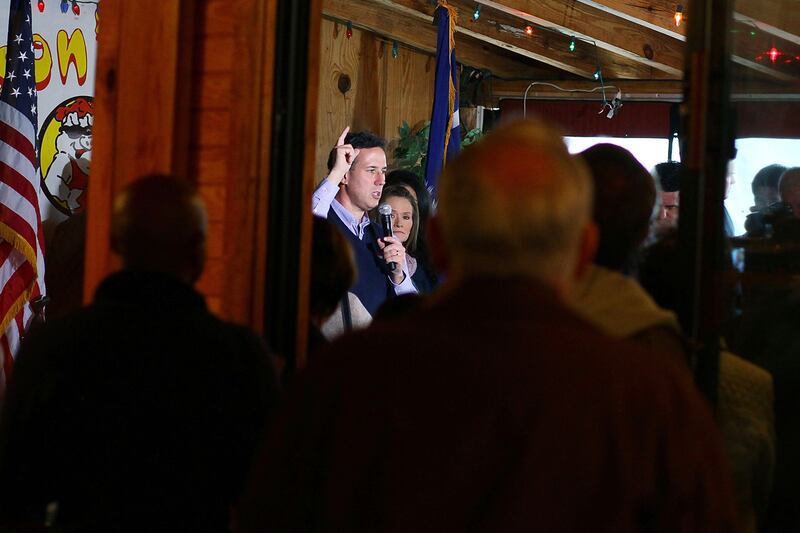
But despite a second round of social-conservative support for Santorum in the run-up to South Carolina—including pushes from direct-mail guru Richard Viguerie and WorldNetDaily editor and birther-conspiracy theorist Joseph Farah—Santorum finished a distant third on Saturday.
In the social conservative bellwether state in the January primary gauntlet, 65 percent of South Carolina voters were self-identified evangelicals or born-again Christians. If the leaders of the religious right can’t deliver a victory for their chosen candidate here, where can they do it?
The failure to convert endorsement into actionable support raises a real question: just how much juice do they have? Is their self-appointed leadership role inside the GOP more bark than bite, perpetuated by a compliant media looking for stereotypes and soundbites?
South Carolina evangelical voters cast their ballots overwhelmingly for a thrice-married admitted adulterer. Rick Santorum, the squeaky-clean social conservative purist received just 21 percent of born-again support—tying Mitt Romney, whose bland establishment demeanor (and perhaps in part his Mormon faith) caused evangelical leaders to try to find another candidate to coalesce around in the first place.
While nearly two thirds of South Carolina primary voters identified as evangelicals, the economy was overwhelmingly issue No. 1, followed distantly by the deficit and only then social issues. Gingrich claimed the largest share of the voters concerned with the first two issues, while Santorum won only along the few who named social issues as their primary concern.
In the wake of the 2004 Bush campaign, its chief strategist Matt Dowd argued that evangelicals weren’t motivated primarily by social-conservative-wedge issues after all. Instead, they ended up voting on national security and economic issues, like most other voters.
That’s not to say that social issues aren’t important—being an apostate can be a disqualifier in the Republican primary. It’s just that the idea of amass-mobilizeable, single-issue voter is increasingly a myth perpetuated by special-interest activist groups who are literally invested in the idea. It gives them their influence, and in many cases becomes the basis of their own financial well-being.
They have certainly been successful in getting Republican candidates to conform to their policy positions. Despite the fact that 70 percent of Republican primary voters say that fiscal issues are the basis for deciding their vote—just over 20 percent say social issues are the defining issue in 2012—this GOP field is as far to the right on social issues as any in the party’s history.
There are no pro-choice candidates running for the Republican nomination this time around. In 2008 Rudy Giuliani represented that centrist Republican tradition, once embodied by George Romney, George H.W. Bush (before he became Reagan’s VP), and Mitt Romney (when he was running to be Massachusetts governor). The new standard seems to be opposition to abortion even in cases of rape and incest.
Likewise, though gay rights are increasingly supported in America—even by evangelical youth—most Republican presidential candidates in 2012 support a Federal Marriage Amendment, a notable break from the party’s longstanding opposition to meddling with the Constitution.
In other words, social-conservative leaders have succeeded in eliminating diversity of opinion on social issues from presidential contenders. They have cowed candidates into submission and burnt down the Big Tent in the process.
Now, with the Republican field split with separate candidates winning Iowa, New Hampshire, and South Carolina, evangelical leaders will have one more chance to break the tie and help deliver a win for Rick Santorum in Florida. But the Sunshine State is more centrist than South Carolina—with Hispanic voters and Tea Partiers more likely to play a decisive role in picking the winner of the Republican primary than evangelicals.
With Gingrich riding high after his decisive win in South Carolina, there are likely to be growing calls for Rick Santorum to fold up his tent. If he doesn’t take that advice, the only recourse for his campaign is to double-down and try to raise money in a two-pronged “Stop Mitt” and “Stop Newt” effort, arguing that Santorum is the least flawed vessel for evangelical’s deeply held beliefs.
But judging from South Carolina, it’s no sure thing that the faithful will listen to the political advice of their self-proclaimed leaders.