
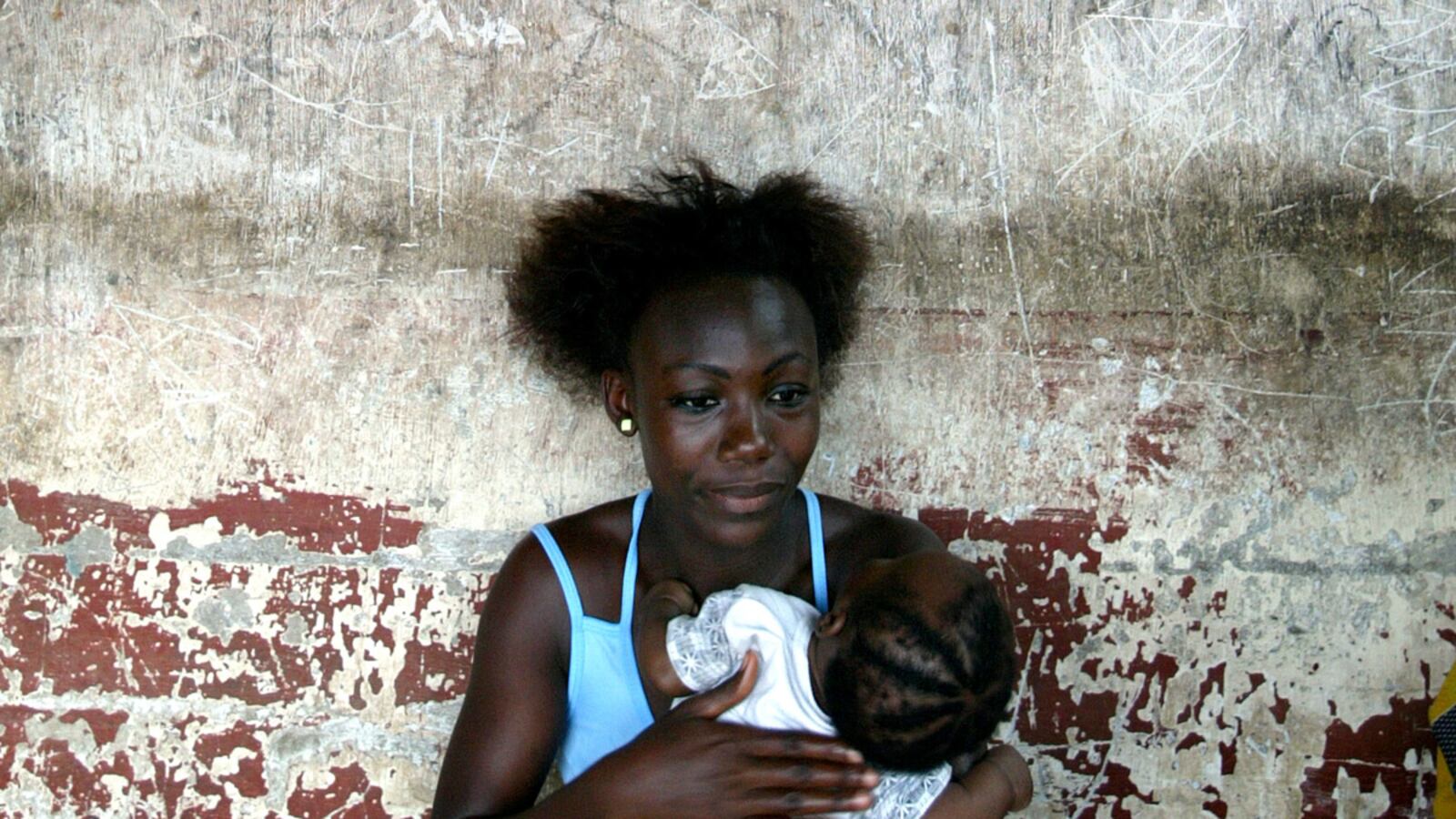
Gertrude Gorma Cole, a midwife in Liberia’s Bong County, is almost universally known as “Mother Dear.” A warm, grandmotherly presence in a traditional lappa dress, she has been practicing at least since the 1970s. In some ways, she is conservative. Speaking of Liberia’s disastrous teenage pregnancy rate—which is high even by West African standards—she blames both the social breakdown caused by the country’s savage civil war and the lax ideas of the international NGOs that swept into the country in its wake. “After the war, the NGO people came in and they brought ‘child rights,’ so the children became so loose, and even to discipline them, they will take you to the police,” she says. Western aid workers dispute this, insisting that the idea of Liberian kids informing on their parents is an urban legend. Still, her views speak to a level of distrust toward the humanitarian agencies that play an outsized role in governing the decimated nation.
Yet there is one thing Mother Dear does not distrust: the programs to provide birth control, which are largely supplied by USAID. In addition to being a midwife, Mother Dear is the county’s reproductive-health supervisor. When I tell her that support for international family planning is controversial in the U.S., and that some candidates for president would like to end it, she is shocked. “If they cut off funding for family planning, more mothers are going to die,” she says.
She’s worth listening to, because whatever effect the upcoming election has on the reproductive health of American women, the effect on women worldwide is likely to be even greater. I was in Liberia recently as part of a World Health Organization-sponsored trip to look at the future of funding for AIDS, TB, and malaria in an age of global austerity. But the country is also an object lesson in the potential global impact of our interminable culture wars.

Those culture wars have turned birth control into a significant issue in the U.S. presidential campaign. All of the Republican candidates have slammed the administration’s refusal to give religious institutions a broad exemption from the mandate that insurance cover family planning. One of them, Rick Santorum, has promised to use the presidency to speak out about “the dangers of contraception in this country,” and has said he believes states should have the right to ban it. Mitt Romney, the likely nominee, has laughed off threats to birth control as an absurd nonissue, but even he has pledged to eliminate Title X, the federal family-planning program founded under Richard Nixon.
To understand how radical that is, consider that Mike Pence, one of Congress’s leading crusaders against Planned Parenthood, has never gone that far. “I’ve never advocated reducing funding for Title X,” he told an Indiana radio station last year. “Title X clinics do important work in our inner cities. They provide health services for women and children that might not otherwise have access to them.”
If Romney is willing to scrap the only federal program to provide birth control to low-income women in the United States, programs to do the same thing abroad certainly aren’t safe. We already know that, like every Republican since Ronald Reagan, he’ll impose the global gag rule, preventing any American money from going to organizations that perform or even counsel about abortions. He will likely follow George W. Bush in withholding money from the United Nations Population Fund, or UNFPA, an agency that promotes reproductive health worldwide, on the demonstrably false grounds that it supports coerced abortion in China. (Restore Our Future, the pro-Romney Super PAC, has tried to tie Newt Gingrich to China’s one-child policy because he co-sponsored a 1989 bill that included a UNFPA appropriation.)
There’s reason to believe Romney would go even further than Bush did. He’s already signaled a desire to cut some of the international HIV/AIDS prevention and treatment programs that Bush championed. At a New Hampshire town hall in October, he was asked if he would “continue the tradition that was laid forth by the Bush administration” of funding global health. “I am very reluctant to borrow lots more money to be able to do wonderful things if those things can be done by people making charitable contributions or other countries that are wealthy,” he responded.
If Romney is willing to slash American funding for HIV/AIDS, which has significant Christian conservative support, it seems likely he’d be willing to do the same for USAID’s family planning programs, which don’t. USAID remains the world’s largest source of birth control for poor countries—a role it played even under Bush. If that changes, as Liberia shows, the consequences for the world’s most vulnerable women will be horrific.
Right now is a relatively optimistic time for Liberia, a country founded by freed American slaves who, for most of the country’s existence, formed an imperious elite. A vicious civil war, often fought with drug-crazed child soldiers, ravaged the country between 1989 and 2003, punctuated only by a few years of repressive relative stability under the rule of the warlord Charles Taylor, who ran for office promising to reignite the fighting if he lost. (One of his campaign slogans was, “He killed my Ma, he killed my Pa, but I will vote for him.”) Thanks partly to the pressure of activist Leymah Gbowee, a peace agreement went into effect in 2003, leading to the election of Ellen Johnson Sirleaf, Africa’s first and only female president. For bringing the civil war to an end, the two women were awarded the 2011 Nobel Peace Prize, an honor they shared with the Yemeni journalist, politician, and human-rights activist Tawakel Karman.
Under Johnson Sirleaf, there’s a cautious sense of hope throughout the country. “When I first came here, I’d never been anywhere where the affect of people was so stoic and angry,” says Laura O’Hara, chief of child survival and development at UNICEF in Liberia, who arrived three and a half years ago. She specifically recalls the first time she saw someone in Liberia laughing in the street, which is no longer a rare sight. “Things are changing,” she says. “It’s really an exciting time to be here.”
But the country is trying to rebuild from less than nothing amid a global economic crisis. Only 13 percent of men and 5 percent of women have at least a secondary education. According to the CIA’s World Factbook, it has an unemployment rate of 85 percent. This economic devastation hits women particularly hard, with many teenage girls having sex to survive. “Some of them are the breadwinners for their family,” says Mother Dear.
More than a third of Liberian girls give birth before 19, sometimes, says Mother Dear, as young as 12. The country has the world’s fifth-highest maternal mortality rate, and a serious shortage of doctors. In Bong County’s Phebe hospital, the UNFPA funds one of the country’s two fistula repair centers, but it can only afford to bring in surgeons once a year. I met a 30-year-old woman who ended up there after a quack doctor pressed on her belly after two days of labor, leaving her partly paralyzed and incontinent. She lay on a bed attached to a urinary catheter. Nearby, a 20-year-old fistula patient who’d been abandoned by her husband spoke to me while squatted over a bucket beside a rubber mattress. Neither knew how long they’d have to wait for help.
The country’s high rate of unsafe abortion is testament to women’s desperation to control their fertility. As in most of sub-Saharan Africa, abortion is illegal in Liberia, sending women to dangerous underground providers. “If you stay here three hours, you might see about three cases,” a nurse at Redemption hospital in Monrovia, the country’s capital, told me. Some women have been reported to resort to a method called a Rocket Propelled Grenade, a mix of herbs and broken glass that’s inserted into the vagina.
By all accounts, Johnson Sirleaf takes these problems extremely seriously. Launching the World Health Organization’s Commission on Women’s Health in the African region, she tied women’s health to her country’s economic future, saying, “Women need to be in good health and be given the opportunity for them to unleash their potential for social and economic prosperity.” This year, for the first time ever, the Ministry of Health will have a specific line item for reproductive health. But the country is poor, and the allocation is only $100,000.
By contrast, according to Randolph Augustin, USAID’s health team leader in Liberia, USAID spends $3 million just on family planning supplies. “Between us and UNFPA, we supply all of the contraceptives in the country,” he says. Already, it’s not always enough. Mother Dear says she frequently runs short of implants, which Liberian women prefer because they last five years, saving them onerous journeys to clinics. (They’re also easy to hide from disapproving husbands.) There are chronic shortages of Depo Provera at Liberian medical centers, and the provision of birth control pills can be erratic, forcing women to switch types each month. Should these supplies be reduced or cut off, the fallout for Liberian women would be catastrophic.
And not just for women. There’s an enormous amount of research showing how high maternal mortality and rapid population growth destabilize entire societies. Mother Dear hasn’t read all the social science literature, but she understands it intuitively. “When you’re using family planning, you can help to prevent poverty,” she says. “The mothers will have enough to feed their children.” Without it, she says, “all the other aid that they give to Africa will not be useful.” Of course, none of this is really about what’s most useful for Africa, but that’s not an easy thing to explain to someone with so much at stake.


