
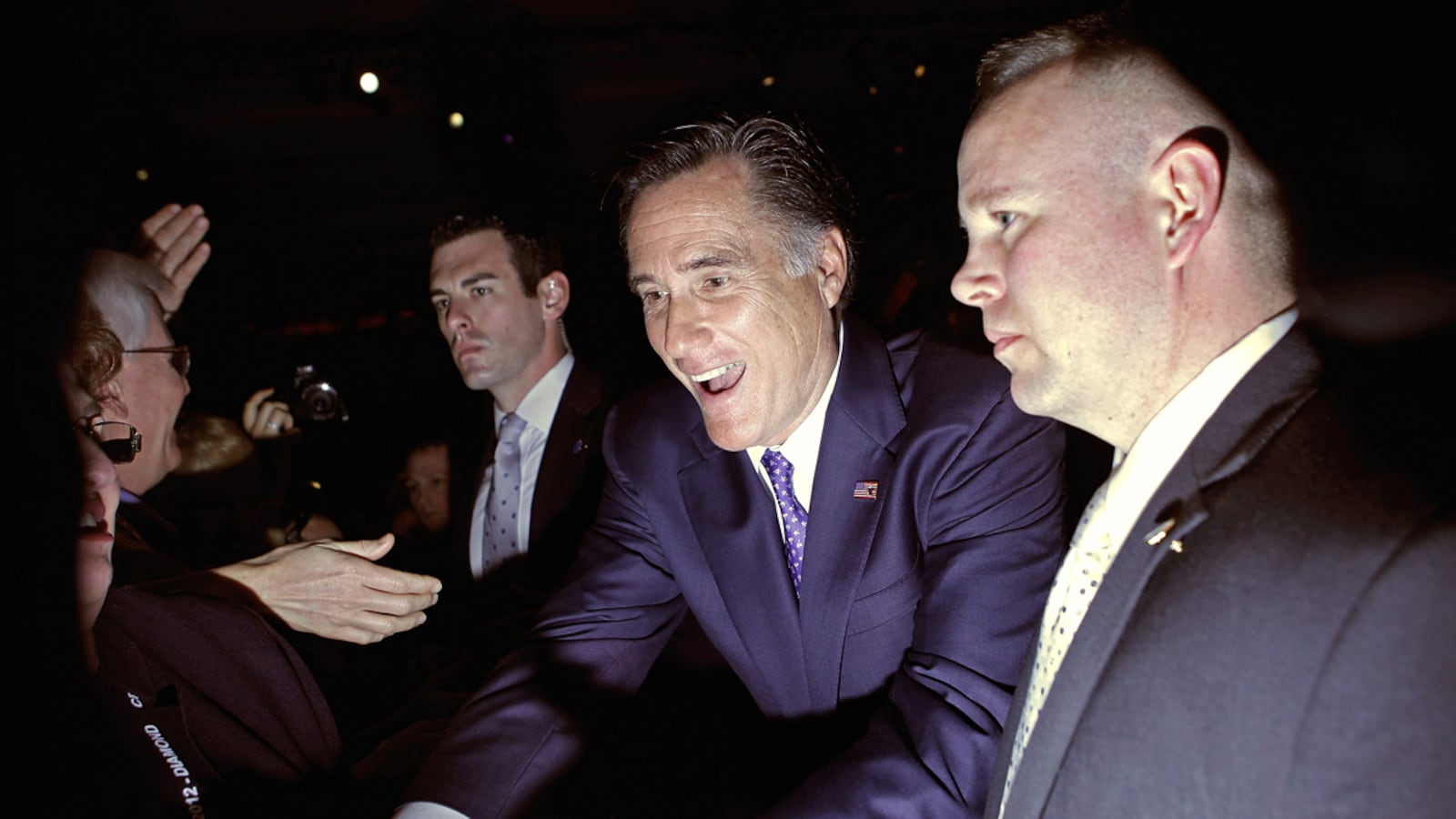
It was while I was watching Mitt Romney’s speech to the CPAC conference last week that the light bulb went off. The crowd liked the speech, but he never had them anywhere near the palm of his hand. I figured out why, and this is Romney’s whole problem, really. He tries to appeal to conservatives with reason, not emotion. And he just doesn’t hate liberals enough. (The consequence? According to Nate Silver, Santorum, and not Romney, has a 77 percent chance of winning the Michigan primary. Meanwhile, the two men are tied in Arizona.)
Reason and emotion. Recent research, notably by Drew Westen has shed light on the roles they play in our political thought process. Westen says that when it comes to politics, we “reason emotionally.” That is, we make up our minds about such-and-such a position or issue not really on its merits, but on the basis of all kinds of signals, like who’s for it and who’s against it. Also, he notes, successful appeals by politicians recognize the fact that people don’t approach politics rationally, and they make appeals that aim more for the gut than the brain.
As a rule, Republicans are better at this than Democrats. The latter often still base their appeals on reason. Not because they’re superior human beings, but because there is something about the liberal brain that wants to believe that if there is a problem in the country, the experts will study it and offer a solution and the politicians will implement it. This brand of “liberalism,” which prizes empiricism and pragmatic problem solving, was for many years the default position in American society. The conservative movement, in contrast, rose up in opposition to this alleged dictatorship of the empirical. So conservative appeals by their very nature are more tightly constructed around denunciations of the liberal status quo—which is to say, around emotion.
This means, to put it more simply, hating on liberals: feminazis, socialists, freedom haters, French apologists, and so on. A big part of the definition of a true and fully engaged conservative today is that that person really, really hates liberals.
But Romney just doesn’t hate liberals. You can tell he just doesn’t. Then he tries to act like he does, and you can tell it even more. He didn’t grow up in that kind of atmosphere—his dad, though a Republican, was plenty liberal by today’s standards—and later in life he obviously didn’t govern in that kind of atmosphere. And so liberal hatred is simply not woven into his DNA.
Back to the speech. The specific moment all this hit me came when he said he’d repeal Obamacare. Huge applause, his biggest applause line of the day. But then, he just moved on. So that was it. One sentence. And I thought, you know, if he really wants to connect with these people on the most visceral level, he’d spend 10 minutes on Obamacare—how evil it is, how it’s exactly the kind of totalitarian garbage those liberals cook up all the time, how these liberals want to take away your freedom step by step, et cetera. Everyone made a big deal out of the fact that he used “conservative,” or a variant thereof, two dozen times in the speech. But more telling is that he used “liberal” only three times, and two of those were sort of neutral.
Think about it: the far better way to tell people you’re a conservative is not to say “conservative” a bunch of times, which comes across as straining; it’s to say “liberal” a bunch of times, and to seem to be spitting out nails while you’re saying it. He doesn’t know how to connect with right wingers. I don’t blame them for not really trusting him. They’re right not to. He isn’t one of them at all.
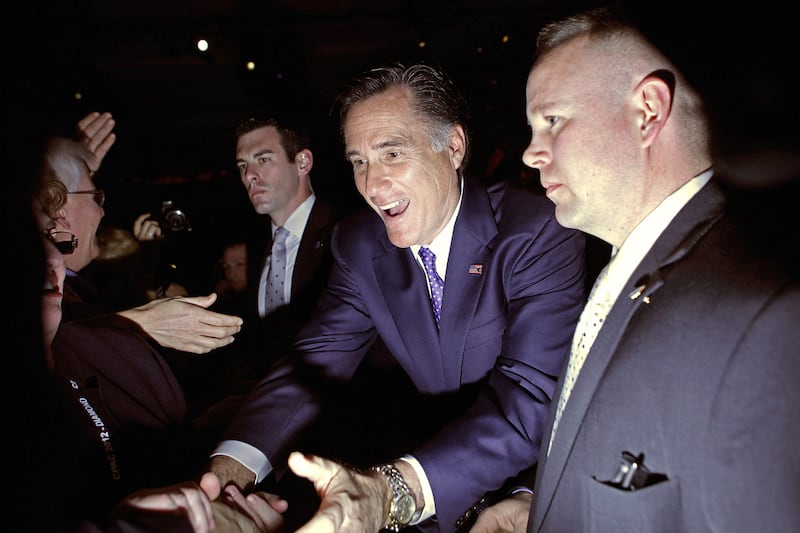
I am not saying, however, that he is “really” a moderate. This is an important point, and poorly understood, because in much political journalism, a person has to be either A or Not A. But the true answer to the supposedly big question about the “real” Romney—is he moderate or conservative?—is, as I wrote recently in The New York Review of Books, “that he is neither, and both. The lessons he learned from watching his father fail to make it to the White House are: don’t stick to your guns; be flexible; suit the needs of the moment.” He took on the positions he did in Massachusetts because it was Massachusetts and he had to. But ponder this: if he’d stayed in Utah after the 2002 Olympics and run there, does anyone think for a second that he’d have been pro-choice or pro-gay? Of course not. He’d have been what the situation demanded.
But there is one very damaging sense in which he’s kind of a “liberal.” He is, according to the authors Michael Kranish and Scott Helman, who wrote one of the books I discussed in the Review piece, an empiricist. While at Bain & Company, they write, and as governor, he was a big believer in studying the evidence and going wherever that took him. This is a death warrant in today’s GOP. Any real conservative knows that evidence has a liberal bias, because only fussbudgets like Al Gore use prissy words like evidence. So Romney is like the Republican Al Gore. That comes across too.
They may yet nominate him. But they’ll never trust him. And liberals would be in grave error to think that because conservatives don’t trust him, it reflects well on him. What conservatives don’t trust is his almost total inauthenticity. And once in a great while, even conservatives can be right.