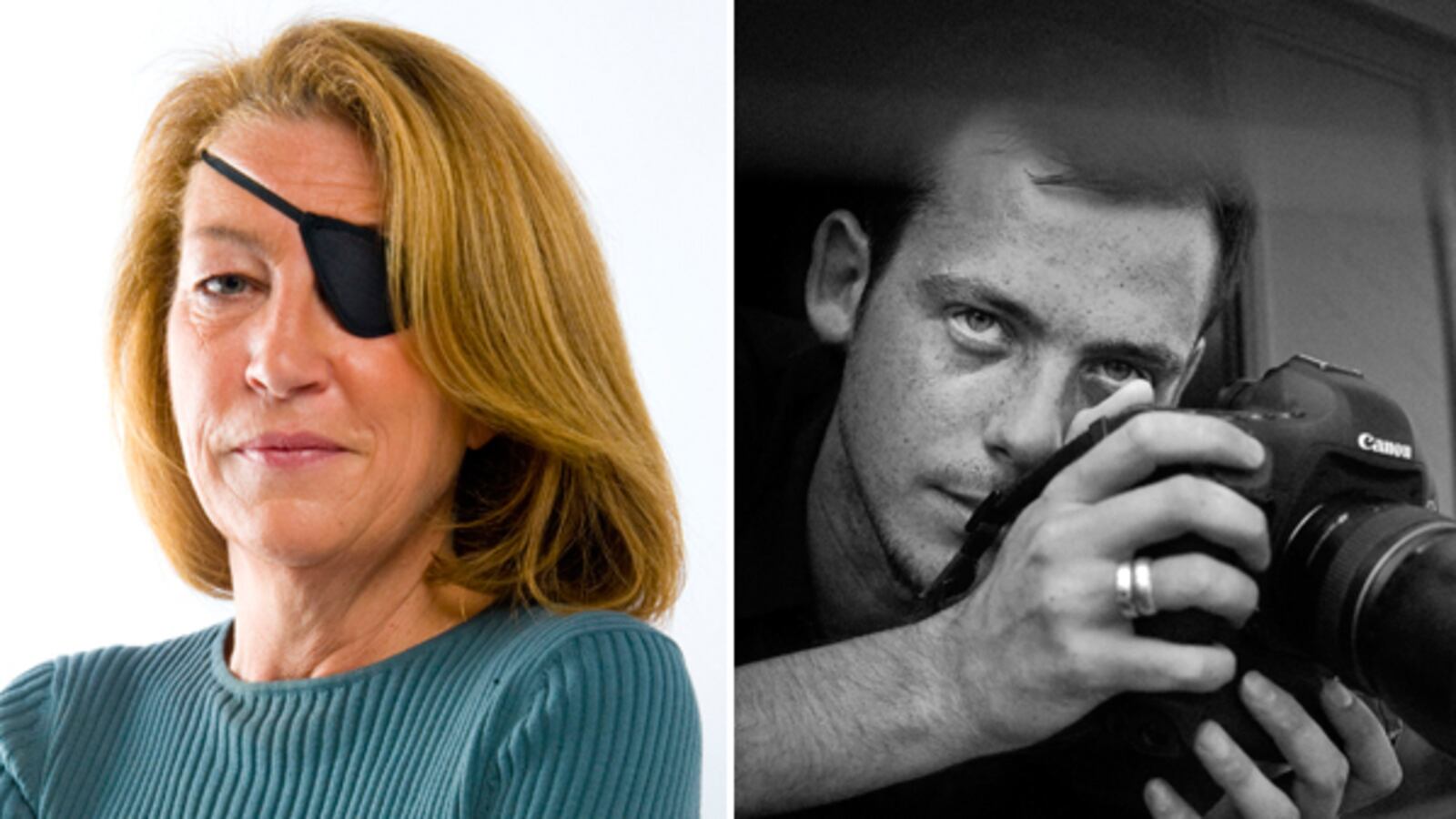
It’s been a tragic week for journalists in the Middle East, with news of the deaths of the New York Times’ Anthony Shadid, Sunday Times correspondent Marie Colvin and French photographer Rémi Ochlik. As the Arab Spring revolutions continue to unfold across the region, the battle to get information out of conflict zones to the world at large has been a dangerous one for reporters of all kinds, from citizen journalists with camera phones to the staff of major global publications. This truth became painfully apparent with the journalism community’s latest losses: it was suggested yesterday that Colvin, Ochlik and their colleagues may have been directly targeted in shelling by the Syrian army, with French president Nicolas Sarkozy saying the journalists were “assassinated”. The pair were killed inside a house that was reportedly being used as a press center.
On Tuesday night, Joel Simon—executive director of the Committee to Protect Journalists—sat down with The Daily Beast at London’s Frontline Club ahead of the launch of the CPJ’s annual report, Attacks on the Press, to discuss how the combination of social media, traditional reporting and citizen journalism are posing a serious threat to oppressive regimes—and why struggling dictators are likely to continue to target journalists as their power crumbles.
Simon: “There’s a lot of new potential using these technologies and using these tools, but governments now recognize clearly what’s at stake. What’s interesting about what’s happening in Syria is that’s really been a battle over information. The Syrian opposition is going to get fragments of information out, and some horrific images, but it didn’t really reach the broader public in the same way as images from Tahrir Square did, because it wasn’t amplified by the presence of international journalists on the ground inside the country. That dynamic is starting to change now. The images of carnage and destruction and violence from inside Syria are getting out now, because journalists are able to get in, a handful of them. Then they’re using these images and videos provided by people on the ground—but they’re reaching a global audience, and that has changed the whole dynamic.

“Repressive societies have always been about controlling and managing information. But it’s much more complex now. Unless you want to be North Korea, you have to have some interaction with the rest of the world. So governments can’t just completely unplug, at least without paying a very high price. It’s definitely harder to control information, unless you completely close your borders. This is a challenge to hierarchical systems of control, no question about it. But governments are responding.
“There is an interaction—between social media and online citizen journalists, and those voices being amplified by traditional media. You get these two synergies, and that’s when governments really feel vulnerable. That’s what happened in Egypt, and that’s what seems to be happening now in Syria. Because you have a convergence now. A handful of traditional journalists are getting in. They’re using these images, this footage, this information that’s being gathered by citizen journalists, activists, this whole network. And then they’re disseminating that to a global audience. That’s a real threat to the regime. Clearly, they’re very concerned about it.
“Look at what happened in Egypt [during the infamous “Battle of the Camels,” when pro-Mubarak thugs tried to violently clear Tahrir Square]. What was the strategy there? We’ll never know precisely. But it seemed that the strategy was to create an environment in which there was a sort of global blackout, and that would give them the opportunity to move in and clear the square. They didn’t want to do that with the world watching. And so they targeted international reporters. They tried to create conditions that would make it impossible for them to work, and there were moments when they were highly vulnerable. These pro-Mubarak mobs were singling out anyone carrying a camera, anyone who looked like a Western journalist. That strategy failed.
“But in that moment, those international reporters who had the ability to disseminate images from Egypt to a global audience were a serious threat to the ability of the regime to maintain power. And they were targeted as a result.”