
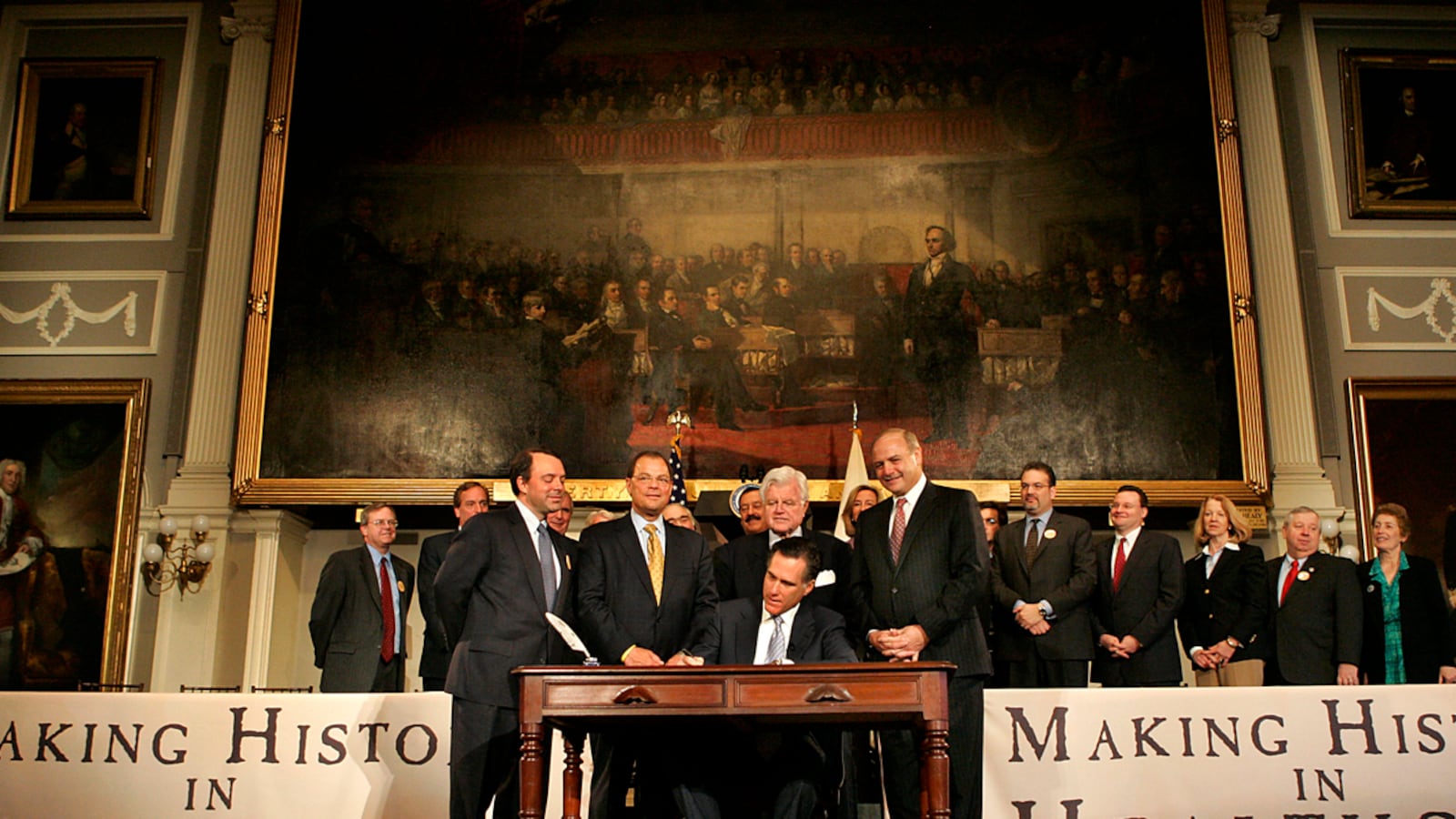
No other issue--not his wealth, his 15 percent tax rate, or “corporations are people, my friends”--has given Mitt Romney as much trouble as the health care law he passed while governor of Massachusetts. Each of Romney’s opponents has taken a shot at the law Tim Pawlenty dubbed Obamneycare, pointing out again and again that it was the inspiration for President Obama’s reform so loathed by the Republican base. At a town hall rally in Ohio Monday, a Romney supporter pleaded for the candidate to give her something to say to critics. "I understand that Romneycare was good for Massachusetts at the state level, whereas Obamacare is federally mandated," she said. But "I don't know what the fundamental differences between the two [are] and I really would like your assistance with being able to tell others."

The problem for Romney is that there are no fundamental differences between the two laws. Both programs create exchanges where private insurers compete. Both require individuals to purchase insurance. And both subsidize those who can’t afford it. It’s a relatively new way of extending coverage. Massachusetts was the first place it was adopted, and the Affordable Care Act was the second. The two laws are, in the words of Jonathan Gruber, who helped design both the Romney and Obama plans, “the same fucking bill.”
To find any differences between the two, you must look to the margins.
The Individual Mandate
This is the part of the Affordable Care Act that really enrages Republicans, whose challenge to it is awaiting judgment by the Supreme Court. It’s an essential part of both plans. The only difference between Romney’s mandate and Obama’s is that Romney’s plan levies a harsher penalty on people who don’t buy insurance: $1,200 versus Obama’s $695.
It’s not something Romney can easily distance himself from. Last week Buzzfeed uncovered a 2009 op-ed by Romney in which he urges Obama to follow Massachusett’s lead and adopt the mandate. “Using tax penalties, as we did, or tax credits, as others have proposed, encourages ‘free riders’ to take responsibility for themselves rather than pass their medical costs on to others,” he wrote.
Subsidies
Both plans subsidize people who can’t afford to buy insurance on an exchange. The only difference is that Massachusetts gives more money to fewer people (anyone earning up to 300 percent of the poverty level), while Obama’s plan gives less money to more people (anyone earning up to 400 percent of the poverty level).
Employer Mandate
Again, both plans require employers to provide insurance, and again the differences are marginal. In Massachusetts companies with 11 or more employees must provide insurance or pay a $295 penalty per employee. Under the Affordable Care Act, companies with 50 or more employees must offer insurance or pay a $2,000 penalty per employee. Romney’s plan affects smaller businesses; Obama’s levies harsher penalties.
Young Adults
Both plans let children stay on their parents’ plan until they’re 26 years old. The only difference is that in Massachusetts children can stay on their parents’ plan for two years after they’re no longer claimed as a dependent or until they turn 26, whichever comes sooner.
Limits to Benefits
The Affordable Care Act forbids insurers from placing limits on the benefits someone can receive over their lifetime or in a given year. Romney's plan doesn’t, but most Massachusetts plans don’t place limits anyway because it could run afoul of the state’s Minimum Creditable Coverage regulations.
Pre-existing Conditions, Rescission
Both plans require insurers to cover pre-existing conditions and prohibit insurers from rescinding coverage retroactively. However, in Massachusetts an insurer can limit coverage of certain pre-existing conditions to six months, whereas there’s no limit under the Affordable Care Act.
Preventative Care
Insurers in Massachusetts are allowed to charge co-pays for preventative care, whereas preventative care is free under the Affordable Care Act. However, the Massachusetts program requires insurers to cover preventative care without a deductible.
Contraception
The latest aspect of the Affordable Care Act to come under fire is the inclusion of contraception under the forms of “preventative care” insurers must provide for free--including some businesses and colleges with religious affiliations. Romney tried to capitalize on the issue when he told the woman at the Ohio town hall that one key difference between his insurance plan and Obama’s is that his doesn’t require religious institutions to cover practices that are against their belief. That’s true, but tenuously. Romney’s plan doesn’t mention contraception, but only because Massachusetts already had a similar mandate. Under the 2002 law, insurers must cover contraception in the same way they cover other prescription drugs. Unlike Obama’s law, the Massachusetts law didn’t require insurers to provide contraception for free, but it did require them to cover it.
The substance of Romney’s health care reform is so similar to Obama’s that he’s been forced to invoke states rights to defend himself, saying that federal government is wrong to force other states to adopt a Massachusetts-like plan. But as his 2009 op-ed makes clear, his resistance to a federal mandate is fairly recent. And there’s plenty more where that came from. For example, there’s the 2008 ABC News debate, where Charlie Gibson pointed out that Romney “backed away from mandates on a national basis,” and Romney replied, “No, no, I like mandates. The mandates work.”