
“There are always gasps,” says Dr. Mohammad Jawad, discussing audience reactions to Saving Face, this year’s Academy Award-winner for Best Documentary Short.
“We were so deep in the filming and editing of it that it was surprising to us to hear the gasps that we hear in screenings,” adds Daniel Junge, who co-directed the film with Sharmeen Obaid-Chinoy, “but moreover, to see the tears and how this emotionally affects viewers.”
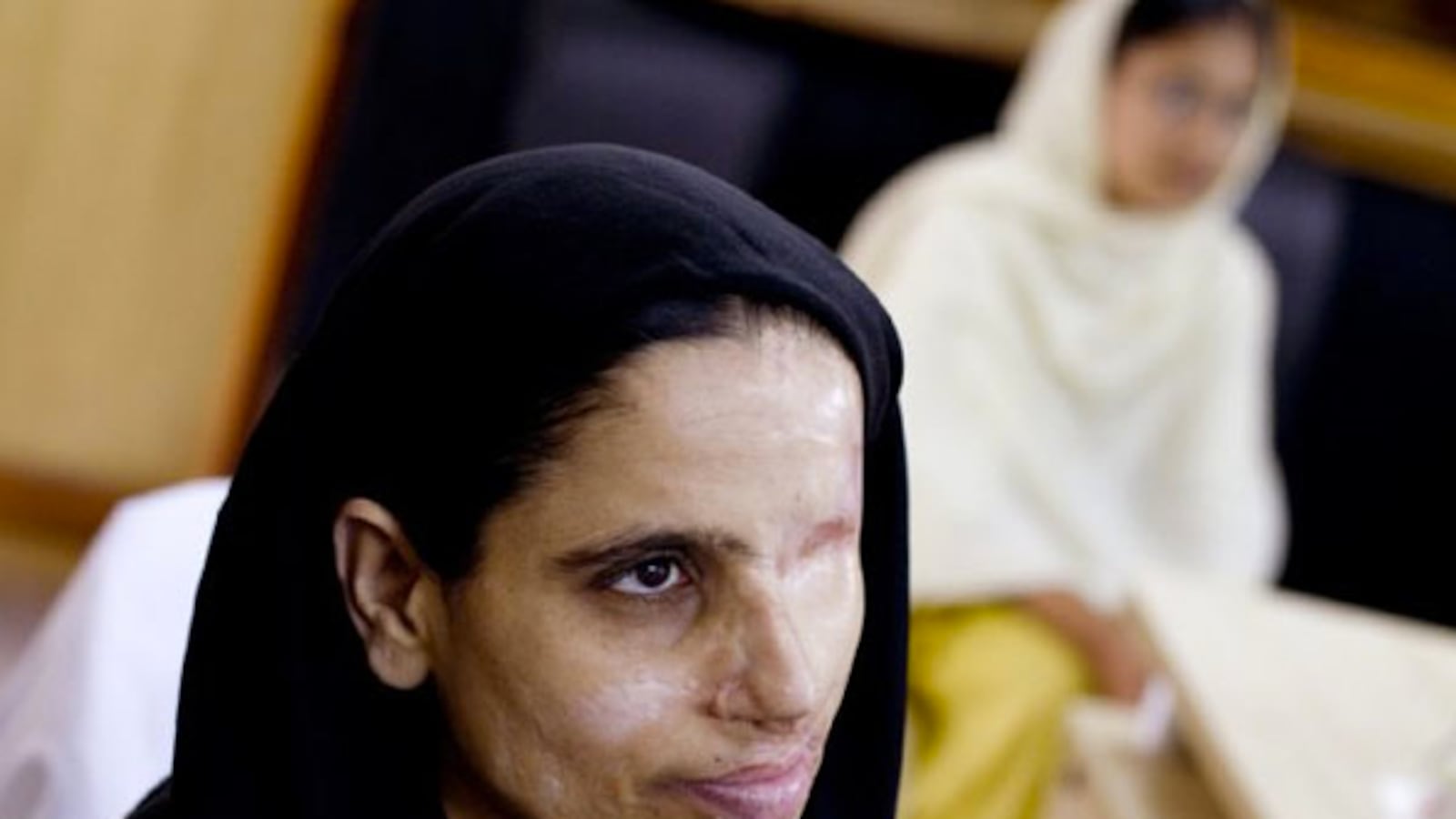
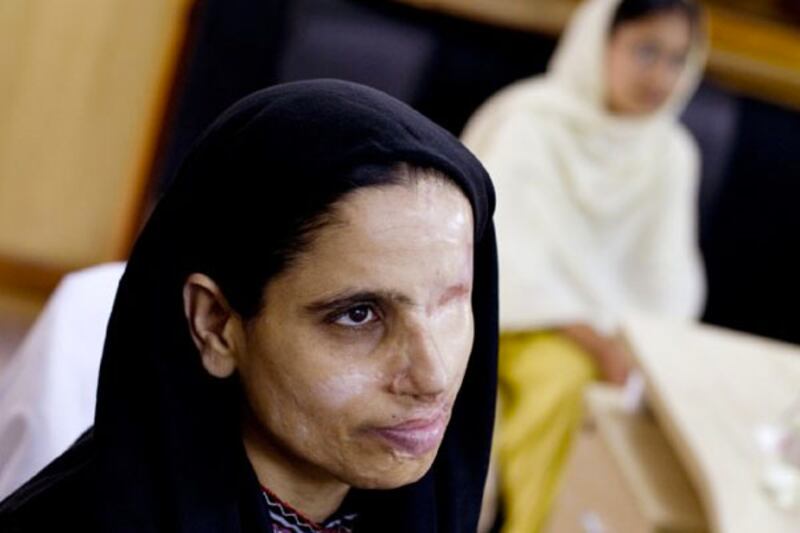
Saving Face, which premieres on HBO at 8:30 ET tonight, follows Pakistani acid attack survivors Zakia and Rukhsana as they attempt to rebuild their lives, and the work of Jawad, a U.K.-based plastic surgeon who returns to his homeland, to reconstruct their faces. The documentary is at times visually arresting and downright jarring in capturing the sheer brutality of acid violence.
The film begins in a Pakistani hospital burn ward populated all by women—some missing eyes, their skin burned, and faces flat. Despite the horror, the film ultimately offers hope and redemption, as Zakia and Rukshana slowly move forward with their lives: Zakia’s attacker is given two life sentences in jail, the Pakistani parliament unanimously passes a bill to criminalize acid throwing, and Rukhsana is joyful at giving birth to a baby boy.
Obaid-Chinoy, who dedicated her Oscar to Zakia, Rukhsana, Jawad, and the women of Pakistan, recalls one of several stories that didn’t make it into the film, that of Aziz Mai. Mai’s estranged ex-husband threw acid on Mai and her entire family, including her pregnant daughter and her youngest child, who was just 5 years old at the time. “That was particularly gut-wrenching,” she says.
“Each story is unique, but it’s all a form of domestic abuse,” Junge says of the stories they encountered during filming, “and it’s all premeditated.”
Saving Face, which garnered Pakistan’s first ever Oscar, has brought to international attention the practice of acid throwing, a unique form of violence unfamiliar to many across the globe. Acid violence is by no means limited to Pakistan: attacks occur in Bangladesh, India, Cambodia, Nepal, Liberia, Afghanistan, Iran, the United Kingdom, and even the United States.
The Acid Survivors Trust International (ASTI) estimates there are approximately 1,500 acid attacks a year globally. Putting together accurate figures on acid violence can be problematic, as acid attacks are thought to be largely underreported, and numbers vary wildly from NGO to NGO. According to ASTI, 80 percent of victims are female, and attackers almost always are male (with the exception of Cambodia, where women attack other women just as often as men do). Victims are attacked for refusing proposals of love, sex or marriage, with assaults often fueled by the “if I can’t have her, no one can” mentality. In other instances attackers throw acid in business or land disputes. In Liberia, acid was used as a weapon during the country’s civil war.
Since 2009, Jawad, an affable and confident man, has been visiting Pakistan to perform surgeries on acid-attack survivors. In Saving Face we see the emotional toll his work takes on him. “Each case is a horrible story, and they are so visually disturbing,” he says. Acid violence, says Jawad, is “a local disease, a man-made disease.”
Dr. Ebby Elahi, an oculoplastic and reconstructive who has worked on numerous acid attack survivors in Cambodia, Sri Lanka and Liberia, agrees. “Coming at this from a medical standpoint, we kind of look at everything, especially surgeons, as kind of ‘see it, fix it,’” he says. “It didn’t take long for me to realize that this is not really a medical problem. It has medical consequences [but] this is a social problem, and the response to it has to be social.”
Acid attacks occur in different countries for different reasons, but “the commonality is that the people who create this crime want to create a social stigma,” says Elahi.
Bangladesh, once known as the “acid-attack capital of the world,” has been the most successful in cracking down on acid violence. Whereas in 2002 Bangladesh saw 500 attacks annually, it now sees about 100 per year. Bangladesh was the first nation to adopt acid-specific legislation, and acid attacks carry a death sentence.
Obaid-Chinoy and Junge are working with ASTI and the Acid Survivors Foundation in Pakistan on an anti-acid violence outreach campaign that, as Junge says, “involves an education and awareness component.” Obaid-Chinoy has directed two public service announcements to air in Pakistan. “In Pakistan the outreach strategies will target Southern Punjab and Northern Sindh,” says John Morrison, founder and chair of ASTI. “There will be TV, radio and public service broadcasts. Schools, colleges, NGOs, mosques, local MPs, and community associations will be involved.”
Both Obaid-Chinoy and Junge are working to screen the film globally, as well as on their accompanying outreach campaign. “Of course our most important audience is in Pakistan, and we hope to show the film there, but first we have to be assured of the women’s safety on the ground,” says Junge.
Education and awareness are just one part of a multi-faceted approach necessary to crack down on acid violence in Pakistan. According to Mohammad Khan, executive director of the Acid Survivors Foundation—Pakistan, the nation’s government needs to adopt a new, comprehensive acid attack-specific law that, among other things, will: deal with the length of court cases so they are not dragged out; reduce corruption among law enforcement involvement; establish a monitoring system to properly document acid attacks; provide free medical treatment for victims, and, of course, secure a funding mechanism for the aforementioned.
Though a recent amendment to the penal code imposed harsher penalties for acid attacks, “there are a lot of misconceptions about what has happened recently in Pakistan in respect of legislation,” says Morrison, “Many people think that Pakistan has now got a full and comprehensive acid crime law.” Morrison says adoption of a comprehensive law is the next most important step, along with securing “accessible and affordable specialist surgery and burns care.”
Dr. Jawad plans to visit Pakistan to work on acid attack victims three to four times a year, and is encouraging colleagues to step up and offer their services: “Surgeons should register that they are available to help and travel to these parts of the world. I think that locally, too, surgeons should also come forward.”
Says Elahi: “In a lot of these places, the medical training is lacking, especially with subspecialties. And most importantly, facilities are lacking.”
According to Jawad, “One thing is very clear. I cannot take what happens at Cornell or MIT and take it to Pakistan. That is a stupid idea to even think about. It’s going to be low-tech but high-impact, not high-tech, low-impact. I’m aware of the limitations in the society and I’m not happy about it, but I can be realistic about it.”
Moving forward, Khan is hopeful that NGOs and civil society can make progress: “We have a problem and we own it and we’ll fix it.”