The horrific genocide of Darfur may have subsided; a so-called peace document between the Arab-dominated Sudanese government and black African rebels has been the object of prolonged and dithering negotiations; the country has been formally divided into Sudan and South Sudan; but government-sponsored carnage continues apace in the Nuba Mountains on the oil-rich border.
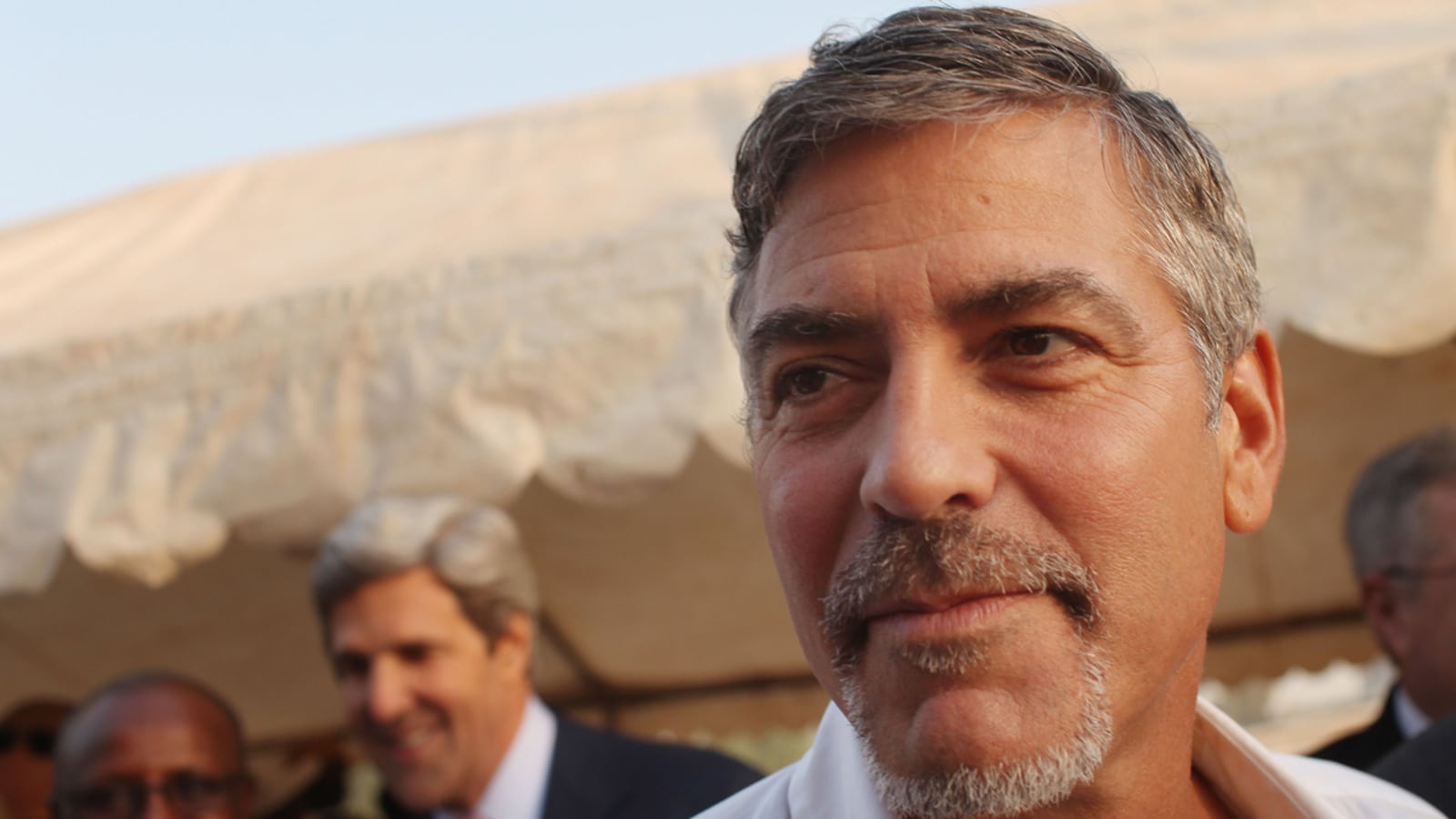
George Clooney once again is bearing witness.
The 50-year-old movie star, who for the past decade has taken up the suffering of the Sudanese people as his personal cause, reported that the situation is as bad and bloody as ever during a panel discussion Tuesday night at the Council on Foreign Relations.
“There’s a difference between two armies fighting and what the Geneva Convention calls war crimes—the indiscriminate bombing of innocent civilians,” Clooney told a packed house at the council’s Manhattan headquarters. “It’s all the same people who were involved in Darfur,” Clooney went on, mentioning President Omar Hassan al-Bashir, Defense Minister Abdelrahim Mohamed Hussein, and former interior minister Ahmad Haroun, three of the north Sudanese officials charged with Darfur-related war crimes by the International Criminal Court. “They’re scaring the hell out of these people”—the men, women and children of the Nuba Mountains—“and they’re killing them and trying to get them just to leave.”
Clooney has just returned from the conflict zone with fellow peace activist John Prendergast, who warned of “a coming cataclysm” in East Africa. They were scheduled to press their case today and tomorrow in meetings with President Obama, Secretary of State Hillary Clinton, and the Senate Foreign Relations Committee, arguing that the United States should work with China, the biggest customer for Sudan’s recently halted oil production, to get the oil flowing again by prevailing on al-Bashir to stop the violence. They were joined on the panel—moderated by Today show anchor Ann Curry—by Darfur activist Omer Ismail and exiled Anglican bishop Andudu Adam Elnail, whose Nuba congregation in Kadugli has suffered rapes and murders; the bishop has been targeted for assassination.

All of them gave compelling testimony about the 22-year-old Khartoum dictatorship’s campaign of house-to-house “ethnic cleansing,” mass rape, and murder (tossing the bodies into mass graves), dropping bombs from high-flying Antonov planes, firing 300mm rockets into villages, and generally wielding instruments of terror against the Nuba civilians.
But Clooney—who has long used his star power to aim a spotlight on the mayhem—was the big draw.
“There’s a lot of things swallowing up the news right now,” Clooney said, describing the difficulty of getting media attention for Sudan’s plight over the past year as the violence has ramped up. “There was the Arab Spring. Go down the list of the big news stories that were happening at the time. News organizations were covering them because they’re big. Syria is still a big story today. Iran is a big story today. We’re in the middle of an election year ... John [Prendergast] and I are gonna do every press thing in the world in the next three days, and people will know more and more about it.”
Clooney suggested that the strongest argument for the United States taking a leading role in solving the problem is economic, not altruistic. The South Sudanese government recently shut off oil production to pressure the north Sudanese (who control pipeline and refining facilities) into stopping the terror, contributing to the hike in gasoline prices.
“You can’t guilt people into doing the right thing,” Clooney argued. “China gets 6 percent of its oil imports from the Sudan. That’s a big number to China. They have $20 billion of oil infrastructure in South Sudan ... When they can’t get their oil, they’re going to go somewhere else ... That raises the price of oil. So that gives us the ability now to say, as advocates, “Every time you put gas in your car, you have reason to be concerned that these cross-border problems aren’t being addressed—because now you’re actually paying for it.”
Clooney also suggested the U.S. make a concerted effort to track down the Khartoum government’s foreign bank accounts—which they’re using to purchase weapons and ammunition. “We should track that down—find it, freeze it, and make it harder and harder for these guys to spend their money,” Clooney said. “Tighten this noose and make Khartoum a very small place to live.”
Clooney and Prendergast are cofounders of the Satellite Sentinel Project, through which they are amassing photographic evidence of the Sudanese government’s crimes against humanity using a satellite hovering over the region. On Monday, Clooney said, they were able to document an Antonov bombing run, and, using corroborating testimony on the ground, have also collected evidence of mass-grave sites.
Yet President al-Bashir and his cronies have managed to escape arrest by the International Criminal Court, and while such countries as South Africa have banned them from visiting, they are still welcome in Saudi Arabia and Qatar.
An audience member asked how members of the Khartoum government can be brought to justice.
“We could have a surprise party in Lake Como for Omar al-Bashir,” Clooney joked, referring to his Italian vacation home. “Come on over! It’s a great party! And have the ICC waiting for them.”