If you’re a Republican operative or office holder, still dreaming of a quick, clean end to the punishing primary process, where’s the good news in the unsettling returns from Alabama and Mississippi?
Yes, there is one small scrap of encouragement for GOP loyalists who actually hope to win elections in November: the “Ron Paul Revolution” looks less and less relevant and, therefore, less and less threatening to the future of the party.
Paul continued his unbroken string of primary and caucus defeats, gathering only 4 percent of the vote in Mississippi and a glorious 5 percent in Alabama. In the 27 states and territories that have awarded delegates so far, the cantankerous curmudgeon has been shut out in 18 of them, winning only 43 Paulestinians to represent his ideals at the Tampa Convention. Romney, in other words, has outperformed Paul by more than 10 to one (with more than 450 delegates so far), Santorum by more than five to one (with at least 230 delegates) and even Newt-ered Gingrich by nearly three to one (bringing 117 supporters to Tampa).

It’s obvious that the Paul juggernaut has been losing rather than gaining momentum, never able to recapture the magical aura that surrounded his strong third-place showing in the Iowa caucuses 10 weeks ago. More recently, he’s underperformed even in low-turnout caucus states (Alaska and North Dakota) where his supporters had expected him to do well.
This counts as good news for the GOP because it means that the bitter battles sure to break out at the national convention will center on a competition of personalities, not a conflict of ideology. Paul won’t have the delegate strength to push his controversial foreign-policy agenda: dragging the Republican Party toward a more isolationist posture that looks less kindly on old friends like Bibi Netanyahu and more favorably on impassioned enemies like Iran’s Ahmadine-whack-job.
The ongoing battle between Mitt Romney and Rick Santorum will remain nasty, demeaning, and undoubtedly destructive to the party’s long-term prospects, but it won’t become a reprise of the epic moderate vs. conservative struggle that characterized the 1976 duel between President Gerald Ford and former California Governor Ronald Reagan.
In the 36 intervening years, Reagan and his followers succeeded in remaking the GOP in their own image so that every major candidate in this cycle proudly claimed the mantle of pro-life, pro-Second amendment, small-government conservatism. Rick Santorum can’t claim to do battle as some right-wing David, casting his pebbles against the ungodly Goliath of the party’s moderate wing for the simple reason that this wing ceased to exist as a meaningful force some 20 years ago. The few remaining moderates in elective office have either abandoned the party (like Michael Bloomberg, Charlie Crist, or Arlen Specter), retired from the field (like Arnold Schwarzenegger, Christie Whitman and Olympia Snowe) or face tough primary challenges for their own survival (like Richard Lugar of Indiana). In the last presidential race, Rudy Giuliani attempted to win the nomination by combining hard-line positions on economic and security issues with more moderate positions on social policy, but failed miserably—and memorably.
Despite his heterodox past, Mitt Romney campaigned as an uncompromising conservative in 2008 (when he won Rick Santorum’s enthusiastic support, not to mention the backing of Jim DeMint, Rush Limbaugh, and other pillars of the conservative camp), and tried to position himself as the right-wing alternative to Giuliani and “maverick” John McCain. With that lavishly financed but failed candidacy fresh in the national memory, Mitt could hardly reinvent himself one more time as a “pragmatic problem-solver,” “centrist” or “non-ideological businessman” for the battle of 2012, even though that image might have made strategic sense both for the nomination fight and the general election.
Even though self-described GOP moderates have all but disappeared from the ranks of GOP elected officials, they still do vote in some numbers in Republican primaries–even in states as stoutly conservative as Alabama and Mississippi. A quarter of all Tuesday’s voters in Alabama called themselves “moderate” in exit polls, as did a fifth of those who cast ballots in Mississippi. Had this substantial bloc broken overwhelmingly for Romney he could have won both states, given the closeness of the final results, but he garnered only 41 percent of Alabama moderates and 46 percent of moderates in Mississippi.
In other words, Romney’s repeated insistence that he be counted as a true-believing Reaganite (a “severely conservative governor” he called himself at the Conservative Political Action Conference, where he won the straw poll of assembled activists) actually may have undermined his candidacy. Hard-core conservatives in most states had a tough time accepting that Romney really counted as one of them, but moderates (who, even in the Deep South, scattered the clear majority of their votes on other candidates) seem to believe Mitt (and, apparently, to resent it) when he claims to have deserted their ranks.
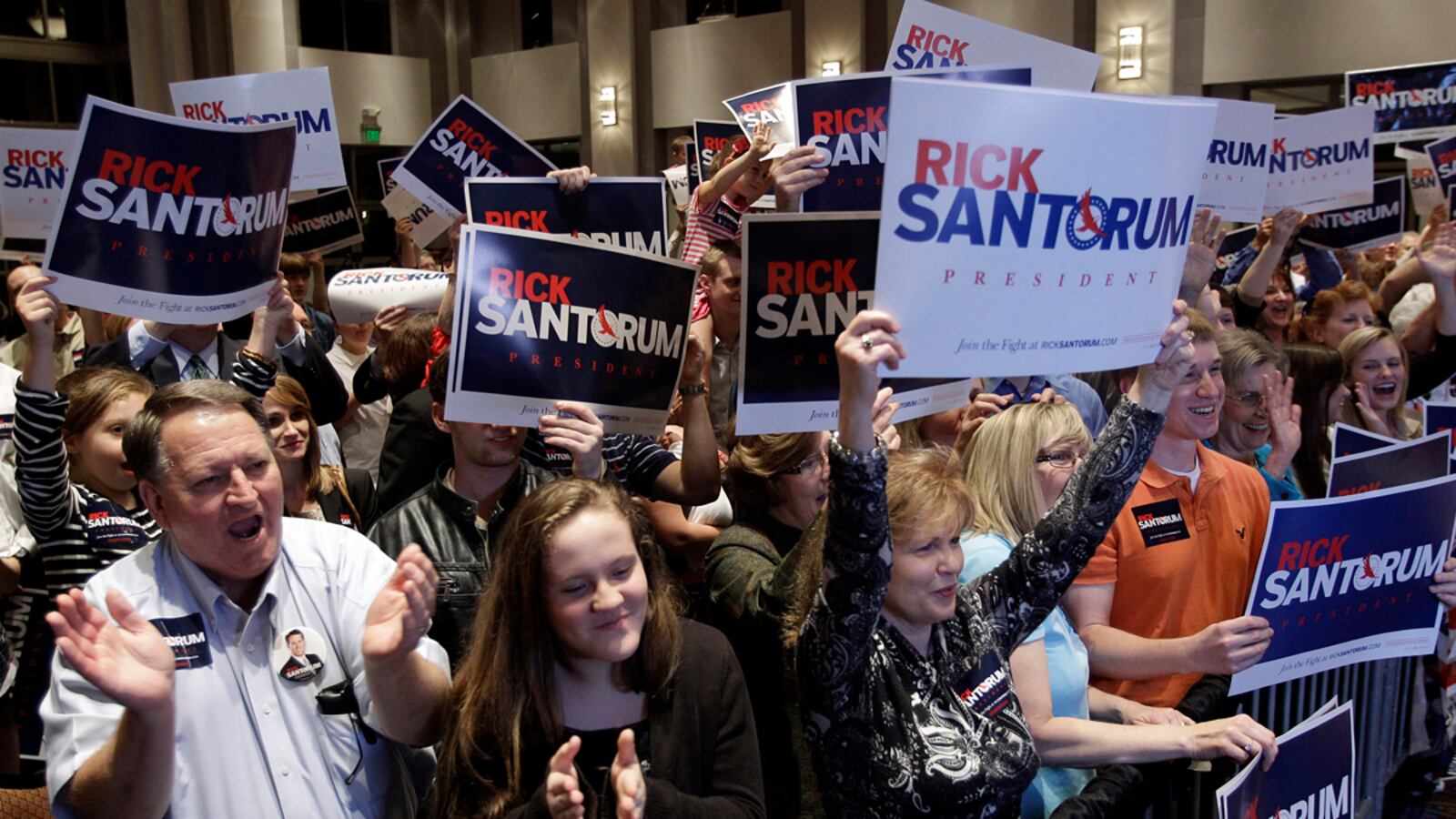
Meanwhile, Santorum’s exultant victory speech showed a dazed and delighted candidate who seemed for the first time to actually believe that his illogical underdog campaign could win him the nomination. In that context, a bit of graciousness might have helped his cause: There was no reason not to congratulate Romney and Gingrich on their strong showings, especially given the close, three-way races in both states and Righteous Rick’s obvious need for Gingrich’s support at some point before the convention. Instead of living up to the old maxim, “defiant in defeat, and magnanimous in victory,” Santorum has followed the pattern of whining in defeat and sneering in victory–not the way to win over the majority of Republicans who have yet to join his impassioned crusade.
The other danger sign in Santo’s speech involved its inescapably churchy overtones, with thanks to God and references to prayer at the very beginning and the biggest applause line invoking “the integrity of the family and the centrality of faith in our lives.” Given that Santorum has already collared the overwhelming majority of GOP voters for whom faith is the central aspect of their political lives, wouldn’t it make more sense to emphasize jobs, gas prices, the budget, and the economy? While even the most secular of GOP operatives acknowledge that a majority of reliable Republicans count as loyal churchgoers and devout believers, the party clearly can’t win in November without competing more successfully among the unchurched. In most states, Santorum hasn’t even been able to win pluralities of fellow Catholics who vote in Republican primaries.
Self-described white, “born-again,” or “evangelical” Christians represented more than three quarters of the GOP vote in Alabama and Mississippi, providing Santorum with his margins of victory, but that group amounts to only one-quarter of the overall national electorate. In 2008, the born-again vote went overwhelmingly for McCain, but Obama won by comfortable margins among the three fourths of voters who don’t embrace the evangelical identity.
If the ongoing primary battles make the Republican Party look like the God Squad, that identification could cripple congressional and senatorial candidates as well as destroying the presidential contender, while alienating the disproportionately secular young voters who are crucial to the party’s future.
As Rick Santorum moves on to the remaining primary battles, he should make the plausible case that he can do a better job than Romney as the champion of optimistic, pro-growth, muscular, common-sense Reaganite conservatism, but he ought to try to avoid assaulting his rival with the “mushy moderate” label Mitt emphatically rejects.
If both candidates use the term “moderate” as a curse word or as the ultimate insult, it can only serve to drive remaining moderates decisively from the Republican big tent and alienate the independents that any candidate will need for victory in November.
But if the campaign transmogrifies into a holy crusade for the “centrality of faith in our lives,” with Republicans in open opposition to contraception, university education, and the separation of church and state, then it will take a miracle of Red Sea proportions to escape unscathed from a tidal wave of rejection.