
Content Section

A Rape Victim’s Suicide Proves Morocco’s Culture of Silence Must Go

The suicide of rape victim Amina Filali is a reminder that the shameful blame-the-victim culture in Morocco needs to go.

“Moroccan Girl Kills Herself After Judge Forces Her To Marry Her Rapist.”  This horrific headline, or some version of it, spread from Twitter to traditional news outlets around the world earlier this week. Using the hashtag #RIPAmina, people voiced their outrage and disbelief, and called for a reform of Article 475 of the Moroccan penal code, which was said to enable rapists. But preventing this tragedy from happening again isn’t simply a matter of legal reform. It’s a matter of how cases of rape are handled by Moroccan society at large.

The death of Amina Filali was reported on the front page of Al Massae, Morocco’s largest newspaper. Though some details have been disputed, the facts themselves are sadly straightforward. Amina, a 16-year-old girl from the northern city of Larache, was abducted at knifepoint and raped sometime last year. Her family went to the public prosecutor’s office in Tangier to press charges against the alleged rapist, a 26-year old laborer named Mustafa F. Friends of the family intervened, however, and suggested an “amicable solution”: marrying the girl to the rapist.

Because Amina was legally a minor, a family judge was called upon to review the petition for marriage—a petition he approved. A few months ago, Amina went to live with her husband’s family, who reportedly treated her poorly. She told her mother that she was being repeatedly beaten. After another vicious fight, she committed suicide by drinking rat poison. She died in a hospital in Larache last week.

Under Moroccan law, rape is punished by prison sentences of five to 30 years, depending on a range of aggravating circumstances, including the age of the victim. Had the law been applied properly in this case, Mustafa F. would have been charged with “rape of a minor under the age of 18” and, if convicted, would have been sentenced to 10 to 20 years in prison. The public prosecutor failed Amina when he or she did not immediately proceed with an arrest and an investigation.

People still prefer to keep silent about rape, to act as if it hadn’t happened, to blame the woman who was the victim…

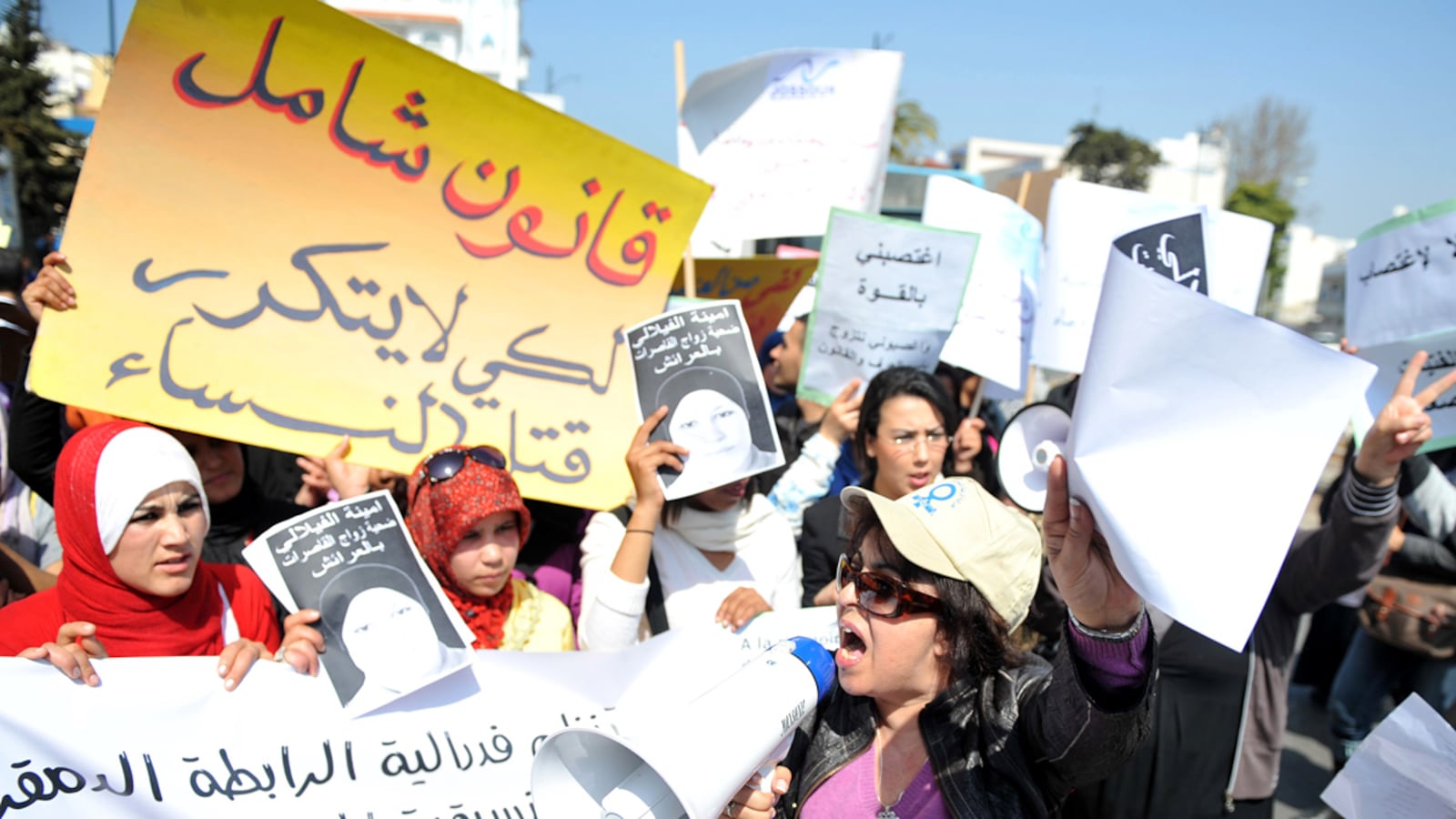
Protests Over the Suicide of Amina Filali

Women with Morocco's Democratic League for Women's Rights protested outside the court in Larache that had approved the marriage of Amina Filali to the man who raped her. She committed suicide last week to avoid the marriage. (Abdelhak Senna, AFP / Getty Images)

Another, more terrible failure is that the family agreed to the “amicable solution” offered by their friends. Rape is a crime in Morocco, but it is also a taboo. The woman who has been raped is often seen as having been shamed—her marriage prospects change radically, and her morals are called into question. In other words, the victim is blamed and the perpetrator is forgotten. “If we married her off,” Amina’s sister Hamida told a Spanish network, “it was to protect her, so that people would not speak ill of her.” The Filali family apparently preferred to sacrifice their daughter’s physical and emotional well-being rather than live with the reminder that she had been raped.

And then there is Article 475 of the penal code, which was the focus of so much discussion online.  Contrary to what has been reported, this law does not apply to violent crimes, such as rape. Article 475 states that when an adult corrupts a minor without the use of violence, threat, or fraud, the sentence is five years of imprisonment, whether or not there has been sexual intercourse; further, if the minor has married the adult, then the adult can only be tried if the minor’s legal guardians press charges and obtain an annulment. It was this loophole that the family used in order to marry off their daughter, close the case, and wash the shame.

For many years, Moroccan feminist organizations, such as the Democratic League of Women’s Rights, have been demanding that Article 475 be abrogated. After Al Massae’s report on Amina Filali, Moroccans took to Twitter to express their outrage. They started a petition and a Facebook page asking that this law be repealed. It should. Without it, the case would never have reached the desk of the family judge—another person who failed Amina. This judge, presumably in full awareness of the facts, agreed to the marriage petition. It is telling that while Amina Filali’s name has been made public, the judge who forced her to marry her rapist has neither been named nor shamed.

But abrogating Article 475 is only the beginning, not the end of the battle for justice, because the truth is that all of us Moroccans have failed Amina.  Her case, though particularly horrific, is not unique. People still prefer to keep silent about rape, to act as if it hadn’t happened, to blame the woman who was the victim, to open a debate about her morals, or to find an “amicable solution” for the perpetrator. Legal reforms are not enough so long as Moroccan society views the victim of a rape as something that needs to be solved. Rape is not puzzle. Rape is a crime. Amina Filali’s death is a stain on our collective conscience.


You Might Also Like

2013 Women in the World Speakers

2013 Women in the World Speakers

Inspiring women from around the globe will convene in April for the 2013 Women in the World Summit. See who’s coming!

International Women's Day

Through Her Lens

Through Her Lens

From invisible Iranians to dealing with an overweight body, see works from female photographers to watch.

FINANCIAL INCLUSION

Turning Poor Kids Into Savers

Women in the World

How to End Violence Against Women

Secret Weapon

The Woman Behind ‘Girls’

Women’s Advocate

Climate Change’s Gender Gap

Women in the World: It’s On!

Women in the World: It’s On!

Newsweek and The Daily Beast are excited to announce the 2013 Women in the World Summit on April 4 and 5. Get your tickets today.

Why I Choose to Be Child-Free

Why I Choose to Be Child-Free

DINKs, DILDOs, and other readers respond to Joel Kotkin and Harry Siegel’s Newsweek story about America's declining birthrate and share their reasons for remaining child-free.

Beyond Betty Friedan

Beyond Betty Friedan

Gail Sheehy looks at the new, strategic feminism, as PBS prepares to air the documentary ‘Makers: Women Who Make America’ tonight.

‘We Were Really Naïve’

‘We Were Really Naïve’

The mother of a domestic abuse victim speaks out

The Next Women’s Ambassador

The Next Women’s Ambassador

As Melanne Verveer departs, who could be Obama’s new champion for women and girls? By Katie Baker.

Robin Roberts to Be Honored at DVF Awards

Diane von Furstenberg joins GMA's Robin Roberts to talk about the annual DVF Awards and reveals the courageous anchor will be honored at this year's event on April 5th.

  1. Welcome Back, Robin! Play

    Welcome Back, Robin!

  2. Mobama: Bangs Are 'My Midlife Crisis' Play

    Mobama: Bangs Are 'My Midlife Crisis'

  3. R.I.P. Mindy McCready Play

    R.I.P. Mindy McCready

The Plus-Size Blogging Craze

The Plus-Size Blogging Craze

“Fatshion” is a popular community on Tumblr, where plus-size bloggers post pictures of themselves as a way of celebrating their size. Judy McGuire reports.

The Power in ‘Girl Rising’

The Power in ‘Girl Rising’

The film, which will be released March 7, advocates for the education of girls around the world. Eliza Shapiro reports.

‘Feminine Mystique’ at 50

‘Feminine Mystique’ at 50

Three feminists from different generations revisit Friedan’s classic. By Jessica Bennett, Letty Cottin Pogrebin, and Alisa Solomon.

Breastfeeding Wins Another Round

Breastfeeding Wins Another Round

A new CDC study is just the latest news to buoy the pro-breastfeeding camp, reports Eliza Shapiro.

The Book China Hates

The Book China Hates

Ping Fu talks to Katie Baker about the online backlash to her new memoir, ‘Bend, Not Break.’

The World After Hillary

The World After Hillary

She changed the game irrevocably, and now she’s about to transform it again—by walking away. Plus, read the full transcript of her farewell speech.

Malala Speaks!

Malala Speaks!

Tina Brown and Angelina Jolie announce gathering strength for an education fund in her honor.

women-in-the-world-foundation

Calling Out Victoria’s Secret

Calling Out Victoria’s Secret

How two women’s online plea is pushing the lingerie giant to the ‘survivor bra’ market. By Nina Strochlic.

Taking Stock

Roe v. Wade Turns 40

Interactive: The Geography of Abortion Access

Interactive: The Geography of Abortion Access

See locations of the country’s 724 clinics and distance to the closest clinic in different areas. By Michael Keller and Allison Yarrow.

STARTING OVER

Ground Zero of the Abortion War

Word Play

Call It By Its Name: Abortion

Roe v. Wade

Readers Share Their Abortion Stories

A Day in the Life

Inside an Oklahoma Abortion Clinic

Why Investing in Women Works

Why Investing in Women Works

When companies support women, write Melanne Verveer and Kim Azzarelli, their businesses and communities win.

Way to Go, Panetta!

Women on the Frontlines

The Female Fighter I Knew

The Female Fighter I Knew

Veteran Anthony Woods recalls a brave lieutenant who lost her life in Afghanistan.

Military Progress

Fully Integrated, Finally

WOMEN IN COMBAT

Bravery and Beauty

The Sperm Donor Trap

The Sperm Donor Trap

After gifting his DNA via Craigslist, a Kansas man may be on the hook for $6,000 in child support. Fair?

witw-1200-800-tease

150 Women Who Shake the World

They're starting revolutions, opening schools, and fostering a brave new generation. From Detroit to Kabul, these women are making their voices heard.