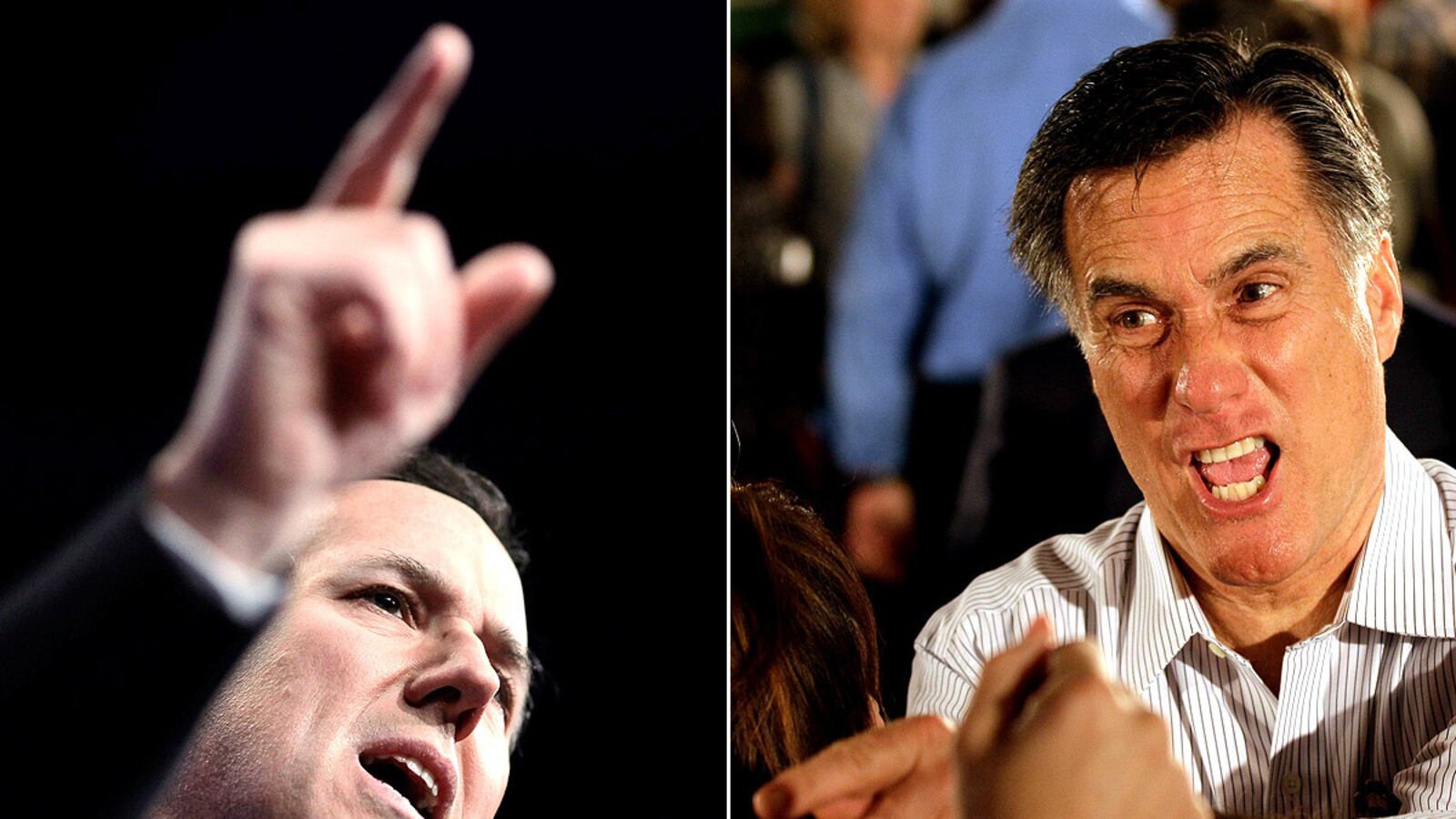
The Illinois primary Tuesday is the next key marker in the grinding race for the Republican nomination, the latest front in a GOP contest that has become political trench warfare between Mitt Romney and Rick Santorum. Here are five things to watch as the returns come in:

DELEGATES VERSUS POPULAR VOTE
When Illinois Republicans step into voting booths tomorrow to cast ballots for a presidential candidate, those votes will be decide nothing, but merely register in a symbolic beauty contest, like the primary held in Missouri ahead of that state’s caucus. Illinois’ delegates, who voters choose by their name (not the name of the presidential candidate) in each Congressional District, will be elected further down the ballot. So if, for example, Santorum voters, (who tend to be less well educated than Romney voters, according to exit polls) neglect to check the down-ballot boxes in the delegate race, their candidate could win the popular vote in a congressional district but not pick up any delegates.
GINGRICH DELEGATES IN SANTORUM DISTRICT
In four congressional districts—the 4th, 5th, 7th and 13th—the Santorum campaign didn’t file the paperwork for delegates. Thus, while voters can vote for Santorum in those districts, they will only be able to vote for delegates pledged to Romney, Gingrich or Paul. This could be an opportunity for Gingrich to capitalize on the “anti-Romney” vote to rack up as many as 12 delegates. in a state where he’s not otherwise competitive. Since the key question in the race has become whether Romney can accumulate enough delegates to lock up the nomination before the convention, the Santorum campaign won’t complain if Gingrich pursues this strategy.
CHICAGOLAND VERSUS DOWNSTATE
Like the Korean Peninsula, Illinois is cleft into two parts: Chicagoland and “downstate.” Chicagoland is Cook County and the five “collar counties” that surround it. Downstate is everything else, from high bluffs facing Iowa on the Mississippi River, to the southern twang of “little Dixie” along the Ohio River and everything in between. So far, the Republican contests have registered an urban-rural split, with Romney consistently winning big cities and prosperous suburbs, while Rick Santorum has been the only candidate who can “play in Peoria.” Among the Illinois Republican primary electorate, these two areas vote in about equal proportions (although downstate is significantly less populated than metro Chicago, it is also significantly more Republican). The question is whether Santorum can do well enough downstate to balance out the margins that Romney will likely pile up on the shores of Lake Michigan.
REDISTRICTING
Illinois was one of the few states in the country where Democrats controlled the redistricting process this year. The result is a map that is carefully constructed to create as many Democratic seats as possible. Many districts are tadpole shaped, their heads inside Chicago city limits and long tails reaching out into the suburbs and beyond, entrapping as many Republican voters as possible, while maintaining a Democratic advantage. The result is that several congressional districts will have a majority of their population inside Chicago but a majority of their Republican primary voters will be out in the suburbs and exurbs. In contrast, while the base Democratic vote is widely dispersed, many Republican voters will be packed into a handful of congressional districts. This means the areas with the most Republican votes are usually not the most efficient places to campaign for delegates. The result will be that the GOP primary will be taking place on a peculiar battlefield, which does not follow the state’s traditional cultural or geographical divides.
MANZULLO V KINZINGER
The presidential race is not the only one on the ballot tomorrow for Illinois Republicans. There is a ferocious GOP primary between two incumbent Congressmen in Illinois’s newly created 16th Congressional District, a masterpiece of gerrymandering that stretches from the Wisconsin line down and across from Indiana, walling off Chicagoland from the rest of the state. The race pits ten-term incumbent Donald Manzullo against Adam Kinzinger, a first termer elected in the GOP wave of 2010. But while Kinzinger is new to Congress, he has broad establishment backing, while Manzullo has the backing of Tea Party groups and other insurgent elements of the Republican Party. The contest between a relative political newcomer backed by the party establishment and a Capitol Hill veteran backed by rebellious social conservatives will serve as a very interesting barometer for the state of the GOP electorate.