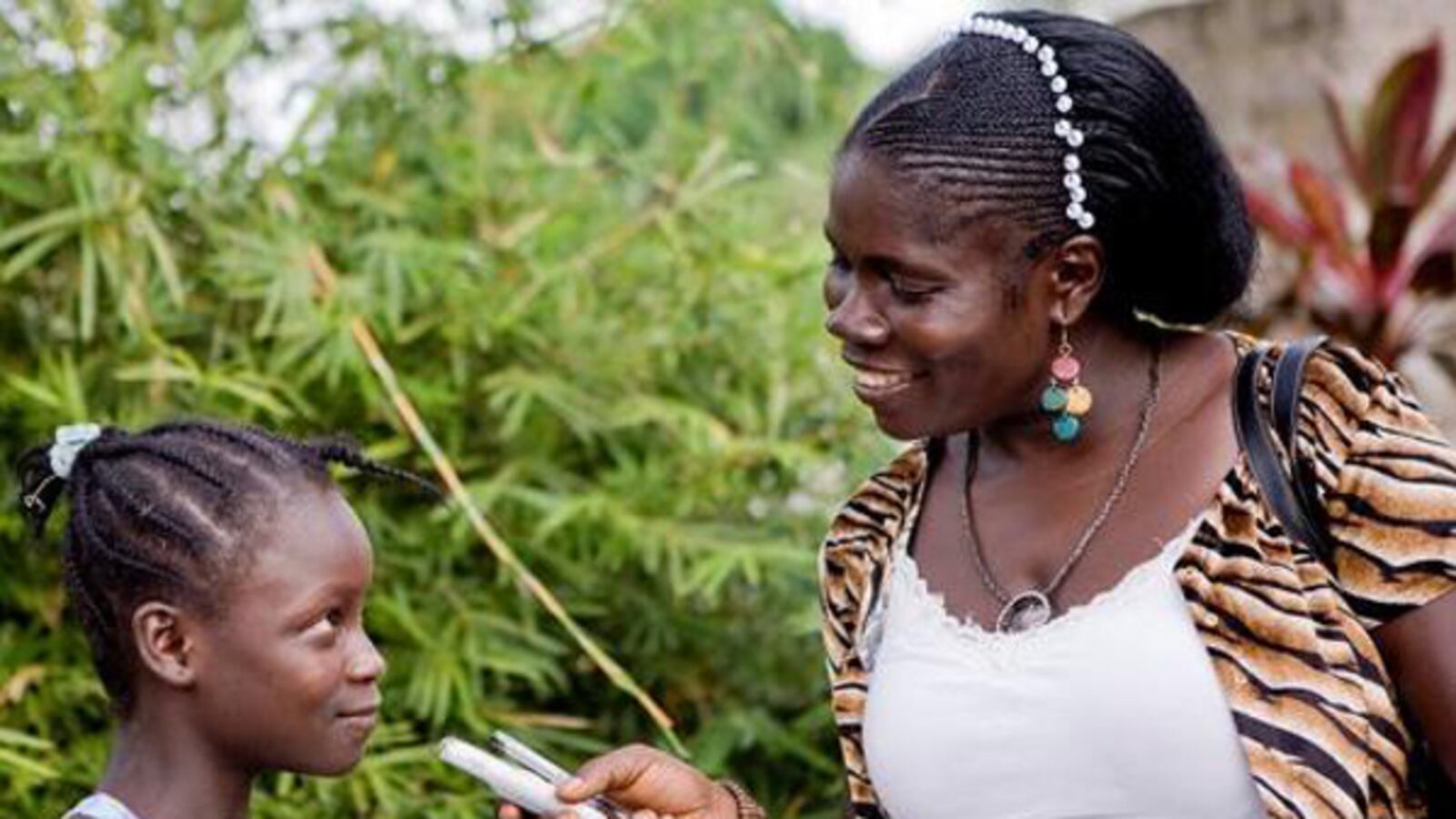
Mae Azango hasn’t slept in her own bed, or seen her 9-year-old daughter, in almost two weeks. She hasn’t been sleeping well; “tension headaches” are keeping her up, she said, and she’s been eating so little that friends have taken to remarking on her weight loss.

The Liberian journalist has been living in fear since March 8, International Women’s Day, when the newspaper Front Page Africa published an article she had written about the negative health implications of female genital cutting, which is practiced among a powerful secret women’s society in many of the country’s rural counties. The threats started pouring in—over the phone and by email—almost immediately. The callers warned that “they will grab me and put me in the Sande bush and cut me,” Azango told The Daily Beast, referring to the Sande society of women who perform the female genital cutting. “And for putting my mouth in this business, I will pay for it.”
Since then, Azango has gone into hiding, avoiding her office and sleeping in a different house every few days. But while her detractors may have forced her into flight, they have yet to succeed in silencing her. She even said that she intends to continue reporting on female genital cutting and has another story on the subject planned.
“I won’t back away. Let me tell you that: I won’t back away,” Azango said by telephone from Monrovia. “I am not saying I will do it today or tomorrow, but eventually I will do a story on it. Because this thing needs a lot of public awareness.”
Azango began her reporting career in 2002, around the time that Liberia was emerging from 14 years of war. In 2011 she won a grant from the Pulitzer Center on Crisis Reporting to cover reproductive health in Liberia. She has written stories about teen mothers and fathers, abortion, rape, illegal mining, erosion, and even on the fate of workers on projects Libyan leader Muammar Gaddafi financed in Liberia before his death.
This wasn’t the first time she’d written about female genital cutting. In 2010 Azango published a story about women whose husbands left them because they had gone through the procedure. That piece, however, provoked none of the stinging backlash the latest one has.
The practice—mutilation, as it is sometimes called—is a procedure in which all or part of the female external genitalia is cut away. Globally, 130 million to 140 million women and girls have been cut, according to the World Health Organization, and roughly three million, or about 8,000 each day, are at risk of undergoing the procedure every year. Liberia is one of nine African nations with no laws banning the procedure.
According to the Population Reference Bureau, the prevalence of female genital cutting or mutilation among Liberian women ages 15 to 49 is about 58 percent. The procedure is practiced among 10 of Liberia’s 16 tribes, Azango wrote in her story.
Azango was in a rural village the day her story appeared on the paper’s front page. When her editor, Wade Williams, called her to tell her about the threats, they were already so bad that Williams told her to immediately return to the safer environs of the city.
In her story, Azango quoted a 47-year-old woman who went through the painful procedure among the Sande when she was 13. She described in detail the lack of anesthesia, the five women who held her down as her clitoris was cut, and the leaves they used to cover the wound.
When a girl goes through the procedure among the Sande, she is sworn to secrecy. Often the punishment for speaking up is death. In telling the vivid tale, Azango, it seems, crossed a dangerous line.
The day after her story appeared, Azango said, a prominent female village leader left a message for her at the offices of New Narratives, a nonprofit organization supporting independent media in Africa, with which Azango is affiliated. “She said I was not to write that story, it was not good,” Azango said, “I should leave it; I should be careful.”
The next day, a female tenant in her home told Azango that if she left Liberia’s capital city of Monrovia for one of its rural counties, she would not return alive. And last Wednesday evening, women dressed in traditional clothing showed up at her home asking for her daughter. The next morning, similarly dressed women (it is unclear if they were the same people) arrived at the New Narratives and Front Page Africa offices looking for Azango herself.
Azango has since sent her daughter to stay with distant relatives in an undisclosed location.
Female genital cutting is not a new topic, but it remains a highly sensitive subject in Liberia. Prue Clarke, the co-founder and executive director of New Narratives, believes it’s the way Azango told her story that has generated such interest and anger.
“Mae’s story said this is harming our girls,” she said. “And it did so in an effective way,” with a strong lead and a good character.
Azango said her inclusion of a firsthand account of what are supposed to be secret Sande practices was unique and probably what incited such wrath. The fact that she is a woman revealing such secrets didn’t help.
“Because I am a woman, and I went deeper and talked to a victim, so the other women are angry with me,” Azango said. “If a white lady picked this story up, nobody would have time for her.
“Because it was a Liberian woman writing it,” Azango continued, “I betrayed a secret.”
On March 13, the Committee to Protect Journalists, a media watchdog group based in New York City, sent a letter to Ellen Johnson Sirleaf, Liberia’s president and Africa’s first female head of state. They called on her to “direct the Liberian authorities to ensure [Azango’s] safety and fully investigate the threats made against her.” It further urged Sirleaf to “to speak out against the threats made against Azango, and to ensure that other journalists taking on this sensitive topic do not suffer the same fate.”
To date, Sirleaf has not responded. Some speculate that her reluctance is indicative of how much power Liberia’s two secret societies wield—both the Sande, who are women, and the Poro, who are men—and that she may be avoiding stepping into the fray in order to protect her political career.
In a telephone interview on Monday, Jerelinmek Piah, the president’s press secretary, would not explain specifically why Sirleaf, a Nobel Peace Prize winner known for her promotion of women’s rights, hasn’t made any comments on Azango’s case. He only said that the Ministry of Information, Culture and Tourism is the “voice of the government” and that it would issue a statement sanctioned by the government.
On Monday, Information Minister Lewis Brown did release a statement to media outlets in Liberia. It said the government was aware of the threats against Azango, is taking them seriously, and, pending the outcome of the police investigation that began March 13, has taken all “necessary precautionary measures” to protect those associated with the case. The press release also emphasized that the Liberian government “will neither countenance nor accept any form of intolerance whose objective is to stifle the exercise of individual freedoms and to frustrate the advance of civil liberties.”
Prue Clarke and her staff at New Narratives welcomed the government’s response, saying it has moved faster on this than on other matters in the country. But Azango and her editors have been frustrated about the time it took for a government reaction, and because they said she has had to provide her own security; that the government has not given her protection.
“They should be doing what they are not doing. They should be protecting her,” said Rodney Sieh, editor in chief and publisher of Front Page Africa. “This is a very complicated situation that I don’t think any government official is brave enough to tackle.” Fear of the Zoes, the traditional Sande and Poro leaders, is to blame, he said.
Yet the government has not been idle. George Bardue, a spokesman for the Liberian National Police, said investigators are in touch with Azango, have taken two statements from her, and have interviewed two witnesses so far. He added that police intelligence officials have been monitoring the situation on the ground, though he wouldn’t give specifics on what that entailed because the investigation is ongoing.
Brown, the information minister, said the police would determine whether Azango needs a bodyguard or further security measures based on the outcome of their investigation. He said she had asked to be put up in a hotel for safety, but that doing so could “open a can of worms where every journalist feels threatened.”
Nevertheless, he also acknowledged the potential for serious damage to Liberia’s postwar development if the threats against Azango force other journalists into silence.
“This matter is very close to us,” he said. “If we can’t protect journalists, then we can’t build a free society.” In fact, Brown continued, protection for all Liberians is essential for the country to become more open, democratic, transparent, and tolerant. “We can’t do that without the free expression of ideas; that’s the commitment this government has.”
At least one colleague of Azango’s so far refuses to remain mute. Tetee Gebro, a radio journalist for Liberia’s Sky FM station who also is affiliated with New Narratives, broadcast a radio version of Azango’s story Thursday. Clarke, of New Narratives, said Gebro was aware of the risks but felt people need to talk about this subject. The story was to be aired on the U.N. radio station as well.
Likewise, Azango said that rather than dissuading her, this recent experience has made her more determined to report on sensitive topics like female genital cutting. “It’s a human-rights violation; it needs to be stopped,” she said. “Forget about culture and tradition. Abolish it.”