While a Supreme Court rejection of Obamacare this summer would be an embarrassment for the president, and an obvious blow to his legacy, a case can be made that a health-care defeat in the high court might actually benefit Obama in his reelection campaign.
Apart from the fact that Republicans would lose their most animating issue in the presidential race, the overturning of the health-care reform law would free Obama of the burden of having to mount a broad defense of his health-care plan as a centerpiece of his campaign. The president, who can read polls, managed to absent himself from any public observance of the reform law’s second anniversary last week. A Supreme Court invalidation of the reform law’s individual mandate, the feature that Americans find most odious (PDF) would allow Obama to embrace the issue anew, focusing on those portions of the reform (such as the provision allowing families to keep their children on their policies until they reach the age of 26) that most people actually like. Obama’s Democratic allies, meanwhile, could hammer home the importance of deciding who will be making the next appointments to the Supreme Court.
If Obamacare stands, on the other hand, the president faces a politically vexing dynamic that is an inevitable consequence of his health-care reform—the ongoing process of actually implementing the sweeping law.
When the 2,700-page bill was passed into law, critics complained that few in Congress had actually read the legislation (a complaint underscored by then-Speaker Nancy Pelosi’s remark that “we have to pass the bill so that you can find out what’s in it”). The writing of health-care regulations by federal bureaucrats amounts to a loudly amplified, slow-motion reading of the Affordable Care Act, a process fraught with the prospect of unwelcome surprise.
That is what happened in January, when the Department of Health and Human Services announced that its interpretation of the health-reform law required employers to provide their workers with contraception services, including sterilization and abortion-inducing drugs. That was an incitement to many Catholics, and church leaders were not assuaged by the administration’s subsequent tweaking of the mandate, shifting the contraception obligation from employers to insurers. Cardinal Timothy Dolan, the archbishop of New York, and, as president of the United States Conference of Catholic Bishops, the most influential Catholic in the country, made clear in a recent Newsweek interview that he would make opposition to the mandate—framed as a fight for religious freedom—his top priority.
Every four years, the bishops send an instruction to their flock, called Faithful Citizenship, urging them to be mindful of Catholic teachings when deciding how to vote. The instruction formulated in 2007 was sufficiently ambiguous to allow an interpretation that a politician’s deviation from church instruction on a matter such as abortion could be balanced by his or her positions on other matters of social justice, such as supporting programs for the needy. For this election, under Dolan’s leadership, Faithful Citizenship includes a clarifying introductory note. “The one we issued four years ago was a little misinterpreted,” Dolan told Newsweek. “So, in this one, we did say, even though there are an array of issues that a thoughtful voter, informed by his or her Catholic faith, will take into consideration, there are some premiere ones that are non-negotiable.”
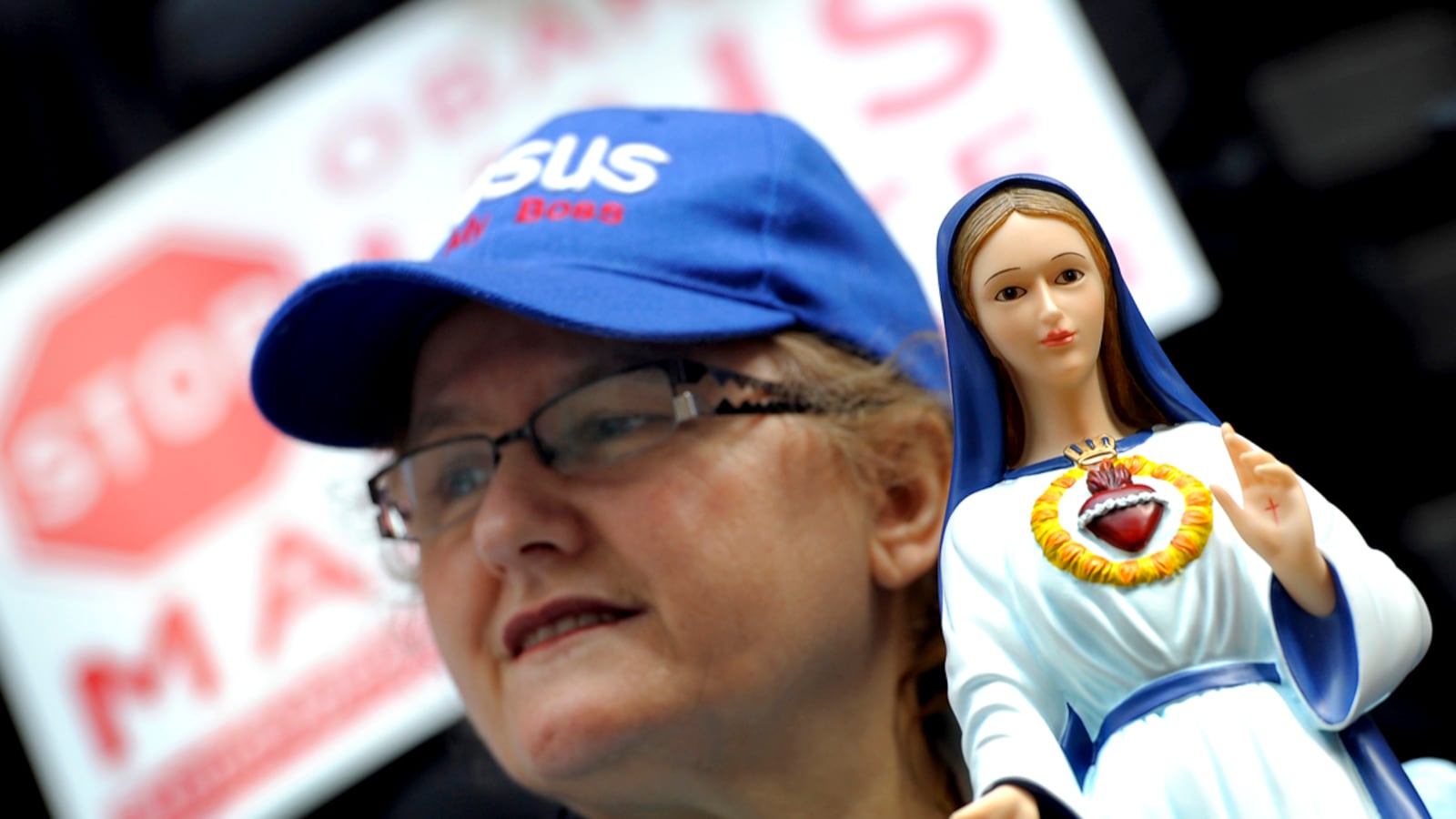
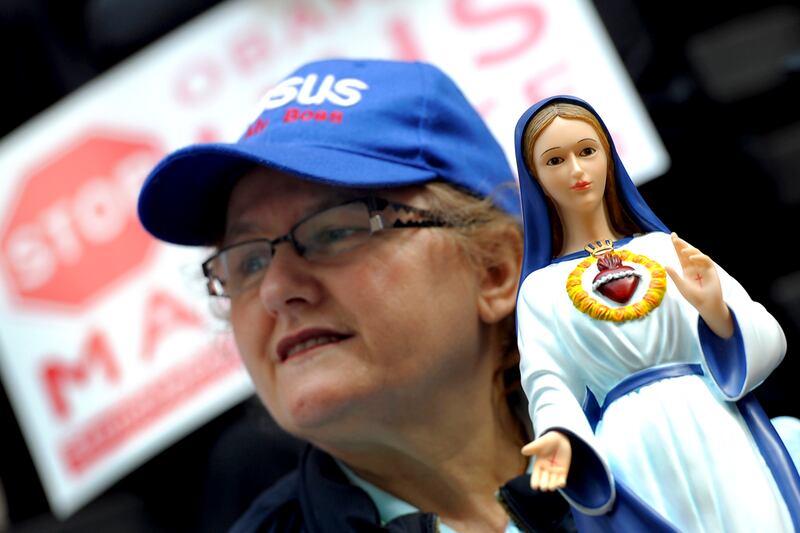
Self-identified Catholics, who make up more than one fourth of the electorate, are hardly a natural Republican constituency (Obama won this group by 8 points in 2008), and do not necessarily heed the guidance offered by the bishops. But within the broader Catholic population, that portion of devout churchgoers is far more heedful of church instruction, and more animated by perceived government intrusion. These motivated Catholics could be seen in force last Friday, at religious-freedom demonstrations staged across the country. And their votes can influence an election. They accounted for 15 percent of the electorate in 2008, and 49 percent of them voted for Obama; a swing away from Obama of a significant portion of these devout faithful can determine the outcome of the election.
The unfolding reality of Obamacare is only likely to intensify such opposition. Earlier this month, HHS announced the finalization of yet another health care rule, this one (PDF) regulating the state health-care exchanges that were established by the reform law. In an apparent effort to avoid an abortion controversy, the HHS regulation requires people insured by policies that provide elective abortions to pay a separate premium ($1), in addition to the cost of the policy. Prolife activists seized upon this regulation, calling it an “abortion premium” that would require citizens to unwittingly help pay for others’ abortions out of their own pockets. This newest controversy became the basis of yet another amicus brief (PDF) filed in opposition to Obamacare.
If that or any other legal argument against Obamacare persuades a majority of the justices, it would certainly place a cloud over Obama’s first-term record. But Obama might well see a silver lining in November.