
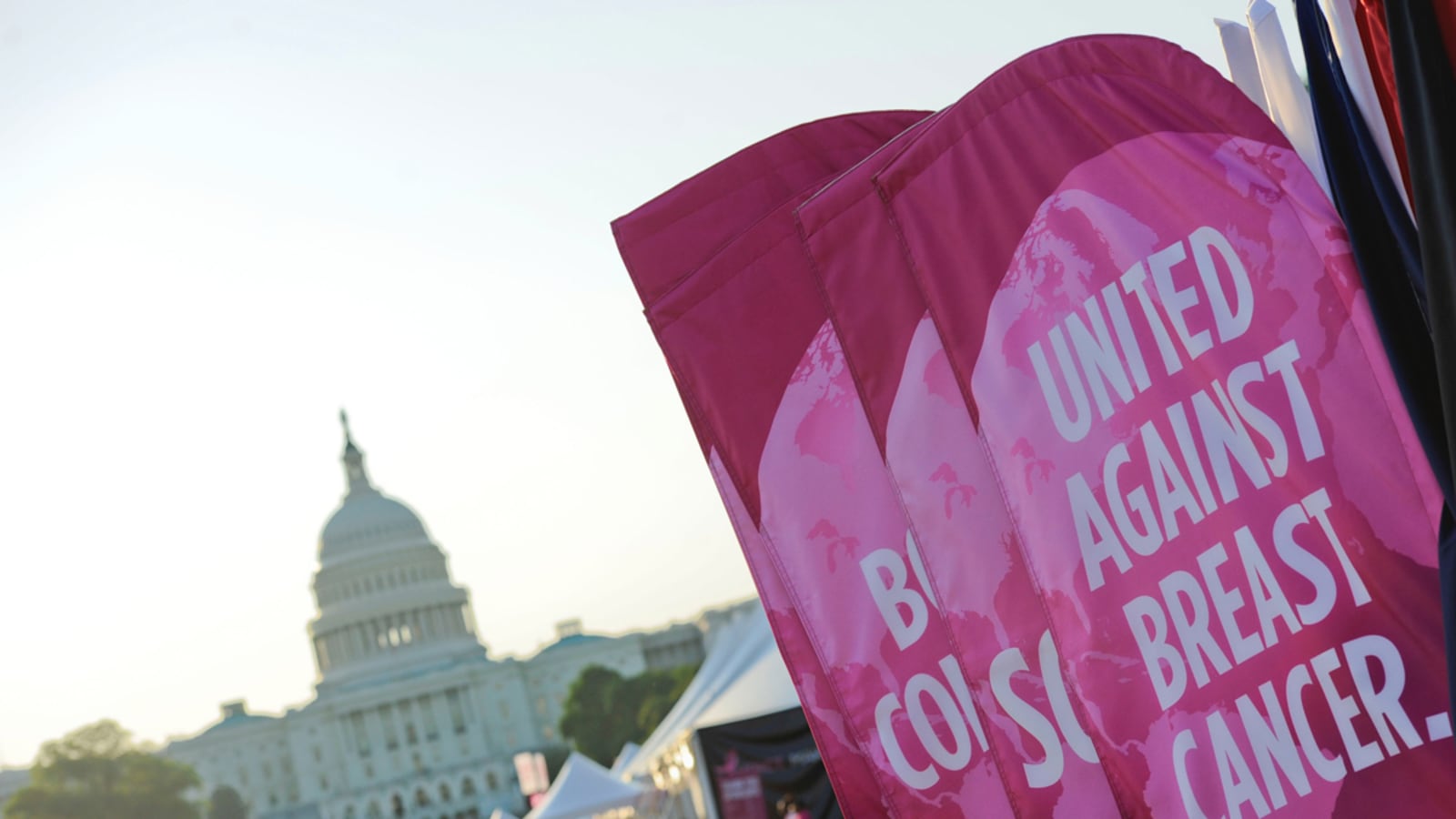
The Susan G. Komen foundation, the powerful charity in the throes of controversy, has canceled one of its most important events of the year: its annual “Lobby Day” in Washington, D.C., The Daily Beast has learned. The move is significant because it indicates that Komen’s problems could impact an array of women’s health initiatives that reach well beyond the ones the charity sponsors itself. At the annual lobbying day, activists push for government programs, not for Komen programs. These government programs focus on cancer research and early detection and treatment for underserved women.

Leslie Aun, a spokeswoman for Komen, did not elaborate on the reasons for the cancellation. The foundation has been reeling in recent weeks from its decision to cut funding to Planned Parenthood amid pressure from donors and Catholic bishops. The move sparked a national backlash, and Komen reversed the decision. Several high-level employees have since departed, and some Komen affiliates around the country have reported struggles with fundraising. The New York affiliate said it was postponing two spring fundraising events due to concerns about raising money.
Lobby Day is an expensive event, as it involves flying hundreds of Komen activists and breast-cancer survivors from around the country to Washington to meet with members of Congress.
“We know folks have been upset with us,” says Aun. “We get that, and we are sorry. We hope that people don’t turn their backs on women. If you don’t give to Komen, that’s someone who’s not going to get a mammogram.” She adds, “We fill so many gaps for women—we gave 700,000 free screenings to uninsured women last year, many of them impoverished. I can’t tell you how many cancers we have detected. Women are alive today because of Komen.”
The foundation has raised some $1.9 billion for cancer research since its launch 30 years ago. The group has a nationwide network of 122 affiliates and 100,000 volunteers. It was all the vision of founder Nancy Brinker, who started the charity after her sister, Susan G. Komen, died of breast cancer in her mid-30s, following inept treatment. Brinker, a breast-cancer survivor and a former U.S. ambassador to Hungary, has come under scrutiny in recent weeks for her management and spending style, but her advocates are quick to point out her important work, noting that her foundation gives more cancer-research grants than any other charity.
People familiar with the situation say the charity’s current challenges can’t all be blamed on the Planned Parenthood flap. They say the group was already facing a number of financial and management hurdles in the months before the controversy. They describe a powerhouse charity trying to deal with the economic downturn and with general fatigue among some donors regarding pink-ribbon campaigns and races.
According to one person familiar with the situation, some of the national affiliates weren’t meeting their goals for participants and fundraising at local races and events last year. Komen was discussing plans to cut its budget for the next fiscal year, this person says, with proposed staff layoffs along with a potential reorganization of the affiliates, including combining some of them or trimming the number of races.
People familiar with the situation also say there was some anxiety among staff about restricted grants Komen had accepted—grants that call for the funds to be given to specific projects, some overseas. It’s not unusual for charities to accept restricted grants, but when budget cuts need to be made, the cuts can’t be made to these grants, since the money has been promised to particular projects.
Komen’s Aun says: “It’s fair to say it’s a challenging economy. We want to make sure dollars have the most impact, and we have to work harder to get some of those dollars. Everyone is facing these kinds of challenges.” She adds: “Eighty-three cents out of every dollar goes to the mission. And we have a lot of loyal supporters. People are so dedicated to this cause—you don’t do it randomly. You do it because you care.” As for layoffs, she says, she is unaware of any such plans.
On the issue of whether people are growing weary of pink campaigns and races, she says: “I don’t think evidence bears that out. And when a woman is dying of breast cancer, there’s not enough pink. We’d love for there to be less pink.”
In recent weeks, at least a half-dozen high-level Komen officials have stepped down, including the head of the group’s powerful New York affiliate, Dara Richardson-Heron. The head of the Komen board, LaSalle D. Leffall Jr., M.D., stepped down from his role as board chief, but will remain a board member. Board member Eric Brinker, the son of Komen’s founder, stepped down this week.
Some of the recent staff moves did not have to do with Planned Parenthood, according to a person familiar with the situation. The news on Leffall surfaced after a board meeting last week, but he had in fact announced his exit internally months ago, this person says, to take on an increased role at Howard University, where he is a professor in the surgery department.
Komen’s Aun agrees, saying: “People come and go in an organization. They’re all very connected to Komen, very focused on the mission.”
One move that clearly had to do with the Planned Parenthood decision was that of Karen Handel, Komen’s senior vice president for policy. She resigned amid the backlash, saying she had been tasked with spearheading the decision to cut funds to Planned Parenthood amid pressure from donors and Catholic bishops. At the time, Handel told The Daily Beast: “More donors said they were pulling out. The issue was ratcheting up. It wasn’t dying down. Two dozen Catholic bishops were saying not to support Komen. We needed to find some options for moving to neutral ground. I was tasked with doing that.” She went on to call Planned Parenthood “a gigantic bully.”
Aun says she wants people to focus on the national affiliates, not the boardroom. “If you go to one of the affiliates and see what is being done, you would see women who wouldn’t be here today if it weren’t for Komen,” she says. “You would meet kids who are in college because of Komen—children of women with breast cancer. You would hear from scientists who say, ‘My work isn’t possible without funding from Susan G. Komen.’”
One person familiar with the situation says Komen is talking to strategists about how to get back on track. An annual study of “brand health” by Harris Interactive released Tuesday showed that Komen fell 54 spots this year to 56th place out of the 79 nonprofits studied. The study was conducted online from Jan. 31 through Feb. 20, 2012, and analyzed the responses of more than 37,500 consumers on key measures of brand health. Harris also said Komen has the ability to bounce back “if they can reestablish the commitment to their mission."
Says Aun: “The way we’re going to get past this is to just live our mission every day. We’ve apologized; we’ve expressed regret. In the end we hope people remember that this is about the women.”
The charity’s annual race in D.C. in June is on, she says, and she hopes people “come out and support it.” She adds: “Seventy-five cents out of every dollar stays in D.C. and helps women here. The other 25 percent goes to research. It’s the same for every race across the country—75 percent of the money stays in the community.”
On Nancy Brinker’s Facebook page, supporters continue to discuss their races and efforts. Says one: “I am a breast cancer survivor who supports you and your organization 100 percent. I saw a news report that said you should resign and I say ABSOLUTELY NOT! Komen has financially contributed to every major breakthrough in breast cancer research and treatment ... Don't give in or give up. Fight the good fight.”