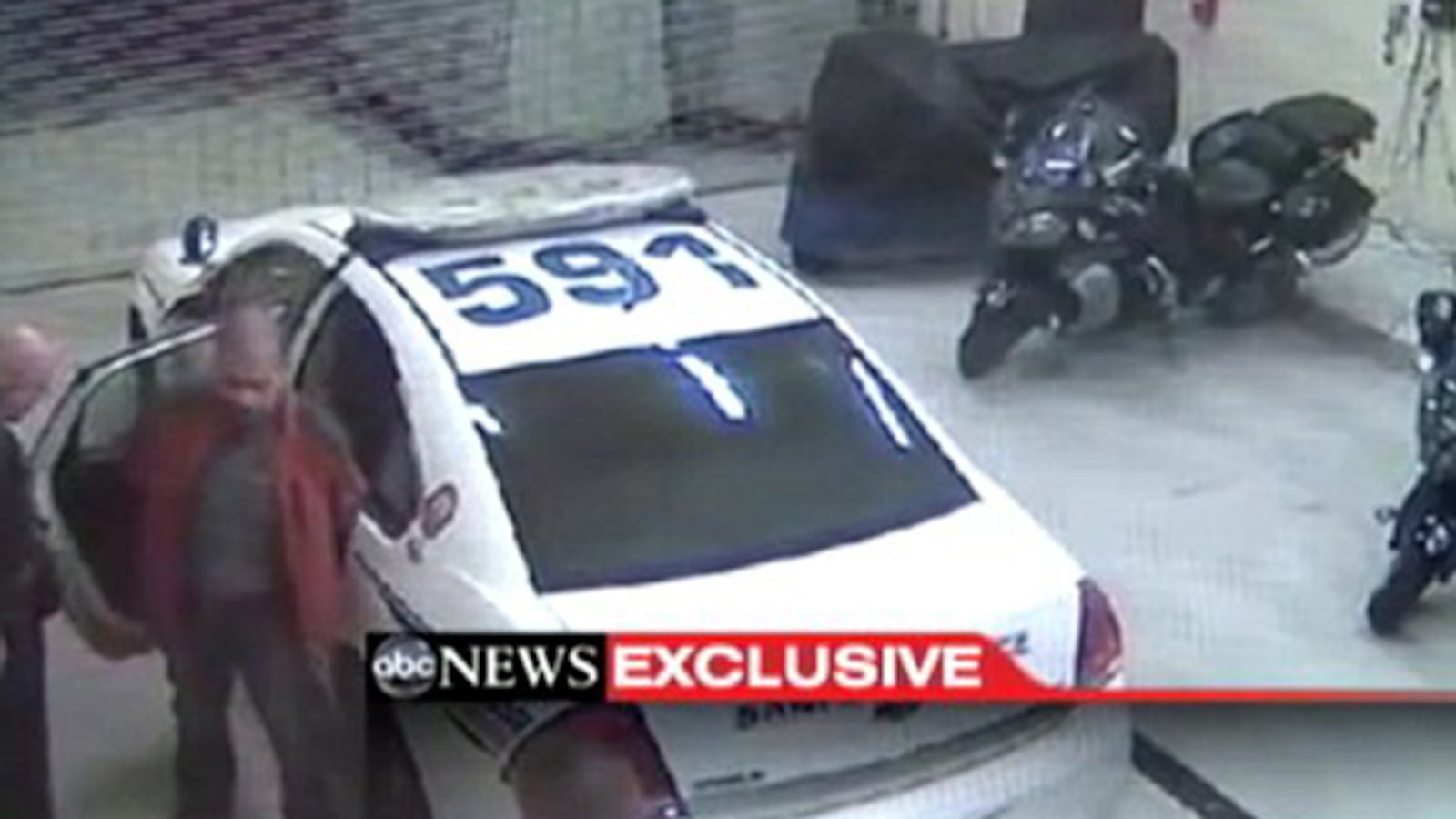
If the police video of George Zimmerman being taken into questioning shows what it appears to show, if Zimmerman really was devoid of the injuries that had been so feverishly and eagerly recounted by his defenders, then we have on our hands an absolutely catastrophic failure on the part of the media, and one of the most dramatic, devastating examples in recent memory of the Internet’s power to decide “the facts” long before anyone has a clue what they are.

In the eyes of many, the story about how Zimmerman came to shoot Florida teen Trayvon Martin had taken a sharp turn into Zimmerman-friendly territory this week. “With a single punch,” the Orlando Sentinel reported Monday, “Trayvon Martin decked the Neighborhood Watch volunteer who eventually shot and killed the unarmed 17-year-old, then Trayvon climbed on top of George Zimmerman and slammed his head into the sidewalk, leaving him bloody and battered, law-enforcement authorities told” the paper.
As Allison Samuels pointed out the next day, there were reasons to be skeptical of this account. Zimmerman’s call to 911 clearly revealed that he had been following Martin, and Martin’s girlfriend said she had been on the phone with him immediately prior to the incident, that she had encouraged Martin to run from the man following him, and that right before the shooting Martin had asked Zimmerman why he was being pursued. (Phone records obtained by ABC confirmed that Martin and his girlfriend had been talking right before the shooting.)
But none of these questions—which, it should be said, didn’t necessarily invalidate Zimmerman’s claims—mattered to the millions of people who had a eureka moment as they read the latest twist: of course Martin was the aggressor! They clicked eagerly, and soon a variety of ostensibly damning facts about Martin were racing around the Internet: not only the Sentinel story, but also Martin’s tweets (which show him to be guilty of nothing more serious than being a teenager) and reports that he had been found with trace amounts of marijuana and possibly stolen jewelry in his bag at school.
None of these facts had any bearing on the case at hand, of course, nor did they change what we know to be true (almost all of which comes from Zimmerman’s 911 call). But a sizable chunk of America reflexively decided that Zimmerman had defended himself against a dangerous, suspicious black teen, and they urgently spread the word. This wasn’t restricted to anonymous bomb throwers; the respectable right chimed in as well. Victor Davis Hanson, considered a conservative intellectual, wrote: “Martin is emerging not quite as a model pre-teen, Skittle-eating student with a slight truancy problem, but as a 6 foot 2 inch teen with troubled Twitter allusions to criminal activity, an obscene n-word Twitter ID, and suspensions entailing possible drug use and theft.”
Of course, that Zimmerman likely outweighed Martin by 50 pounds or more, or that the worst “criminal activity” alluded to in the Twitter account was smoking pot, or that a black teenager has a different relationship to the n-word than a middle-aged white pundit, or that Martin was not suspended for theft but for possessing trace amounts of marijuana didn’t matter. No. What mattered was that this version of events was so much more palatable and digestible than the notion that race had played a part in the death of an unarmed black teen (which is so...liberal). And that’s why the story festered and spread like a virus.
It’s a profound failure of our information environment, and it can be traced in part to a lack of skepticism. In retrospect, there was so little reason for the Zimmerman account to have changed anyone’s view of the case. Neither he nor the Sanford Police Department were disinterested observers. He, after all, was facing potential murder or manslaughter charges, and the department was shielding itself from a nationwide barrage of criticism for not arresting him.
But that’s the problem with the hyperconnected age: the Internet may not make us more prone to spreading or believing rumors, but it compounds the power of these tendencies exponentially.
We still, after all this noise, don’t have a good idea of exactly what happened immediately prior to the shooting. There are twists yet to come and questions yet to be answered. The official police report did, after all, say of Zimmerman that “his back appeared to be wet and was covered in grass, as if he had been laying on his back on the ground. Zimmerman was also bleeding from the nose and the back of the head.” The disconnect between this report and the footage screams for an explanation.
It seems like an impossible thing to ask for at this point, given how irresistible and politicized the lure of speculation has become, but a bit of humility is called for. Over and over, we find out that what we “know” isn’t really what we know. The answer is to shut up and wait until real-life, empirically verified facts—not the viral facsimiles that so easily take their place in moments of tragedy or confusion or racial panic—come in. But don’t hold your breath.