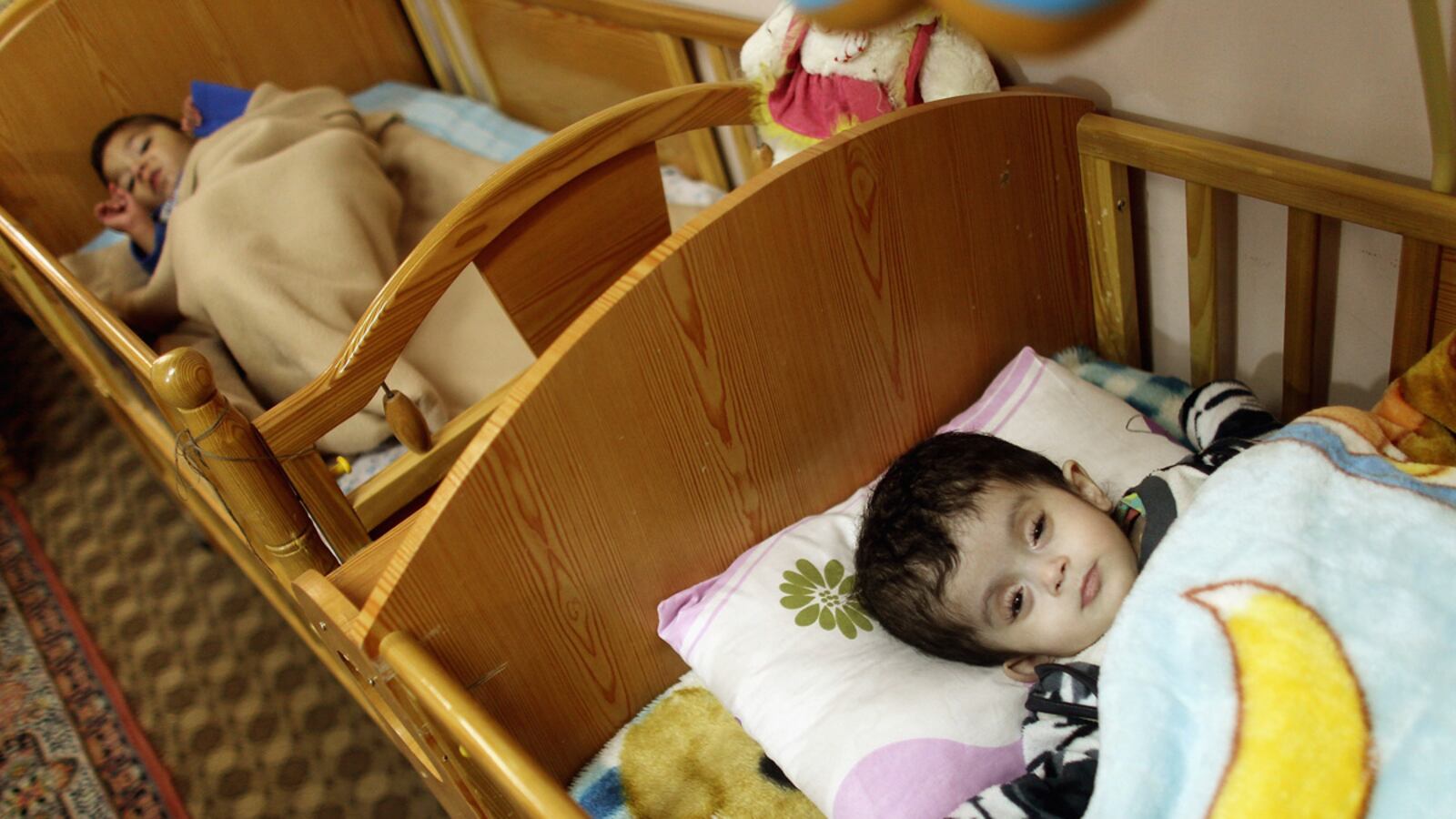
Two years ago, a 13-year-old Somali boy named Abdi was reportedly recruited to be a suicide bomber when he was an orphan. Last year, a Pakistani political leader, Jahanara Watto, penned a brutally honest piece in an English daily observing that most suicide bombers are orphans under age 17. Both stories followed a story in a London-based pan-Arab daily that quoted an Iraqi interior minister as saying al Qaeda was targeting orphans as future bombers.

These headlines underscore a troubling reality in our global Muslim community: we have abandoned our most vulnerable children—because of an antiquated, shortsighted, and regressive stricture that makes adoption illegal. There are a lot of excuses that are used to sanction a ban on adoption: that children shouldn’t lose their biological lineage and that, after hitting puberty, children would be taboo to their adopted parents. In Islam, there is a concept of maharam, or a relative with whom sexual intercourse would be considered incest. That includes parents, grandparents, uncles, aunts, nieces, nephews, children; "in-law maharam" is an accepted concept to cover parents in-law, children in-law, and stepchildren. Alas, mainstream Islamic interpretation hasn't included adopted children. Thus, the logic goes, it means a father could marry his adopted daughter.
This week, Islamic society moved into the 21st century with a slick little brochure by a New York-based advocacy group of Muslim women scholars called the Women’s Islamic Initiative in Spirituality and Equality, an effort of the American Society for Muslim Advancement's Muslim Women's Shura Council, organized to reexamine interpretations of Islamic law that directly affect women. A shura is a committee of scholars, alas, traditionally men. The headline on the pamphlet: “Adoption Is Supported by the Qur’an.” These women offer a new interpretation of the Islamic ruling, blessing "open adoptions," where adopted children know their biological family but are legally adopted.
The council, noting that the Prophet Muhammad was an orphan, supports adoption, citing a Quranic verse enjoining us to practice islah, or "to make better," the condition of orphans. It says: "And they ask you about orphans. Say: Making things right for them (islah) is better." (2:220) The women argue that adoption encourages “the protection and promotion of healthy minds.” Indeed. Perhaps it protects kids from becoming terrorists as well.
In the brochure, the Muslim women's group announced a partnership with a New York-based, nonprofit adoption agency, Spence-Chapin, that just launched a new venture for adoption of children from Morocco: "a pilot program for families of the Muslim faith." It’s also including single Muslim women as prospective parents in the program.
What this kind of new interpretation offers is a critically necessary social safety net within Muslim society. As a single Muslim mother to an only child—my son Shibli, age 9—I have investigated adoption possibilities in a Muslim country, such as Afghanistan, where so many orphans suffer, and have been sadly discouraged, as have many Muslim couples and single Muslim women, about the possibilities of lifting children out of orphanages into stable, loving homes. Most Muslim majority countries adopt the interpretation of Islam that makes it illegal to adopt a child; some allow fostercare or guardianship, known as kafala.
In All-American Muslim, the recently canned TLC reality show, a Muslim couple with fertility problems seeks advice an imam who advises them that they can't do invitro with sperm from another man. They didn't even go down the path of adoption.
Not all Muslims take such as a rigid stance as the imam. In one Muslim listserv, a member advises others to go ahead and adopt—but then, unable to make such a radical suggestion without a qualification, this person suggests not giving the children the family name. “Just don’t put your name on them,” the person advises.
But we are moving in the right direction. Watto, the Pakistani politician, last year wrote an article in a Pakistani English daily in support of orphanages, called Pakistan Sweet Homes, run by Pakistan Bait-ul-Maal, a government-run social-service organization, headed by the country's president and prime minister. She encouraged adoption of children from these homes, saying, “Let us work to save them from falling into malicious hands of terrorists. We want them to be highly educated and civilized citizens, rather than be brainwashed by any terrorist organization, becoming a source of trouble particularly for the society, our country and the world in general.”
As with so many contemporary societal challenges in the Muslim world, we must rise to the highest levels of reason, compassion and lovingness, helping our most vulnerable and indeed plucking them from the grasps of militants and giving them “Sweet Homes.”