
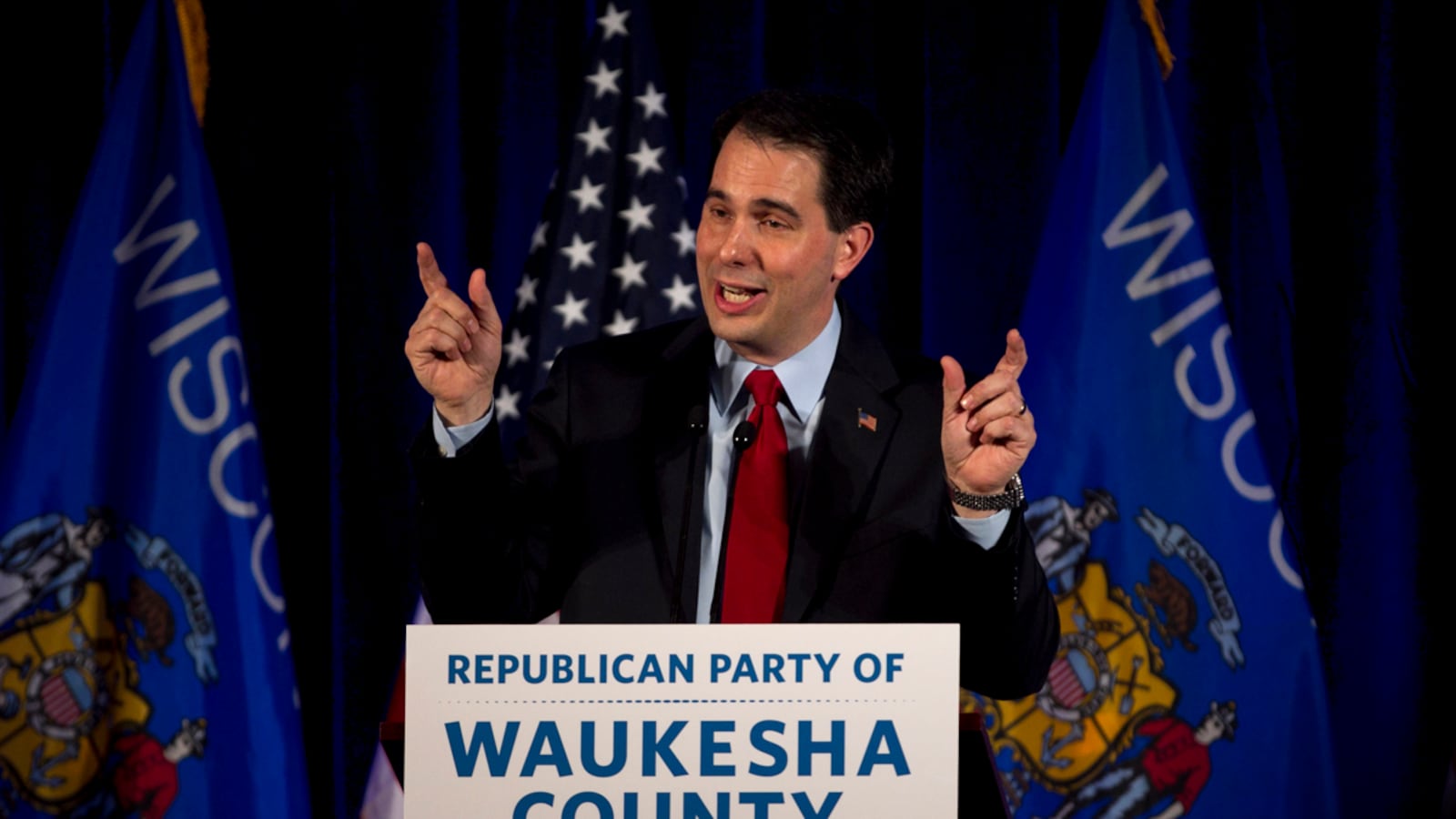
On Thursday, with little fanfare, Wisconsin governor Scott Walker signed a bill repealing the state’s 2009 Equal Pay Enforcement Act, which allowed victims of workplace discrimination to seek damages in state courts. In doing so, he demonstrated that our political battles over women’s rights aren’t just about sex and reproduction—they extend to every aspect of women’s lives.

“This whole session has been anti-woman and anti-middle class, and this fits right in with that agenda,” says Wisconsin state representative Christine Sinicki, a Democrat who co-authored the original legislation.
The Equal Pay law wasn’t just about women—it also offered protection from discrimination based on race, age, disability, religion, sexual orientation, and other factors. But it was enacted largely in response to a large gap between men and women’s compensation, one that was worse than average in Wisconsin—in 2009 the state ranked 36th in the country in terms of workplace gender parity.
Wisconsin’s law was similar to many others—indeed, almost every state in the country has anti-discrimination laws that augment federal legislation. “It’s often easier, faster, and cheaper to pursue a claim of discrimination in state court than in federal court,” says Linda Meric, national director of 9to5, an organization devoted to working-women’s issues. “The law is different in each state, but Wisconsin was certainly in the mainstream in having a law that provided remedies for employees who experienced discrimination on the job.”
To bring a suit under the law, a plaintiff first had to go through a state-level administrative process to prove discrimination. It was rigorous enough that in the two years the law was in effect, not a single equal-pay lawsuit was filed. Still, the law’s supporters believe it has been effective in spurring businesses to pay women more fairly. Thus by 2010, the state had climbed to 24th in the national gender-parity rankings, with women making 78 percent as much as men, compared to 77 percent nationally. “Since the law was put into place, employers actually took notice and were very conscious of the fact that they had to follow this law or they were at risk of a lawsuit,” Sinicki argues.
For the law’s critics, though, even the threat of lawsuits put an intolerable burden on business. “If tomorrow you woke up and some policeman is at your door giving you a summons for something, the fact that you’re innocent wouldn’t make you happy, because you have to show you’re innocent at some considerable time and expense,” says Republican state senator Glenn Grothman, a major driver of the repeal.
Grothman says companies are being bombarded with false accusations of discrimination. “It’s an underreported problem, but a huge number of discrimination claims are baseless,” he says. “Most of them are filed by fired employees, and really today almost anybody is a protected class.” As a result, he says, many companies are forced to pay fired employees to go away. He argues that the Wisconsin law, which allowed for damages of up to $300,000, the same amount as in federal law, raised the cost of doing business in the state to intolerable levels. “It just puts Wisconsin way out of whack with other states,” he says. “I’m not sure there are any other states this bad off.”
Actually, there are—according to data from 9to5, 33 other states have either no cap on damages or the same $300,000 cap as Wisconsin. Still, even if the law isn’t an outlier, it’s not surprising that Grothman would see it as unjust, because he believes that the whole idea of pay discrimination against women is fraudulent.
Whatever gaps exist, he insists, stem from women’s decision to prioritize childrearing over their careers. “Take a hypothetical husband and wife who are both lawyers,” he says. “But the husband is working 50 or 60 hours a week, going all out, making 200 grand a year. The woman takes time off, raises kids, is not go go go. Now they’re 50 years old. The husband is making 200 grand a year, the woman is making 40 grand a year. It wasn’t discrimination. There was a different sense of urgency in each person.”
He continues, “What you’ve got to look at, and Ann Coulter has looked at this, is you have to break it down by married and unmarried. Once you break it down by married and unmarried, the differential disappears.”
In fact, despite Coulter’s well-known expertise in the field, this is incorrect. A 2007 study by the American Association of University Women found that college-educated women earn only 80 percent as much as similarly educated men a year after graduation. Part of that is attributable to differences in life choices and family circumstances, but not all. “After accounting for college major, occupation, industry, sector, hours worked, workplace flexibility, experience, educational attainment, enrollment status, GPA, institution selectivity, age, race/ethnicity, region, marital status, and number of children, a 5 percent difference in the earnings of male and female college graduates one year after graduation was still unexplained,” it said. After 10 years in the workforce, there’s an unexplained 12 percent gap.
“The idea that pay discrimination is a myth is a myth in and of itself,” says Fatima Goss Graves, vice president for education and employment at the National Women’s Law Center. “Study after study has shown the exact opposite.”
Grothman doesn’t accept these studies. When I ran the numbers by him, he replied, “The American Association of University Women is a pretty liberal group.” Nor, he argued, does its conclusion take into account other factors, like “goals in life. You could argue that money is more important for men. I think a guy in their first job, maybe because they expect to be a breadwinner someday, may be a little more money-conscious. To attribute everything to a so-called bias in the workplace is just not true.”
Whatever you think of this perspective, it will now have a major impact on the futures of Wisconsin women. “Scott Walker and the Wisconsin state legislature are rolling back the clock on women’s rights, putting women’s economic security in greater jeopardy at the exact moment that they should be assisting women to get ahead in this tough economy,” says Meric.
As it happens, Republican National Committee Chairman Reince Priebus is from Wisconsin. He’s compared the notion of a war on women to a war on caterpillars. If he wants to know why some women have bought into this ostensibly preposterous idea, he might take a look at what’s going on at home.