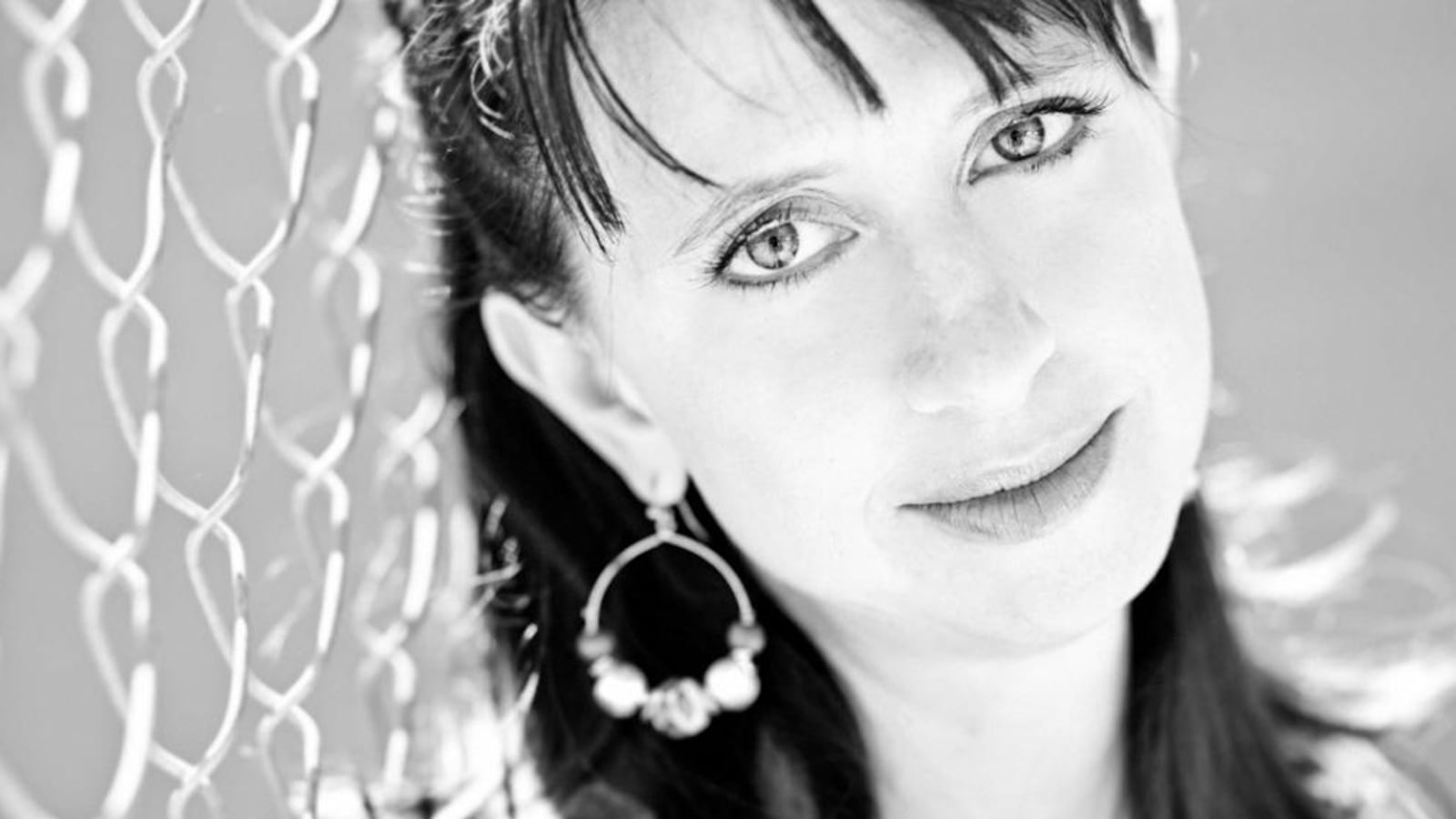
Lauren Myracle, a New York Times bestselling author, knows how to make parents mad. A series of her young-adult novels has topped this year’s annual list of “Most Challenged Books,” released by the American Library Association. In other words, these are the books that receive the most complaints at libraries and schools—the books people want to ban.
The Hunger Games is on the list (No. 3), as is To Kill a Mockingbird (No. 10). The reasons range from “offensive language” to “racism,” according to the American Library Association. Myracle, who has been called a modern-day Judy Blume, is at No. 1 with her Internet Girls series—three books written entirely in “instant-messaging” language. The books’ titles: ttyl, ttfn, and l8r, g8r. (Translation: Talk to Ya Later, Ta Ta for Now, and Later, Gator.) Critics say the books, which focus on a trio of high-school friends, are sexually explicit and offensive.
It’s not the first time Myracle (yes, that’s her real name, she says) has received top billing. The Internet Girls series also topped the list in 2009 (and took third place in 2008). Says Myracle, “If you’re gonna be on a list, you might as well be No. 1.” We asked her why she’s there.
The Internet Girls series is about three high-school girls who like to text each other about their troubles. What’s so controversial?
The books are about three dear friends, good girls who make bad decisions. The series is a testimony to the power of friendship—finding your tribe, having your friends’ backs. I think part of what makes people nervous is that the books are written in instant messaging. The knee-jerk reaction is that it’s different than adult language. Grown-ups see it as a kid version of “don’t look over my shoulder.” But the language is easy to figure out—my mom said the learning curve is about 10 pages.
Also, a lot of people of book-banning mentality think we should be very proper about grammar. There’s an initial barrier of “this does not look like literature to me.” And most people who challenge a book haven’t actually read it. If you’re skimming it, words jump out at you: “fuck,” “penis,” “condom.” It triggers a set of reflexes.
I understand why parents worry about books—they’re worried about their kids. They want to keep their kids safe. But parents aren’t always realistic. One said to me, “I can’t believe you introduced my 13-year-old daughter to thong underwear.” I’m pretty sure she knows about them already. She probably owns a pair.
What are the “bad decisions” the girls make in the books?
One girl goes to a college party when she’s still in high school. She gets drunk. She gets egged on to take her shirt off. Pictures get taken. I don’t write books to teach lessons, but if a girl can read a story like that and think, “Maybe I won’t take off my shirt at a frat party when people have phones there,” my work is done.
Another girl has a potty mouth. When you’re that age, language can be used for a shock factor, especially for girls—you’re trying to carve out your identity. You grow out of it.

The books don’t shy away from sex …
The books definitely deal with female sexuality. One girl gets a boyfriend not because there’s a true and deep connection but because she thinks she needs to have one. And another girl really does fall in love. She’s very religious, and she’s questioning whether she should have sex. She goes to Planned Parenthood and gets a prescription for the Pill. But when you start talking about girls and sexuality, there’s that old double standard. When guys talk about sex, eyebrows don’t get raised. It’s different for girls.
What do your critics tell you?
That I’m Satan. Or Satan’s handmaiden. One asked me, “Are you a pedophile?” Another said, “What’s the matter with you, lady? Your brain is sick. I hope you go to a mental hospital.” They say they’re taking my books to the dump, that they’re chasing the trash truck. In my very first reader review on Amazon—and it still lives on today—a reader talks about how, in a far-off age, when human civilization has crumbled and robot archaeologists are searching the rubble, they will find the lurid piece of trash that brought the world down—the book ttfn. And it will be “the first time a robot cries.”
Well, at least it’s a creative bad review.
It is! I sound glib about it now, but when I was first starting out, reactions like that surprised me. Reviews could really hurt my feelings. I was reviewed in journals that called me pedestrian. My editor told me, “The fact that you’re getting such extreme reactions shows that you’ve written something that matters.”
Your most recent book, Shine, takes on some tough topics—a hate crime against a gay teen, a town where the locals do crystal meth, a girl who was sexually assaulted.
Yes, in that book, a 16-year-old girl named Cat is living in poverty. Cat’s daddy is an alcoholic. He lives in a trailer outside the house. Her mom is dead. The novel is about her onetime best friend, Patrick, who is 17 and openly gay. It’s a small town, and it takes a lot of guts to be openly gay there. He has the confidence to do so because his grandma tells him, “You have a light inside you.” The novel opens with Patrick being beaten, left to die, with a gas nozzle shoved down his throat and a sign saying, “Suck this, faggot.”
That’s pretty brutal. What inspired the story?
I’m always drawn to the underdogs, to the people whose stories don’t get told. When people think of poverty, they think of inner cities, but it’s everywhere. I grew up in North Carolina; I saw some real poverty. My dad grew up in poverty—the son of cotton farmers. The girls in this book wear overalls with a shirt on top, to try to make it look like they’re wearing jeans. So that’s one piece of what it’s about. Also, when I first moved to Colorado, Matthew Shepard, the teenage boy who was the victim of a hate crime, was brought here for treatment. I saw some horrible and also some beautiful things surrounding that.
Wall Street Journal writer Meghan Cox Gurdon said last year that teen literature has become too dark and depraved—too much rape, incest, violence. One of the books she cited, Scars, is about a girl who cuts herself. What’s your take?
I think she looked at a very small sampling of books. I think she herself was sensationalizing. For a girl who is cutting herself, to be able to read something like that and think, “I’m not alone,” what bigger gift can you give someone? Soon after Shine came out, I got an anonymous email. It said, “I’m a gay teen in North Carolina. I want to thank you for Shine. Without it, I would not be alive today.” I know being a teen is a time of high drama, but that really meant something to me.
I remember going to a library once in Ohio. They had invited me, telling me, “We’d love to have you talk here.” But when I got there, a librarian said, “We don’t have your dirty books on display here.” I didn’t want to get into a fight, but I thought, “You should serve your population—kids have different needs.” I asked if they had a book called Thirteen Reasons Why, about a girl who commits suicide. She said, “Heavens no! It’s pro-suicide.” But it’s the opposite. The book shows how horrible it is for everyone when you take your life.
Kids are smart. Knowledge is power. Let them figure things out. Don’t turn into that grown-up who they won’t come to.
Last year the National Book Awards made a mistake and announced that your book Shine was a finalist—then took it back and said there had been a mistake. The finalist was another book, called Chime. That must have been shocking.
Yes, at the time, I felt like my heart was being ripped out. I had to tell my parents that I wasn’t really a finalist. It reminded me that even at 42, there are lessons to be learned. I thought, I have my friends; I have my family—I can deal with a little humiliation. But something good came out of it: the National Book Foundation donated $5,000 to the Matthew Shepard Foundation.
You must have a blizzard of fan mail from girls.
My books really do resonate with girls. One said, “I’ve never had a big sister, but now I feel like I do.” I get about a hundred emails a day, and most of them are like that. They’re filled with emoticons. I have some ongoing relationships with some of my readers. Only about 10 emails a week tell me that I’m Satan’s handmaiden. The people who write those hateful notes, if they sat down and had coffee with me, we’d probably do OK. I have three kids—a 13-year-old son, an 11-year-old son, and a 7-year-old daughter.
What do your kids read?
My 13-year-old is reading Steve Martin. My 11-year-old, my purple-haired skater boy, is reading The Hunger Games—another book people want to ban. My daughter is in a picture-book phase. As a mom, I want my kids to read any fucking book they want! I want them to read.