
When they talk about their commitment to reforming the way the military handles cases of sexual assault within its ranks, Representatives Niki Tsongas and Michael Turner often cite specific stories that rallied them to the cause. For Tsongas, it was the nurse who had served multiple tours in Iraq and Afghanistan, but who told the Massachusetts Democrat that she was more afraid of her fellow soldiers than she was of the enemy. For Turner, it was the case of Maria Lauterbach, a 20-year-old Marine who was killed by the man she had accused of raping her, and buried in his back yard.

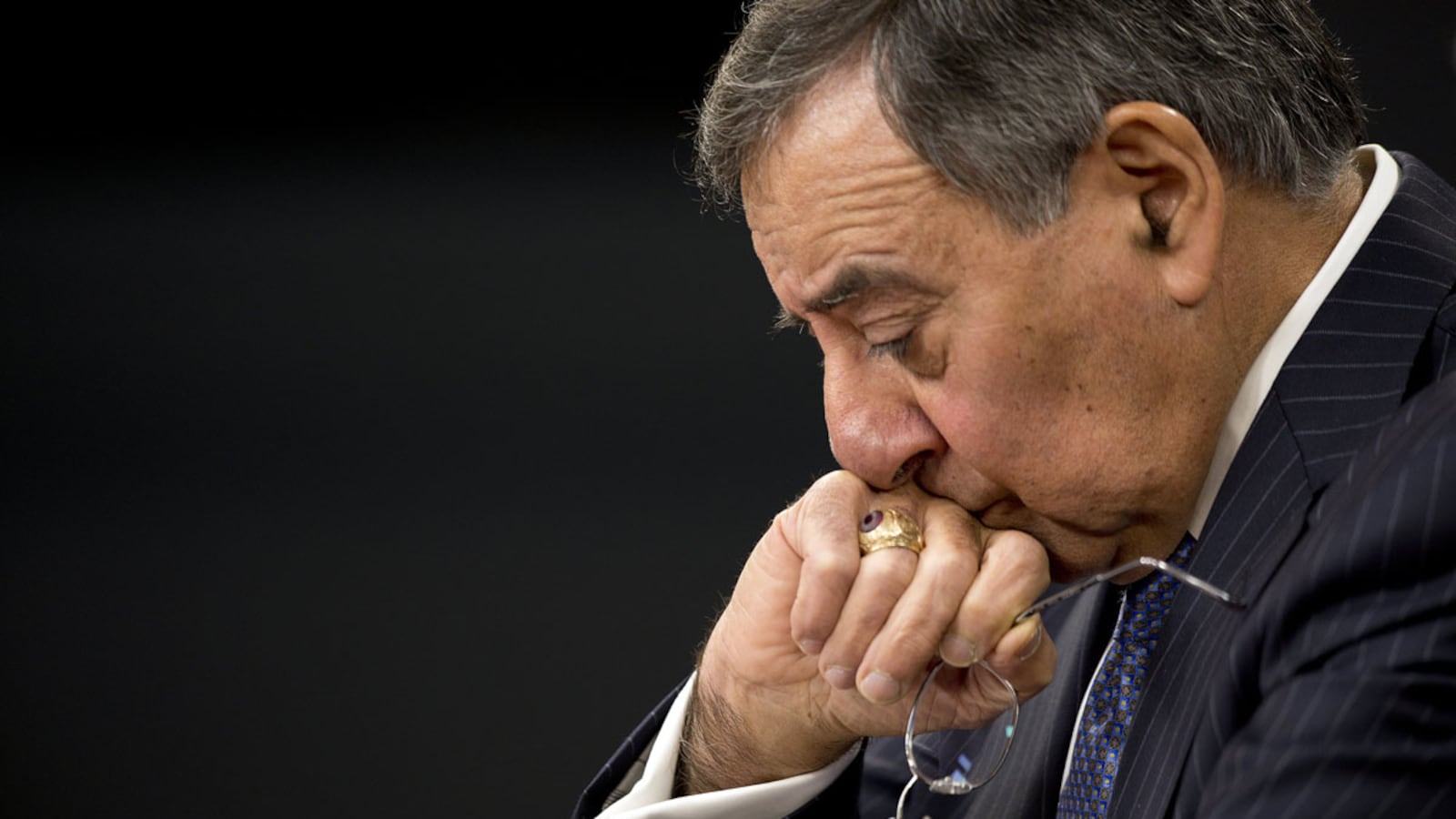
Since assuming office as the secretary of defense last July, Leon Panetta has been inundated with stories such as these. In February, Tsongas and Turner were among a bipartisan group of senators and representatives who hosted a special congressional screening of The Invisible War, a documentary about military sexual assault that won this year’s audience award at the Sundance Film Festival. And just weeks later, Panetta, along with former defense secretaries Robert Gates and Donald Rumsfeld, was named in a lawsuit holding them accountable for an environment in which rape is rampant and victims are subject to retaliation.
On Monday, all these efforts appeared to pay off. That evening, Panetta made what the congresspersons deemed an “unprecedented” visit to Capitol Hill, where he met with Turner, Tsongas, and Rep. Loretta Sanchez of California, and then appeared alongside them and chairman of the Joint Chiefs of Staff Gen. Martin Dempsey. Panetta announced a slew of changes to current military policy, ones that will, he promised, “fundamentally change the way the department deals with this problem.”
The announcement came just days after the release of the Pentagon's most recent annual report outlining the number of sexual assaults reported within the military last year. In 2011, 3,192 assaults were reported, up 1 percent from the previous year. According to the Defense Department's own estimate, just 15 percent of actual incidents are reported, putting the real number at some 19,000 assaults each year. But as survivors and their advocates say again and again, when it comes to rape within the ranks, the attacks themselves are just the tip of the iceberg: more damaging is the way they’re handled. Under current policy, reports of sexual assault are handled directly within the military’s chain of command. Young, inexperienced service members are tasked with handling delicate and complex crimes, and often they know both the victim and the perpetrator personally. The result: cases rarely are prosecuted. According to last week's report, nearly 70 percent of substantiated, “actionable” cases did not go to trial because of lower-level command discretion.
The most significant change is also the one that will be implemented the most quickly. Citing the fact that under the current policy, assault claims frequently are swept under the rug, Panetta announced that he planned to issue a directive requiring local commanders to immediately hand over investigations to an outside, higher-ranking colonel. The new policies also will establish Special Victim’s Units within each arm of the forces, so that cases will be handled by investigators and prosecutors who are specifically trained in sexual assaults; require that sex assault policies are explained to incoming service members within 14 days of reporting to duty; and establish a centrally located record of disciplinary and administrative outcomes related to every assault.
“There is no silver bullet when it comes to this issue,” Panetta told reporters on Monday. “But what is required is that everyone, from the secretary to the chair of the Joint Chiefs all the way down at every command level, be sensitive to this issue, and be aware that they bear the responsibility to take action on these cases. The most important thing we can do is prosecute the offenders.
“If we can do that, then we can begin to deal with this issue, to not only prosecute those that are involved but, more importantly, send a signal that this is not a problem that we are going to ignore in the U.S. military.”
It was a message that advocates and lawmakers had fought long and hard for. “This is hugely radical, and extremely necessary for the military,” Anu Bhagwati, a former Marine captain and the current executive director of the Service Women’s Action Network, told The Daily Beast. Her organization has been working on the issue since its founding, and is a close monitor—and frequent critic—of the Defense Department’s efforts at reform, which, she says, often amount to little more than pomp and circumstance.
Bhagwati cites the Sexual Assault Prevention and Response Office as a prime example. Established under pressure from Congress, SAPRO has had virtually no authority over how assaults are handled, and has done little more, critics say, than compile annual reports and release misguided public-service campaigns. Their most recent report, released Friday, revealed that the military had allowed 36 percent of convicted sex offenders to stay in the armed forces, and, in the two years prior, had allowed another one 10th of them to resign and consequently avoid trial. One of Panetta’s first acts as defense secretary was to replace its civilian leader with a two-star general. Though it still falls short of providing the civil remedies Bhagwati believes will make the real difference, Monday’s emphasis on prosecution and punishment is, she says, a truly encouraging step. “Yes, policy changes alone are not going to radically change the military climate,” she says. “But for the secretary of defense to put the focus on punishment? That’s huge.”
Representatives Tsongas and Turner were equally enthusiastic about Panetta’s apparent commitment to the issue. Before his tenure, efforts at reform had fallen largely on deaf ears, with Department of Defense officials “either unaware of the issue or unconvinced that any action needed to be taken,” Turner told reporters in a conference call on Tuesday. “I just want to applaud his leadership.”
Turner’s and Tsongas’s efforts were further bolstered by the presence of General Dempsey, who acknowledged that the military has thus far been unable to make progress at curtailing what many have deemed an “epidemic” of sexual assaults within the ranks, and who pledged to work together with the secretary of defense and the congressional caucus. “We realize the crime of sexual assault erodes the very fabric of our profession,” he said, noting that he was speaking not just for himself, but on behalf of all the Joint Chiefs. “It’s based on trust, and this particular crime erodes that trust.”