
Content Section

Brazil’s Strong Stance on Women’s Rights

Women’s Affairs Minister Eleonora Menicucci is at the forefront of the fight to end violence against women. Julia E. Sweig meets a woman obsessed.

A 2010 photograph of a dozen women surrounding a newly inaugurated president might well depict the local chapter of the League of Women Voters. But these 60-somethings share more than the bonds of suffrage. They share a history of suffering and survival: they are the women whom the Brazilian military in the 1970s jailed and tortured at São Paulo’s Tiradentes prison along with their friend, comrade, and now president of the world’s sixth-largest economy, Brazil’s Dilma Rousseff.

Brazil

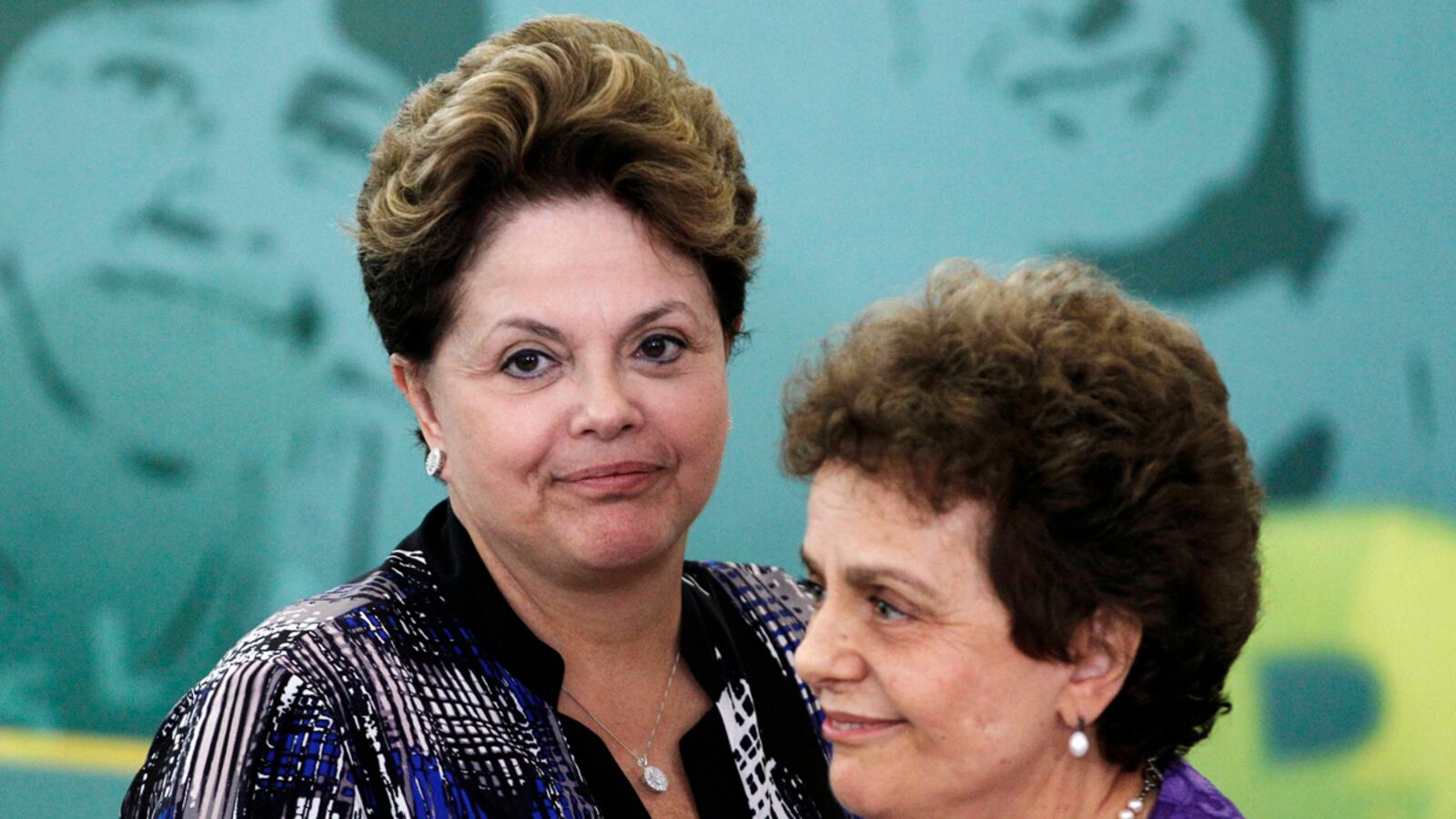
Brazil's President Dilma Rousseff, left, greets Eleonora Menicucci during her inauguration as Chief of the Secretariat of Policies for Women in Brasilia, Brazil on Feb. 10, 2012. (Ueslei Marcelino, Reuters / Landov)

Standing at the center of the beaming group is a curly-haired woman in a purple silk blouse, a lifelong women’s-rights advocate and activist, once a member of Brazil’s Communist Party, and now the cabinet member and minister who leads President Rousseff’s Secretariat for Women’s Affairs: Eleonora Menicucci. Recently dean of her faculty at the University of São Paulo, she talks with the authority of a professor, has the expertise of a world-class political scientist (her research on women’s health is highly respected), and conveys the savvy of a political activist who’s seen it all. Menicucci is a lifelong feminist. She now runs a ministry in Brasília whose top priority she describes as an “obsession” of hers and President Rousseff’s: ending violence against women.

I met Minister Menicucci during her recent visit to Washington for a meeting of the Inter-American Commission of Women at the Organization of American States (OAS). That same week, the U.S. Congress had taken up reauthorization of the 1994 Violence Against Women Act, a law once supported by bipartisan majorities but that today’s GOP leadership is angling to defund.

So it was not without a bit of envy that I listened to Minister Menicucci extol what she described as a “historically unique” sign of the “maturity of Brazilian democracy” when in 2010, more than 56 million Brazilians elected their first woman president. What’s more, President Rousseff’s commitment to gender equality seems to go well beyond her appointment of 10 women as members of her cabinet.

Building on her predecessor’s legacy, President Rousseff has channeled substantial political and financial resources into the implementation of the Maria da Penha law. Enacted in 2006, the law is named after a pharmacist whose husband subjected her on a daily basis to what can only be described as torture—assault with a deadly weapon, electric shock, suffocation—ultimately leaving her a paraplegic. Brazil’s legal protections for victims of domestic violence were at the time so porous that da Penha’s judicial efforts against her aggressor languished in court for 19 years. The final judgment sent him to jail for just two years.

While Dilma Rousseff was serving as President Luiz Inácio Lula de Silva’s chief of staff and principal domestic policy guru, Maria da Penha filed a complaint with the Inter-American Court of Human Rights, and with Lula and Rousseff’s championship the Brazilian Congress passed what the United Nations and a host of legal experts describe as the most robust and comprehensive domestic-violence law in the world. The law establishes a municipal, state, and national web of courts, shelters, police training, and health-care facilities to prevent and prosecute violence against women and girls. One unique aspect: it gives legal standing to claims made anonymously against perpetrators, as a further way to protect victims and clear a path to justice.

Her husband subjected her on a daily basis to what can only be described as torture—assault with a deadly weapon, electric shock, suffocation—ultimately leaving her a paraplegic.

President Dilma and Minister Menicucci’s gender-equality portfolio goes well beyond stopping violence against women. It encompasses health, especially maternal, pre-, post-, and neo-natal care, including an effort to reach diverse populations, vis-à-vis race, class ethnicity, and sexual diversity. It includes equal pay, or what the minister calls “economic autonomy,” wage protection for women working in private- and public-sector jobs, and a major push to formalize job protections for domestic workers.

But in our discussion, Minister Menicucci repeatedly returned to the inroads she hopes to make into changing a culture that tolerates violence against women. Four decades ago the women who now lead Brazil cut their political teeth in clandestine movements to overthrow Brazil’s military regime. They have clearly decided that the best revenge against their own torturers, those who abused state power literally to break them, is to use the tools of democratic government they now lead to create the legal and institutional framework for justice for all Brazilian women, especially victims of sexual, physical, and psychological violence.

Despite widespread access to contraception, abortion rights remain limited in Brazil, the largest Catholic country in the world, and one that also boasts a growing and politically powerful evangelical church. But the next time some American foreign-policy pontificator berates President Rousseff for not taking a strong enough position on human rights, I suggest taking a look at the example Brazil is setting for girls and women worldwide.

You Might Also Like

2013 Women in the World Speakers

2013 Women in the World Speakers

Inspiring women from around the globe will convene in April for the 2013 Women in the World Summit. See who’s coming!

International Women's Day

Through Her Lens

Through Her Lens

From invisible Iranians to dealing with an overweight body, see works from female photographers to watch.

FINANCIAL INCLUSION

Turning Poor Kids Into Savers

Women in the World

How to End Violence Against Women

Secret Weapon

The Woman Behind ‘Girls’

Women’s Advocate

Climate Change’s Gender Gap

Women in the World: It’s On!

Women in the World: It’s On!

Newsweek and The Daily Beast are excited to announce the 2013 Women in the World Summit on April 4 and 5. Get your tickets today.

Why I Choose to Be Child-Free

Why I Choose to Be Child-Free

DINKs, DILDOs, and other readers respond to Joel Kotkin and Harry Siegel’s Newsweek story about America's declining birthrate and share their reasons for remaining child-free.

Beyond Betty Friedan

Beyond Betty Friedan

Gail Sheehy looks at the new, strategic feminism, as PBS prepares to air the documentary ‘Makers: Women Who Make America’ tonight.

‘We Were Really Naïve’

‘We Were Really Naïve’

The mother of a domestic abuse victim speaks out

The Next Women’s Ambassador

The Next Women’s Ambassador

As Melanne Verveer departs, who could be Obama’s new champion for women and girls? By Katie Baker.

Robin Roberts to Be Honored at DVF Awards

Diane von Furstenberg joins GMA's Robin Roberts to talk about the annual DVF Awards and reveals the courageous anchor will be honored at this year's event on April 5th.

  1. Welcome Back, Robin! Play

    Welcome Back, Robin!

  2. Mobama: Bangs Are 'My Midlife Crisis' Play

    Mobama: Bangs Are 'My Midlife Crisis'

  3. R.I.P. Mindy McCready Play

    R.I.P. Mindy McCready

The Plus-Size Blogging Craze

The Plus-Size Blogging Craze

“Fatshion” is a popular community on Tumblr, where plus-size bloggers post pictures of themselves as a way of celebrating their size. Judy McGuire reports.

The Power in ‘Girl Rising’

The Power in ‘Girl Rising’

The film, which will be released March 7, advocates for the education of girls around the world. Eliza Shapiro reports.

‘Feminine Mystique’ at 50

‘Feminine Mystique’ at 50

Three feminists from different generations revisit Friedan’s classic. By Jessica Bennett, Letty Cottin Pogrebin, and Alisa Solomon.

Breastfeeding Wins Another Round

Breastfeeding Wins Another Round

A new CDC study is just the latest news to buoy the pro-breastfeeding camp, reports Eliza Shapiro.

The Book China Hates

The Book China Hates

Ping Fu talks to Katie Baker about the online backlash to her new memoir, ‘Bend, Not Break.’

The World After Hillary

The World After Hillary

She changed the game irrevocably, and now she’s about to transform it again—by walking away. Plus, read the full transcript of her farewell speech.

Malala Speaks!

Malala Speaks!

Tina Brown and Angelina Jolie announce gathering strength for an education fund in her honor.

women-in-the-world-foundation

Calling Out Victoria’s Secret

Calling Out Victoria’s Secret

How two women’s online plea is pushing the lingerie giant to the ‘survivor bra’ market. By Nina Strochlic.

Taking Stock

Roe v. Wade Turns 40

Interactive: The Geography of Abortion Access

Interactive: The Geography of Abortion Access

See locations of the country’s 724 clinics and distance to the closest clinic in different areas. By Michael Keller and Allison Yarrow.

STARTING OVER

Ground Zero of the Abortion War

Word Play

Call It By Its Name: Abortion

Roe v. Wade

Readers Share Their Abortion Stories

A Day in the Life

Inside an Oklahoma Abortion Clinic

Why Investing in Women Works

Why Investing in Women Works

When companies support women, write Melanne Verveer and Kim Azzarelli, their businesses and communities win.

Way to Go, Panetta!

Women on the Frontlines

The Female Fighter I Knew

The Female Fighter I Knew

Veteran Anthony Woods recalls a brave lieutenant who lost her life in Afghanistan.

Military Progress

Fully Integrated, Finally

WOMEN IN COMBAT

Bravery and Beauty

The Sperm Donor Trap

The Sperm Donor Trap

After gifting his DNA via Craigslist, a Kansas man may be on the hook for $6,000 in child support. Fair?

witw-1200-800-tease

150 Women Who Shake the World

They're starting revolutions, opening schools, and fostering a brave new generation. From Detroit to Kabul, these women are making their voices heard.