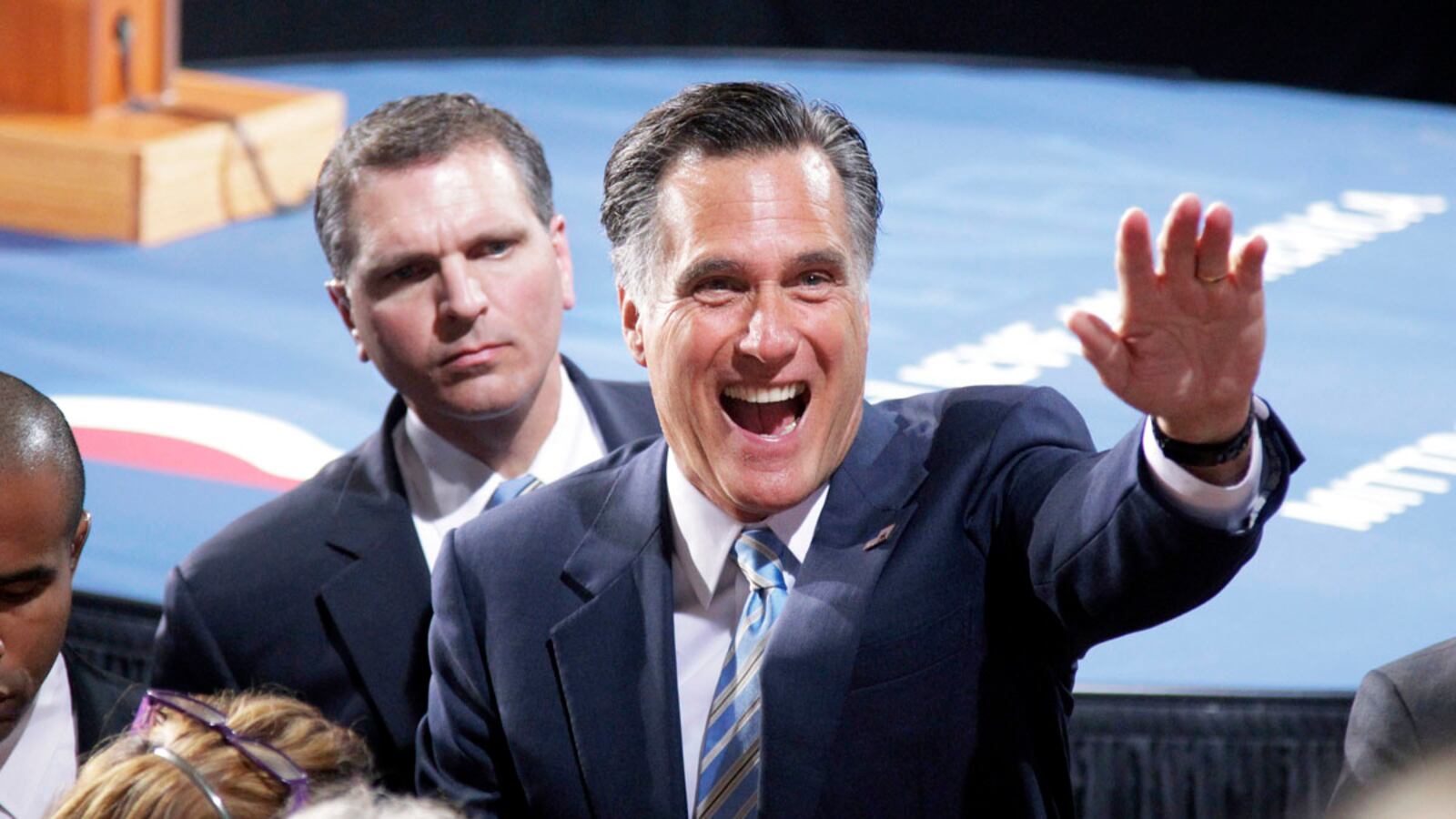
It has all the trappings of a big election night: five primaries, live television coverage, pundits telling us what it all means.
But what if it doesn’t mean squat?
Let’s face it: the GOP presidential race ended weeks ago. You know it, I know it, and every working journalist knows it. Maybe not Newt, but most other sentient beings. If this were a boxing match, the refs would have stopped it long ago.
So why cover contests with about as much excitement as a Politburo election?
There was a time, of course, when this particular Tuesday loomed large on the calendar. Could Rick Santorum win his home state of Pennsylvania? But then Santorum dropped out, leaving Mitt Romney a clear path to the prize.
So those of us who cover politics are left with thin gruel indeed: What would Romney’s margins be in what proved to be a five-state sweep? Would there be a protest vote? How does Mitt do in key counties he’ll need in the fall?
If there was a frisson of drama, it came when Gingrich spoke after Romney was projected to win Delaware. There was some press buzz that Newt, who spent time there, might stay in the race if he carried the tiny state, even though that would have made absolutely no difference in the inevitable outcome. (Nice going, gang, Newt was buried by 30 points.) And Santorum indeed lost Pennsylvania, but then again, he is no longer an active candidate.
Fox and CNN carried Romney’s speech; MSNBC blew it off, with Ed Schultz attacking Sean Hannity instead.
Piers Morgan tried hard to prod Santorum into endorsing Romney, but he wouldn't quite go there, saying the two were going to meet first. So real news was averted once again.
We can’t just call off the remaining primaries: all those congressional and local candidates need to be nominated. And even at the presidential level, the voting often determines which delegates go to the conventions. But that’s inside baseball. We already know the final score.
The cable coverage has been somewhat restrained compared with, say, the night of the Iowa caucuses. In the 8 p.m. hour, Fox stayed with a taped Bill O’Reilly show (with occasional live cut-ins). Schultz didn’t pause during an interview, even as MSNBC threw up a breaking-news banner projecting Romney the winner in Connecticut and Rhode Island. When I first saw John King hit CNN’s Magic Wall, he was counting how the candidates could get to 270. Mitt didn’t even bother to show up in any of the five states, spending the day instead in New Hampshire.
The truth is that journalists switched to general-election mode even while the primaries were still competitive. As a Project for Excellence in Journalism study noted this week, the media essentially pronounced the race over after Romney won the Michigan primary on Feb. 28, even though Santorum would go on to win several more states.
This sort of thing has happened before. Jerry Brown won a couple of late primaries in 1992, after it was obvious that Bill Clinton would be the nominee, but nobody took it very seriously.
So perhaps the events of Tuesday were more of a time-out from the endless general-election slog, a last look back at a crazy season stretching back to Donald Trump and Herman Cain. That is, until the crucial North Carolina primary on May 8.