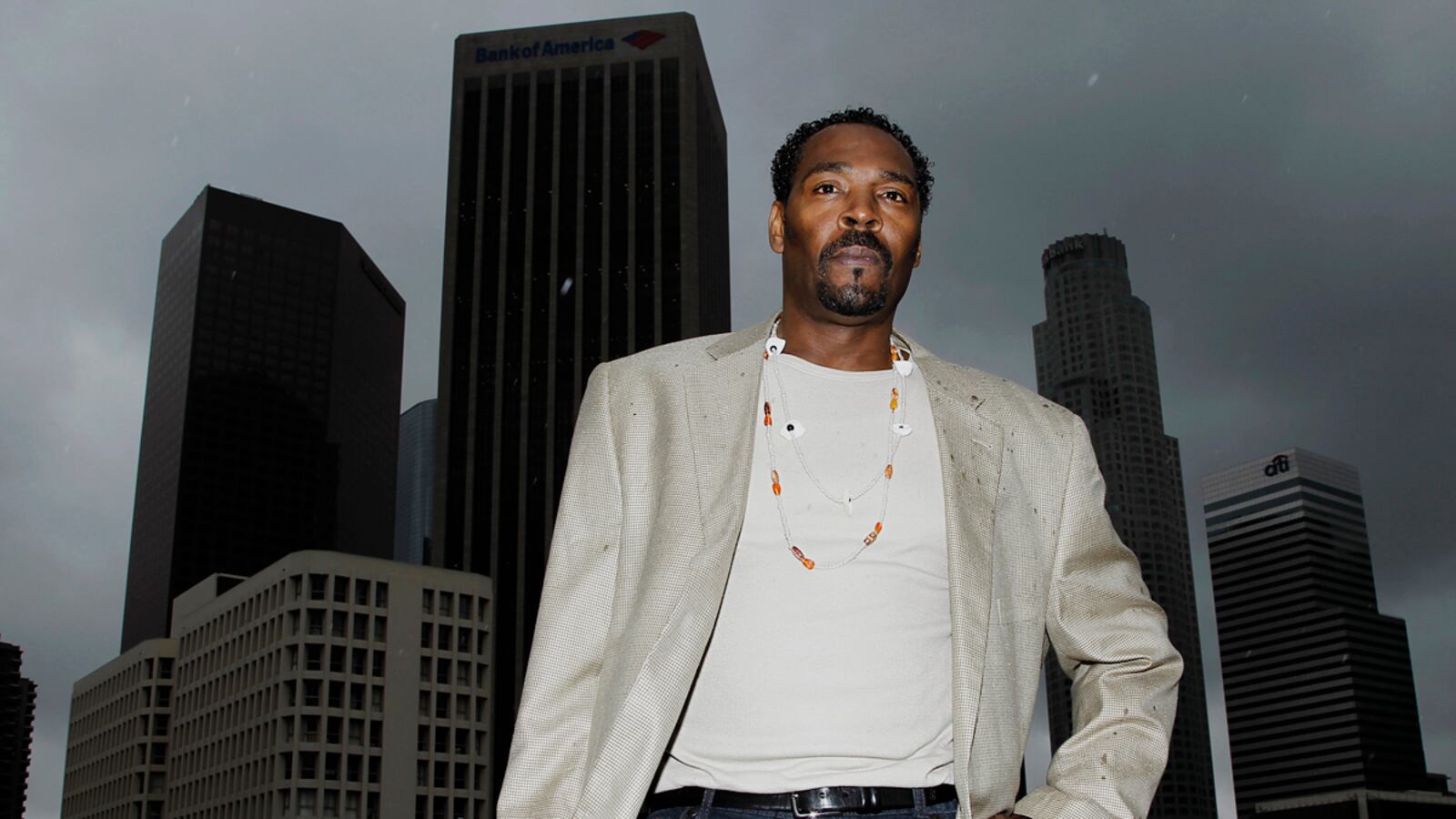
Anger is something Rodney King prefers to keep at bay. The 47-year-old victim of one of the most notorious police-brutality cases says he’s made peace with the incident that changed his life, as well as the lives of so many others, on May 3, 1991.

King’s beating by Los Angeles Police Department officers after being stopped for speeding and reckless driving set the stage for one of the worst race riots in the nation’s history. The severity of the videotaped beating, and the reaction to it, continue to have a profound impact some 20 years later.
“I obviously still think about that night,’’ said King, who had been drinking prior to his arrest. “I still have some pretty bad headaches from that beating. But I don’t let anger take over when the pain comes. It doesn’t help anything.’’ Due to his brain injuries, King easily loses his train of thought mid-conversation. It’s a consequence of the beating that clearly embarrasses and frustrates him at times.
King credits the biblical teachings of his mother Odessa for his attitude of forgiveness toward the four police officers who used their feet and batons to beat him repeatedly after he and two others were pulled over that night. An innocent bystander caught the beating on tape, and its eventual release to the media caused nationwide shock and anger.
King says he received years of physical therapy for the brain injuries he suffered during the incident. He’s also received years of emotional therapy, to cope with being thrust into the national spotlight as the modern-day symbol of the relentless pain caused by continued racism.
“I can remember one of the officers kicking me in the head and saying 'n----r’ again and again,’’ King says. “That’s something you can’t forget, particularly today when so many similar things seem to be happening.’’
Of the four officers caught on tape beating King, three were found not guilty of the charges, while the jury was deadlocked on charges against the fourth officer. News of the acquittals led to the riots of April 1992, and by the end of the uprising, more than 50 people were dead and the city of Los Angeles had suffered more than a billion dollars in damages.
King recounts much of that sad history, and the ups-and-downs of his life afterward, in the VH1 documentary “Uprising: Hip Hop and the L.A. Riots,’’ set to commemorate the 20th anniversary of the event. He has also just written a memoir, The Riot Within: My Journey From Rebellion to Redemption. "I wrote the book for my kids who didn't hear the whole story. They kinda know what happened to me back then but not the entire story. I feel the rest of the country is the same way," says King, who married a juror he met during his civil trial against the city, and has two daughters and two grandkids.
King doesn’t shy away from owning up to his well-documented missteps and run-ins with the law, both prior to and after the infamous beating. King was arrested in 1989 for robbing a store and again in 1993 for driving under the influence and crashing his car into a wall. Awarded $3.8 million in his civil case, King opened a rap label, but it folded a few years later.
“It’s been tough on some level to get myself to where I wanted to be or where I needed to be as a black man in this country,’’ King says. “You feel like you’re always fighting for something or trying to run away from something or people’s attitudes towards you. That can wear you down to the point of always making bad decisions.’’
King says race relations continue to disappointment him some 20 years after his life-altering moment on the national stage. "Black people have had it tough. My daddy was from the South and told me about the way things were in his day. Can't say I think much has changed since then, but I have to stay positive to keep going. I can't get down like that," King says.
King quickly points to the recent shooting death of Trayvon Martin as evidence of the pain and trauma African-American males still face in this country on a regular basis. He recently told several news outlets that hearing Martin’s screams on the tape from the night he was killed reminded him of his own screams 20 years ago. Florida police say they are still uncertain whose voice is on the recording from that night.
King says he’s hesitant to comment more on the Martin case after receiving criticism for implying the two incidents were the same. Whereas King was speeding and driving under the influence the night he was beaten, the teenage Martin was apparently breaking no law as he walked inside a gated community with iced tea and Skittles.
“I don’t want to say the wrong thing,’’ King says. “I was asked about that young guy that was killed, and it did remind me of my situation and the unfairness black people face all the time. I get tired of seeing it. Whatever I did, I didn’t deserve to be beaten like I was, and that young boy didn’t deserve to be killed for doing nothing. Wrong is wrong.’’