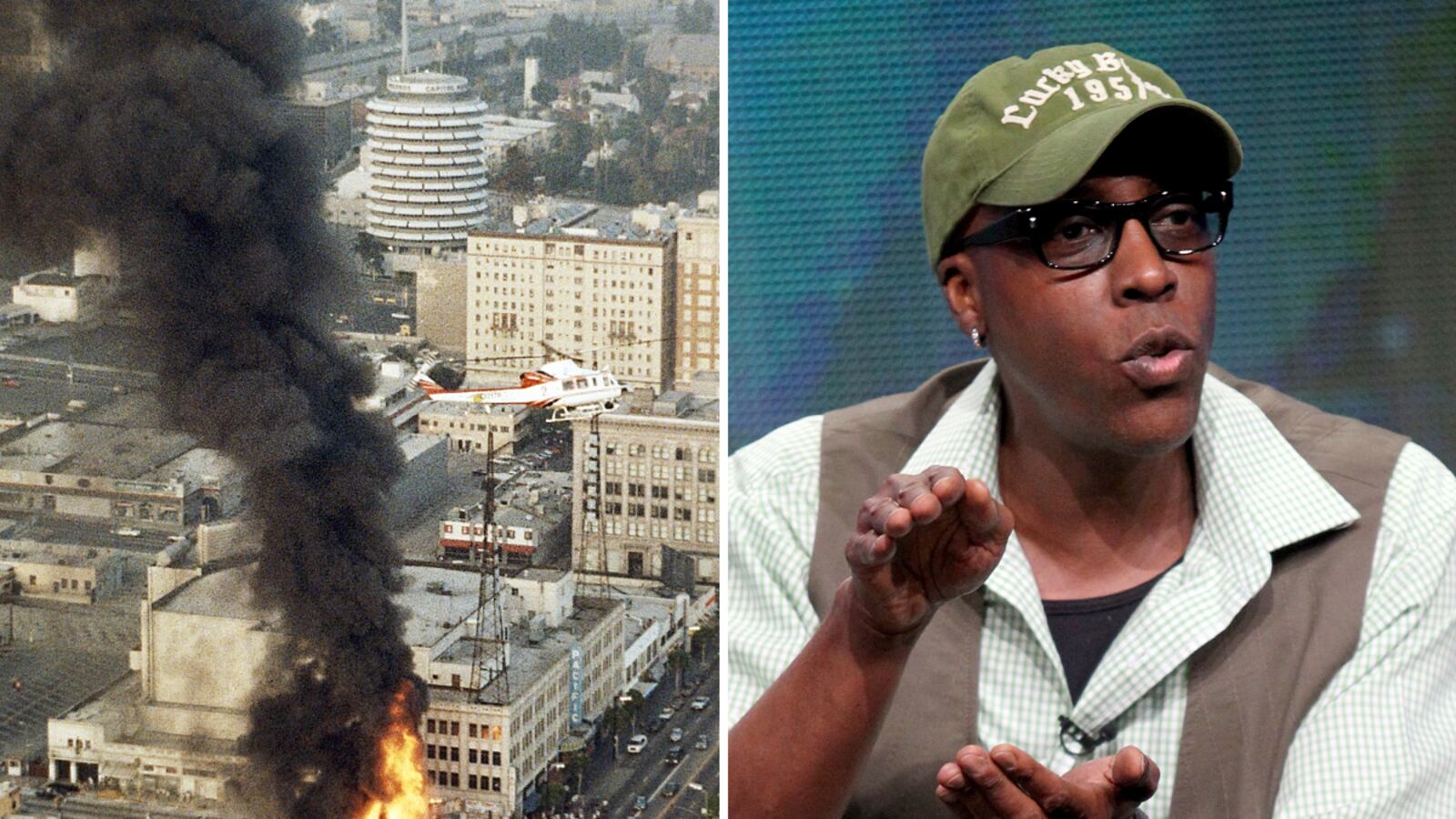
When VH1 first asked me to participate in their special documentary on the Los Angeles Riots, I said no. I didn’t think I had the memory needed to offer anything of note about it, so why waste their time?
Then I went to bed that night. You know how your mind starts racing when you’re trying fall asleep? My mind really began to race. Throughout the night all those images of 20 years ago came back with a vengeance. I couldn’t sleep, because I was having flashbacks of people like Edward James Olmos and Sean Penn on my show the first night the riots broke out. Hell, I’d forgotten I even knew Sean Penn back then, but so many things like that just kept bubbling to the surface.
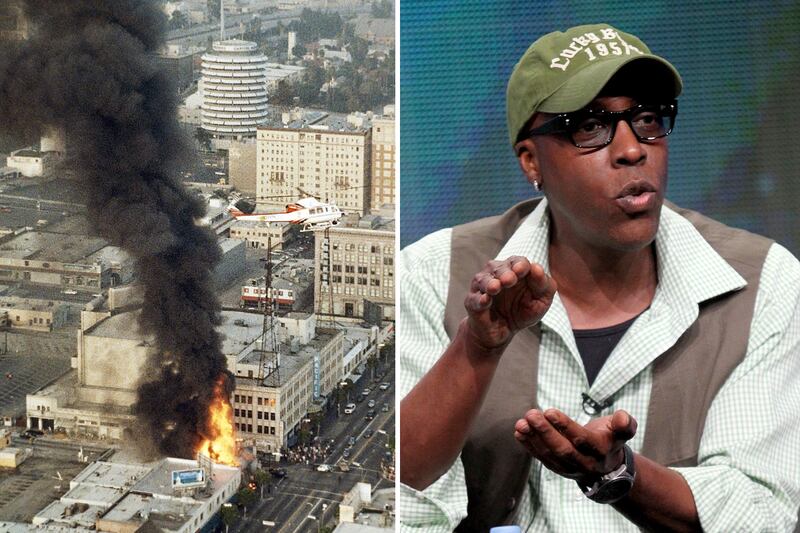
The next day I called VH1 and said I was in. I wanted to talk all about it.
There is no way to forget the first time I saw the video of Rodney King being beaten. Now, everything is caught on camera, but not back then. I kept thinking as I watched it, “How did they get this on camera and, wow, those cops are screwed.” Of course, it didn’t quite turn out that way, and so the city was literally burning the day the not-guilty verdicts were handed down. People were hurt and angry, and they let it be known.
The folks at Paramount wanted me to cancel my talk show that day, but I fought hard to make sure we filmed no matter what. I felt I had a responsibility to my fans and to the people who supported me to tell their story, and to give those who weren’t in Los Angeles a glimpse of ground zero. I arranged to take cameras from my show to the First African Methodist Episcopal Church, where I met with then pastor Chip Murray and the people at the church. It was funny because I also took my good friend Ron Burkle, who owns Ralph’s grocery stores, with me. He was helping me get food to pass out to those in need at a huge discount. People thought I was crazy taking a white guy straight into the heart of south central Los Angeles and into the center of a race riot. I really didn’t care. I didn’t even care if only five people showed up to tape the show at First AME that day either. That’s where I was going to be and of course we had a crowd of people willing to come out and join the discussion of why the city was going up in flames.
I can still recall wearing a bulletproof vest anytime I ventured into the area because my bosses were afraid something would happen to me. They were afraid of all us on the show could or would get hurt, but they also realized they couldn’t really stop me even in the face of that danger. I had a mission to fulfill that week, and I think I did it. It was good to have a voice back then that could discuss every issue happening around the country to all people, but particularly for people of color.
Looking back today I’m not sure how I think the city or the country has changed for the better. Some things have shifted, but many more things have stayed exactly the same. How can you really think or talk of change or improvement when we have situations like the Trayvon Martin case occurring almost 20 years to the day of the L.A. riots? Twenty years later, you have this kid who was younger than Rodney King and deader than Rodney King. What does that tell you? I think Trayvon’s murder has bothered me so much because I have a 12-year-old son. I have a son who I’ve told to stand his ground and to fight for his life when someone he doesn’t know comes up on him for no reason and he feels threatened. I’ve told him to never to go anywhere with anyone he doesn’t know, and I taught him to ask to see a badge even if they are the police with uniforms on. It’s tough to think that the advice I’ve given my own son would have him dead now if he were in Trayvon Martin’s shoes.
What’s also been disturbing to see for me is how the various racial groups are divided over the killing of this young man. How can anyone not see their own child when you look at that kid’s picture? That baffles me. What does give me hope is the way African-Americans handled the Martin situation. It was a dignified response by his parents and their supporters as they waited for an arrest for the murder of this child. I was truly worried for a while that some brother, and it wouldn’t take but one, would say, “Hell, we waited on Rodney King’s verdict—and you see how that turned out. F--k waiting this time.’’ That didn’t happen, and I think that says a lot about our patience as a people to see justice on our part done even today.
I’m not sure what Trayvon’s death says about where we are now as a country some 20 years after Rodney King and the L.A. riots—other than we’re actually going backward.