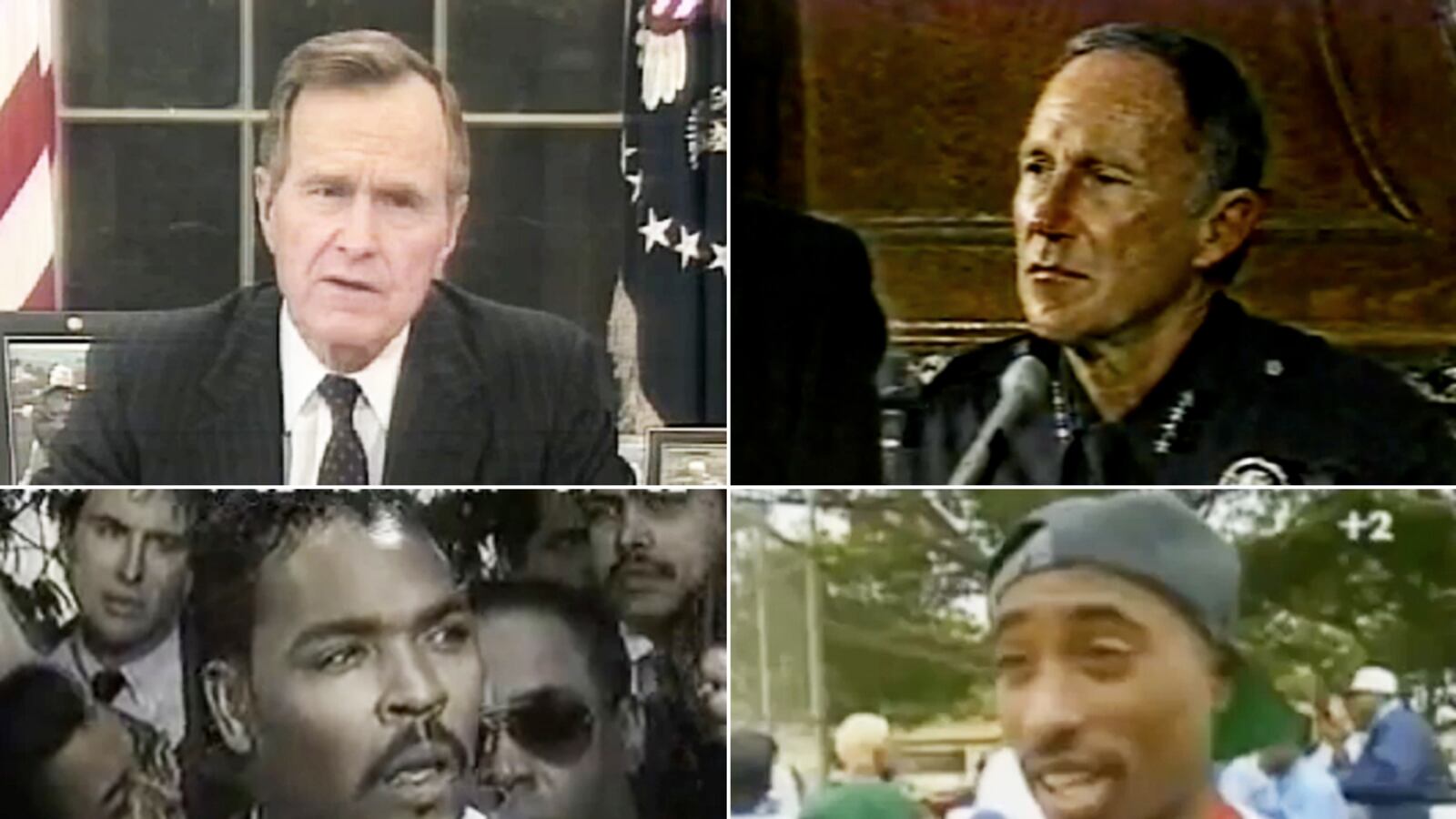
Rodney King: ‘Can We All Get Along?’
After a year-long trial, three of the officers involved in the beating of Rodney King were acquitted of their charges. The verdict shocked many and triggered six days of rioting in Los Angeles. With no hope for a resolution in sight, the man behind the controversy came forward in an attempt to ease tensions. Speaking slowly and visibly shaken, King tried to unite Los Angeles with his simple and now famous line “Can we all get long?”
Reginald Denny: Driving into a Mob
On April 29th, Reginald Denny was driving his 18-wheeler through L.A when he landed right in the middle of an angry mob. Without a radio in his truck, Denny was unaware of the volatile riots that the King verdict had sparked, and was attacked as he pulled into an intersection. After being dragged from his truck, Denny was pelted with bricks and beaten within an inch of his life by a crowd of black men. Eventually, a black truck driver watching the attack from his television at home rushed to the intersection to help. Denny survived the attack. His speech and mobility, however, were permanently damaged.
Koreatown: The Right to Bear Arms
Police officers vow to serve and protect. However, the violence in Los Angeles had become so overwhelming that law enforcement was pulled out of select neighborhoods. Koreatown was one of the areas hardest hit by looting, so when the cops bailed, Korean store owners took matters into their own hands. Armed with guns, owners protected their shops, engaging in gun battles with wannabe intruders. Some say the violent confrontations between blacks and Koreans further escalated the already strained relationships between the two groups. Nevertheless, many shop owners say they were simply trying to protect their livelihoods.
Police Chief Daryl Gates: ‘We Were Overwhelmed’
Where were the police? As the city plummeted further and further into chaos, scared citizens and the media questioned local law enforcement’s preparedness. In a nationally televised press conference, Los Angeles Police Chief Daryl Gates explained the reasoning behind their actions and the obstacles facing local police. When challenged by reporters on the apparent delay of intervention, the chief spoke candidly. “All of our extra resources that we deployed,” Gates said. “Were overwhelmed almost immediately.”
Bush: ‘A Tragic Series of Events’
This is probably the last thing he wanted in an election year. On the third day of violence, President Bush addressed the nation in a televised appearance from the Oval Office. After giving an update on the state of the city, Bush laid out his steps for the restoration of order. In addition the deployment of 3,000 national guardsmen, Bush also called in specialized riot control units and other federal law enforcement agencies. “As your president,” Bush said sternly, “I guarantee you, this violence will end.”
L.A Is on Fire
For those who didn’t have guns, arson was the weapon of choice. From overhead, Los Angeles resembled a war zone with several neighborhoods engulfed in flames. Crews tried to contain the blazes, but as the days progressed, the number of fires was simply out of their control. In many cases, firefighters were unable to extinguish fires due to physical attacks from rioters. By the time the violence subsided, the scorched city suffered an estimated $1 billion in damages.
Bill Cosby: A Sweet Spot in the Chaos
Television offers an escape from reality. And on April 30, 1992, reality is the last place anyone wanted to be. The streets of L.A. were under siege with looting, arson, and murder making constant headlines. Enter the Huxtable family. ‘The Cosby Show’ had become a household staple, doing its part to challenge negative stereotypes of the black community. After much debate, KNBC decided to pause their coverage of the destruction and air the finale of the wholesome show. Mayor Tom Bradley supported their choice, urging Angelinos to stay off the streets and stay home to say farewell to the Huxtables.
Arsenio Hall Gets Serious
No time for jokes. Late-night host Arsenio Hall was one of the premier black entertainers in the early 90s. Taking his cue from Reverend Cecil Murray, Hall used his voice during the riots to encourage the black community to end the brutal attacks. “You cannot get peace with violence,” Hall said. “We are not a violent people.”