
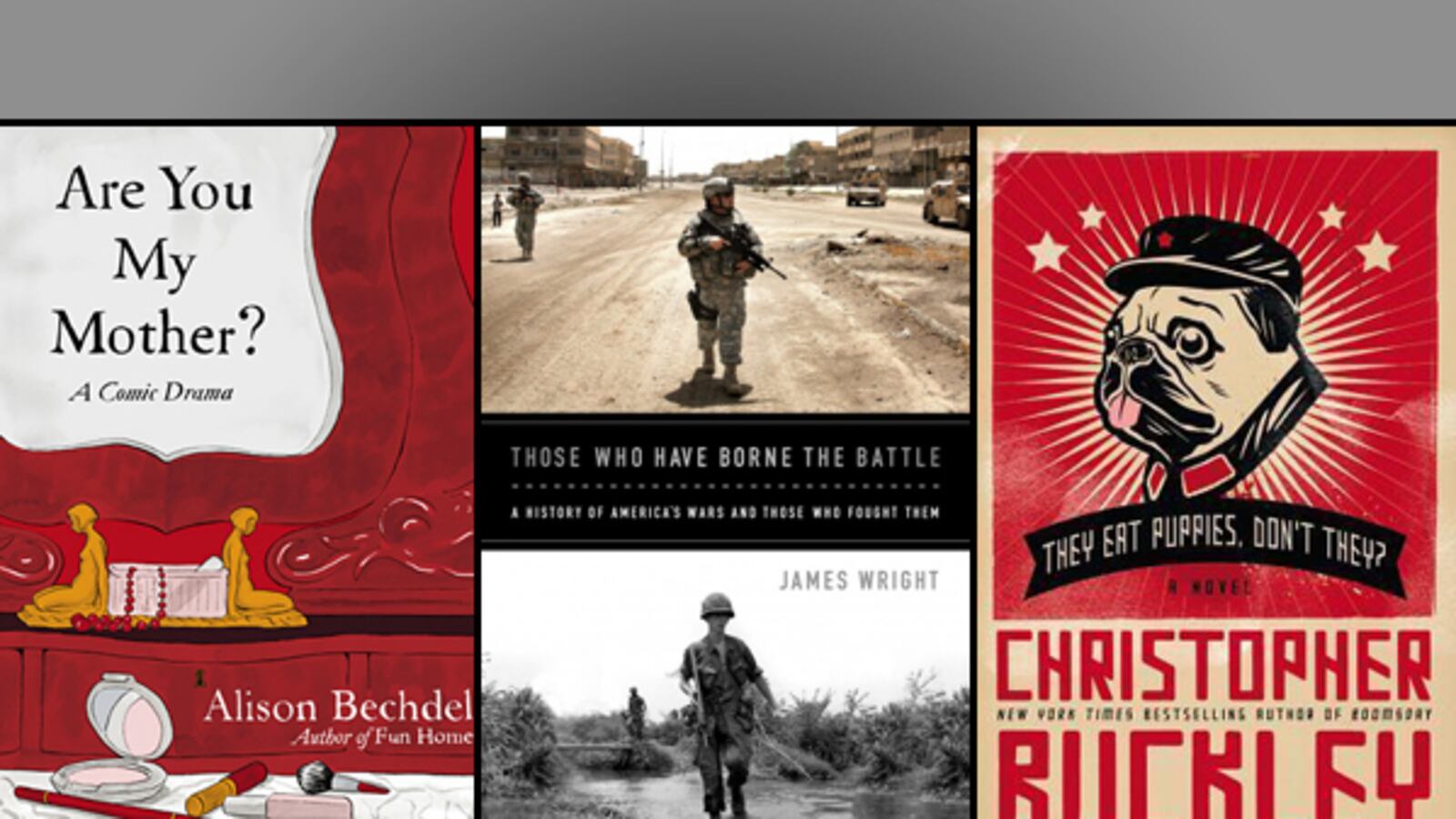
Are You My Mother? A Comic Drama By Alison Bechdel The lesbian memoirist and pioneering graphic storyteller had to show her honest, plumbing new book to her mother. It’s a staggering achievement.

Acclaimed writer/cartoonist Alison Bechdel (author of Fun Home and the long-running comic strip Dykes to Watch Out For) is an artist at the height of her powers and in complete control of her form. The graphic novel itself already represents a tricky blending of media, and the fact that her new book, Are You My Mother, contains elements of both novel and memoir could have muddied things up further. But this is not the case. The book, a psychological investigation into Bechdel’s relationship with her mother, is a staggering accomplishment. She frames her journey toward understanding and forgiveness as a kind of discussion with people like Virginia Woolf, Sigmund Freud, and 20th-century psychoanalyst Donald Winnicott, whose own internal lives gave them no small amount of trouble.
Although Bechdel utilizes all the features of the graphic-novel form, she is so intelligent and perceptive that this story of self-discovery (an abused term, but never more apt) would still be compelling if told only in prose. Which is not to slight her skills as an illustrator; scenes are presented, inverted, and visually expostulated with the eye of a movie director interested in fully exploring the space. Are You My Mother? is a masterwork that gracefully documents the torture that sensitive people can put themselves through while searching for the causal movers of their lives.
Those Who Have Borne The BattleBy James WrightFew know that the former Dartmouth president was a Marine, and his study of the American military urges us to understand our servicemen.

James Wright understands that he is something of an oddity. During his 30-year tenure at Dartmouth College, first as professor and then as president, many of those around him were often surprised to learn that he is an ex-Marine. His new book, Those Who Have Borne the Battle, is a level-headed and respectful analysis of not only the changing demographics of the American military, but also the changing attitudes, and obligations, of the general population toward that military.
Told from the position, too rare these days, of both veteran and serious academic, this is an extremely well-researched book, and there is a refreshing absence of emotional appeal toward patriotism (that could also be called jingoism) or moral revisionism (that could also be called anti-Americanism). Wright uses statistics and an incredible array of primary documents to make an argument here, but not the kind of argument that you’ll find being made by any talking head on cable news; namely, that as the segment of society that makes sacrifices for America’s war efforts becomes more and more narrow, perhaps the best thing we can do for the troops is simply to understand them.
Trapeze By Simon Mawer
Only 53 women served in combat for the European Allies in World War II, and their spy story gets a riveting treatment here.

Of the millions of humans mobilized for combat by the Western Allies during World War II, only 53 of them were women. Not mere soldiers, though; these women were agents of the British Special Operations Executive (SOE), trained to parachute into occupied territory in order to sow as much discord as possible. Taking their little-known story as historical kernel, decorated novelist Simon Mawer gives us Trapeze, the story of 19-year-old Marian Sutro, recruited by the SOE because of her, she at first believes, fluent French. As her mission progresses, however, she realizes that she may have been chosen due to her connection to a research physicist still in occupied France.
Like the best historical fiction, the book is very much of its intended time, full of clandestine tidbits and Churchillian attitude, but not to the exclusion of the human elements that are required of any compelling story. And although the narrative cleaves tightly enough to the realm of possibility, it is also so full of adventure as to be an almost J.K. Rowling–escapist fantasy, with spies replacing wizards. What teenager couldn’t daydream about being plucked from her ordinary life, told that she had special desirable skills, and dropped into the unknown in order to liberate her homeland from history’s most hated heels?
They Eat Puppies, Don’t They? By Christopher Buckley
The Institute for Continuing Conflict is trying to turn America’s cold war with China into a hot one. In this hilarious satire, the media is doing a great job helping out.

It’s been only four years since Christopher Buckley published his last novel (2008’s Supreme Courtship) but so much of American politics has gone un-lampooned since then that his return to fiction feels something like Odysseus returning to slaughter the suitors squatting in his home. Buckley’s new novel, titled They Eat Puppies, Don’t They?, is a hilarious and page-turning story of political absurdity worthy of Dr. Strangelove himself, with bombastic Russian Communists replaced with Sun Tzu–quoting Chinese ones.
Walter “Bird” McIntyre, defense lobbyist by day and would-be novelist by night, is looking to stir up some anti-Chinese sentiment in order to garner congressional support for a secret new super-weapon. Working with Bird is Angel Templeton, the sexy, Ann Coulter–like head of the Institute for Continuing Conflict, who wouldn’t mind seeing the cold standoff turn hot, or at least warm. Arrayed around them are the main players of both the American and Chinese power structures, who all use a poisoning plot against the Dalai Lama (initially fabricated by Bird) as a proxy battlefield to embarrass one another. As the situation escalates, and Bird’s domestic life becomes entangled with his political one, he may come to regret pulling on the tail of the dragon.
It’s a sign of his impishly subtle wit that Buckley’s take on subjects such as the military-industrial complex and the sensationalist 24-hour news will be taken as either playful or excoriating, depending on your own position. Perhaps most of the satirical firepower here is directed toward our new owners, the Chinese themselves, but I imagine he won’t hold his breath waiting for a translation into Mandarin.
Sound By T.M. Wolf
A polyphonic experimental novel tries to superimpose traditional narrative with the sounds that surround our lives, on parallel lines of cognitive experience.

In Sound, the debut novel from T.M. Wolf, there is certainly a good story, about a young man who has returned home to the Jersey Shore after bottoming out in grad school, losing his elusive love interest, and being involved in an unfolding mystery that has the police eyeing him. But even more worthy of note is the manner in which Wolf has chosen, or invented, to tell it. The book (physically very nearly square and about the size of the dust jacket for a 45-rpm vinyl single) is laid out, when you open it, with lines like a musical score. Wolf uses these lines to convey the simultaneity of sounds occurring in a scene, with one character’s dialogue laid out on one line, his thoughts on another, the interlocutors dialogue on still another, and snatches of passing cars or the Yankees game or booming rap music interspersed throughout. It’s a gimmick, sure, but not in the worst sense of the word, and there are also traditional sections of prose where Wolf shows traditional chops. The easy analysis of the novelty of the form would be about how the sounds that surround us create “the soundtrack of our lives.” The more challenging one, that Wolf earns in places, is about how the cogitation of our brains and our interaction with reality function on so many levels at once that traditional prose fails to properly represent actual thought.