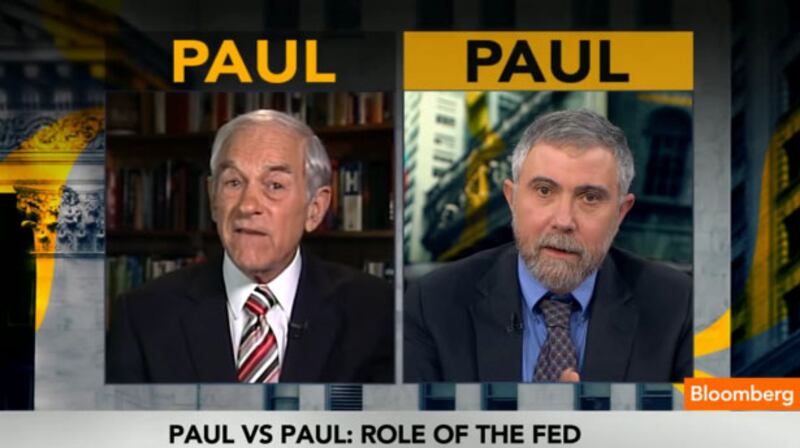
I've noticed that a few of my conservative Facebook friends have linked to the recent debate between Paul Krugman and Ron Paul on Bloomberg. Some of them are embarrassed to find that Krugman was the more convincing participant.
I have a theory as to why. In that short interview Ron Paul revealed that his school of Austrian economics is more about assertions and ideology then it is about empirical data.
I'll give one example that stuck out to me. In Part 1 of the Mediaite video (at 6:00) Ron Paul argues that there was a lot of economic growth after World War Two because:
After World War Two a lot of the debt was liquidated, but guess what else we did. The troops were coming home…big government liberals wanted to have job problems, they weren't put into place. we cut spending by some 60%, we slashed taxes, finally the depression ended.
Ron Paul's gloss over history has a grain of truth and a giant problem. The truth is that America did take a step down from having a war-time command economy. The problem is that Ron Paul makes it sound as if government then immediately shrunk. He even says taxes were "slashed".
Here is a chart from the Tax Policy Center showing what the historical highest marginal tax rates were.
During World War Two, the rate is between 81% and 94%. After World War Two, it is cut down to a low of 82% before being raised back to 91%, which is where it stays till the Kennedy years, during which it drops to a slightly lower 70%.
If this is what Ron Paul thinks it looks like when American liberals lose what does it look like when they win?
There are many more examples that have been cited by other writers about how government remained large long after World War Two. Airlines were heavily regulated, the interest on checking accounts was regulated, even the beer industry wasn't deregulated until 1979, and yes, that was by Jimmy Carter.
After World War Two government was bigger than Ron Paul admits. Krugman was making the point that during the era when taxes on America's richest were highest and the country was most regulated, the country as a whole was better off. That is a very important question to be able to answer, and it is not clear that Paul has even grappled with the implications of that data at all.