

Contestants in the Miss India pageant are gliding across a stage in Mumbai, eyes shining. The winner will become an instant celebrity, gracing glossy magazines and Bollywood films. At the same time, in the nearby city of Aurangabad, girls are learning to hate the pageant. They’re students at a fundamentalist Hindu camp, where they are taught to marry young and shun modern influences.

Filmmaker Nisha Pahuja captured both universes in her film The World Before Her, which took the prize for best documentary last week at the Tribeca Film Festival in New York City. “I wanted to look at not just women in India, but the country itself and how it’s undergoing massive cultural changes,” says Pahuja, a Canadian filmmaker who was born in India. “The country is deciding what it wants to be.”
The film, which is showing in Toronto this week at the Hot Docs festival, started back in 2008, when Pahuja became interested in the Miss India pageant, a controversial annual event that feminists and Hindu fundamentalists want to shut down. Then she met one of those fundamentalists, a 24-year-old woman named Prachi. “Everything changed,” says Pahuja. “I thought, Oh, my God, how often do you meet a woman like that? She told me about these Hindu camps. I started trying to get access.”
Pahuja ended up zooming in on both Prachi and a pageant contestant named Ruhi in the film. Ruhi, a sultry 19-year-old, sees beauty pageants as her ticket to success. Prachi sees a future in fundamentalism; she teaches at a Hindu camp for girls run by a group called the Durgha Vahini, in Aurangabad. Tough and tomboyish, she has participated in protests against pageants.
“There are lots of Hindu fundamentalist and Hindu nationalist groups in India—some are more militant than others,” says Pahuja. “They basically believe that India is a Hindu country and it should be governed by a Hindu philosophy. The more extreme ones attack mosques and churches.”
Pahuja says it took two years to gain access to Prachi’s camp. She did it by slowly building relationships, talking to the right people, “and not talking to the right people,” she jokes.
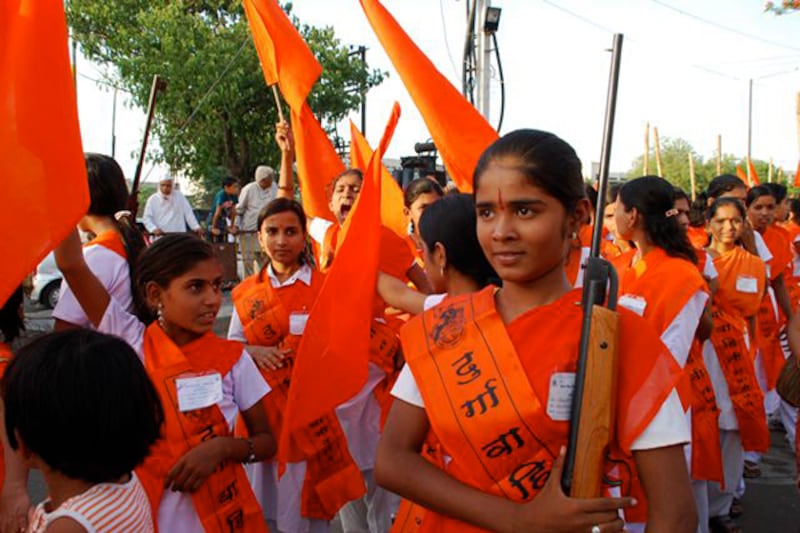
In the camp, the girls learn to despise other religions. They are lectured on how they should marry as teens. They’re told they don’t need higher education. They learn how to fight with knives and fire rifles in case “enemies” such as Muslims and Christians attack. “I will kill people!” chirps one young girl when asked how she will use her newfound skills.
It’s a sharp contrast to the pageant zone, where stylists flutter around young hopefuls, prepping them on how to look their best and be confident but “not bitchy.” In the days leading up to the pageant, the contestants get Botox to perfect their young faces, and pose for a Bombay Times photo shoot wearing tight jeans and ripped T-shirts. When the newspaper comes out, Ruhi gazes at her portrait, musing that the paper is so important, “even the president” must be looking at it.
Perhaps the most poignant parts of the film come when the parents enter the scene. Ruhi’s parents, a middle-class couple in a run-down apartment in Jaipur, encourage their daughter to succeed. Sifting through snapshots of her in various pageants, their faces radiate with pride. They want her to be Miss India.

In contrast, Prachi’s father in Aurangabad brags about the beatings he has dealt his daughter. He laughs about how he once burned her foot with a hot poker when she lied about doing her homework as a schoolgirl. He tells his daughter she must wed. Prachi and her mother tiptoe around him.
Prachi says she doesn’t mind the beatings. After all, she says, they are only administered when she has done something wrong. She says her father has the right to punish her, as he gave her life—and allowed her to live it. The film makes the point that in many Indian families, baby girls are devalued to the point that parents will ship them off to orphanages, or even kill them, simply because they are not boys. Girls are seen as a burden, as the family must pay a dowry to the men they eventually marry. India has essentially outlawed ultrasounds because many families were using them to learn their child's gender and abort the females.
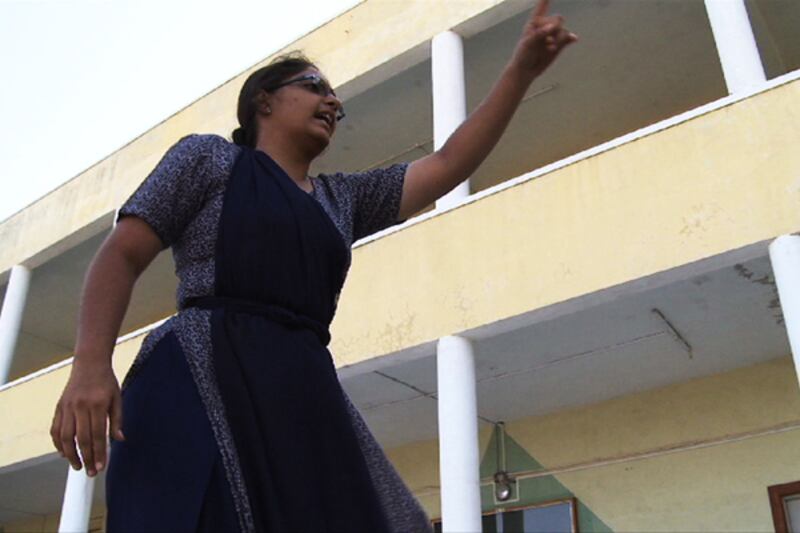
Pahuja says viewers are “intrigued by the complexity” of young women’s lives in India. “There are so many different facets, so many contradictions,” she says. As part of a collaboration between the Tribeca Film Festival and Rikers Island, the notorious New York City prison, Pahuja showed her film to female inmates last week. “By and large, the response was they were really sucked in, really gripped,” she says. “The violence especially affected them, and the fact that Prachi seemed trapped. They were really moved by that.”

Nothing in the film is black and white. The pageant contestants, while proud of their beauty, also struggle at times with morals and modesty. At one point, a young woman laments shedding her dignity when she has to participate in a “best legs” contest ahead of the pageant, donning a white sheet over her head and torso to walk the runway with the other shrouded contestants, showing nothing but leg. Prachi, meanwhile, is obedient to her father, but has a major problem with his mandate that she wed. She just can’t see it happening. She describes herself as being like both “a girl and a boy.” She says, “When God made me, he was in a different mood. He combined two things together and sent me down.”
One option she entertains for her future: becoming a martyr for her Hindu cause.
It’s her story that lingers long after the film ends.