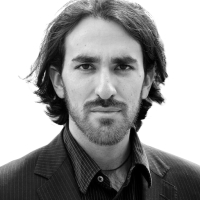
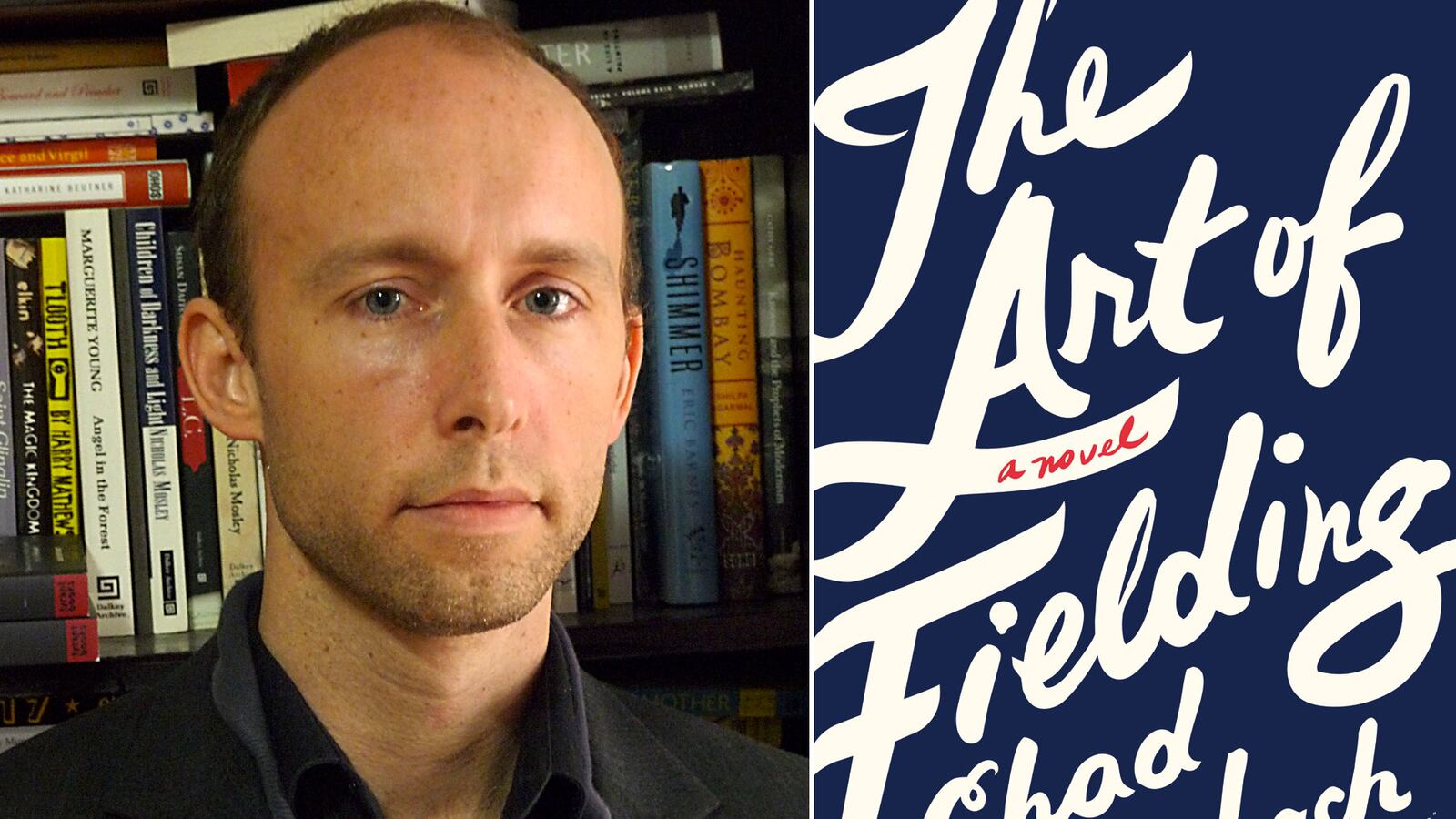
Writer Chad Harbach, whose first novel The Art of Fielding, newly out in paperback, drew rave reviews when it was released last year, from just about every major publication, from The New Yorker to The New York Times Book Review. He is also cofounder of the successful literary journal n+1, which, in a few years, has risen to become part of the New York literary establishment.
Where do you live and why?
I live in Charlottesville, Va., where I attended grad school. I moved back last year, as a sort of temporary respite from New York, and now I’m addicted to the easy living.
Of which of your books or projects are you most proud?
n+1, which I cofounded with several friends in 2004 and which is still going strong.
How does your approach to work differ when you are writing fiction or when you are working for n+1?
Fiction and nonfiction, for me, involve very different processes. When I write for n+1, I begin by doing a lot of reading, to try to convince myself I’m not stupid. Then I scribble down a paragraph here, a paragraph there, when a notion strikes. Then I see if I can arrange those notions in a way that yields an argument. What’s missing, what’s superfluous, where are the gaps? It’s a piecemeal, workmanlike process, whereas in writing fiction, I'm trying to get into a different rhythm, a more spontaneous part of the brain. It’s more linear, but also harder to describe.

Do you have an ultimate goal in mind for n+1, a moment that you could foresee when your initial inspiration for the publication will have been fulfilled? Perhaps it already has been?
Hmm. I guess when wealth is equitably distributed; global warming is halted; and thoughtful, nourishing public discourse about literature and politics becomes normal and unremarkable, then n+1’s work is done. It might take a while. But I do think we’ve achieved one of our goals, which was to help reinvigorate the non-institutional intellectual scene in New York—a scene that’s always had a lot to do with small magazines.
Do you follow a favorite baseball team, and any specific player?
I’ve been a Brewers fan since birth. My favorite player is the great Vinny Rottino.
What is your earliest baseball memory?
My earliest memory of playing (and maybe my earliest memory, period) is of my dad pitching me Nerf balls in our living room when I was barely old enough to stand. As a fan, I have all-too-vivid memories of the Brewers’ loss in the 1982 World Series, when I was 6 years old.
What do you do when you are stuck or have temporary writer’s block?
Walk. Or drink. But walking is more helpful.
What is something you always carry with you?
My ancient, crappy cell phone that gives a busy signal whenever anyone calls me, but which I for some reason refuse to relinquish. (Either I’m too cheap or don’t like getting phone calls or both.)
If you could bring back to life one deceased person, who would it be and why?
One writer I’ve always been eager to hang out with is Chekhov. He seems like a wise and humble and funny guy. Plus he was 44 when he died, and prolific despite his illness; he could do a lot with a couple extra decades.
What phrase do you overuse?
“Awesome.”
Was there a specific moment when you felt you had “made it” as an author?
I guess you never make it as an author. As soon as you finish one project, you’re right back to the blank page and the self-doubt and all that stuff. That’s the beauty and the terror of it. As for The Art of Fielding, it was a thrill for me to read Wyatt Mason’s review in The New Yorker—both because of the venue, and because Mr. Mason really captured what I thought I was up to.
Please recommend three books (not your own) to your readers.
End Zone by Don DeLillo—because it’s my favorite sports novel;
The Red and the Black by Stendhal—because I just read it and it was tremendous;
The Possessed by Elif Batuman—because it’s the funniest book about Russian literature.
Do you have a writer friend who helps and inspires you?
Keith Gessen and Matt Thomas.
What do you need to have produced/completed in order to feel that you’ve had a productive writing day?
It depends. Sometimes you have a tough problem to crack, and you’re happy if you crack it, even if that means writing three words. If I’m moving full speed ahead, three pages a day is a good benchmark.
What advice would you give to an aspiring author?
The best advice is the simplest, and the hardest: one, write every day, and two, stay off the Internet. Beyond that, I always advocate writing by hand, as opposed to using a laptop. I think a pen is the perfect technology for writing fiction. Writing on a computer feels like a recipe for writer’s block. I can type so fast that I run out of thoughts, and then I sit there and look at the words on the screen, and move them around, and never get anywhere. Whereas in a notebook I just keep plodding along, slowly, accumulating sentences, sometimes even surprising myself.
What is your next project?
I’m putting together a book of essays called MFA vs. NYC, based on a piece I wrote for n+1. I’m excited about the project. It has some great contributors, and should provide a pretty fascinating view of the role of the writing program in American letters, historically and today. Plus charts. It’ll be published in the fall. Check it out.