In 1999, when Marissa Mayer became the 20th person hired at Google, she was a 24-year-old computer scientist who specialized in artificial intelligence. Today she’s the company’s vice president of local, maps, and location services—and the driving force behind more than a hundred of Google’s products and services, including search, news, gmail, earth, books, and toolbar. Her touch seems to be part of every piece of the Internet giant’s business, from the signature look of its pages, to the development of futuristic ideas like the self-driving car, a test version of which was licensed in Nevada last week.
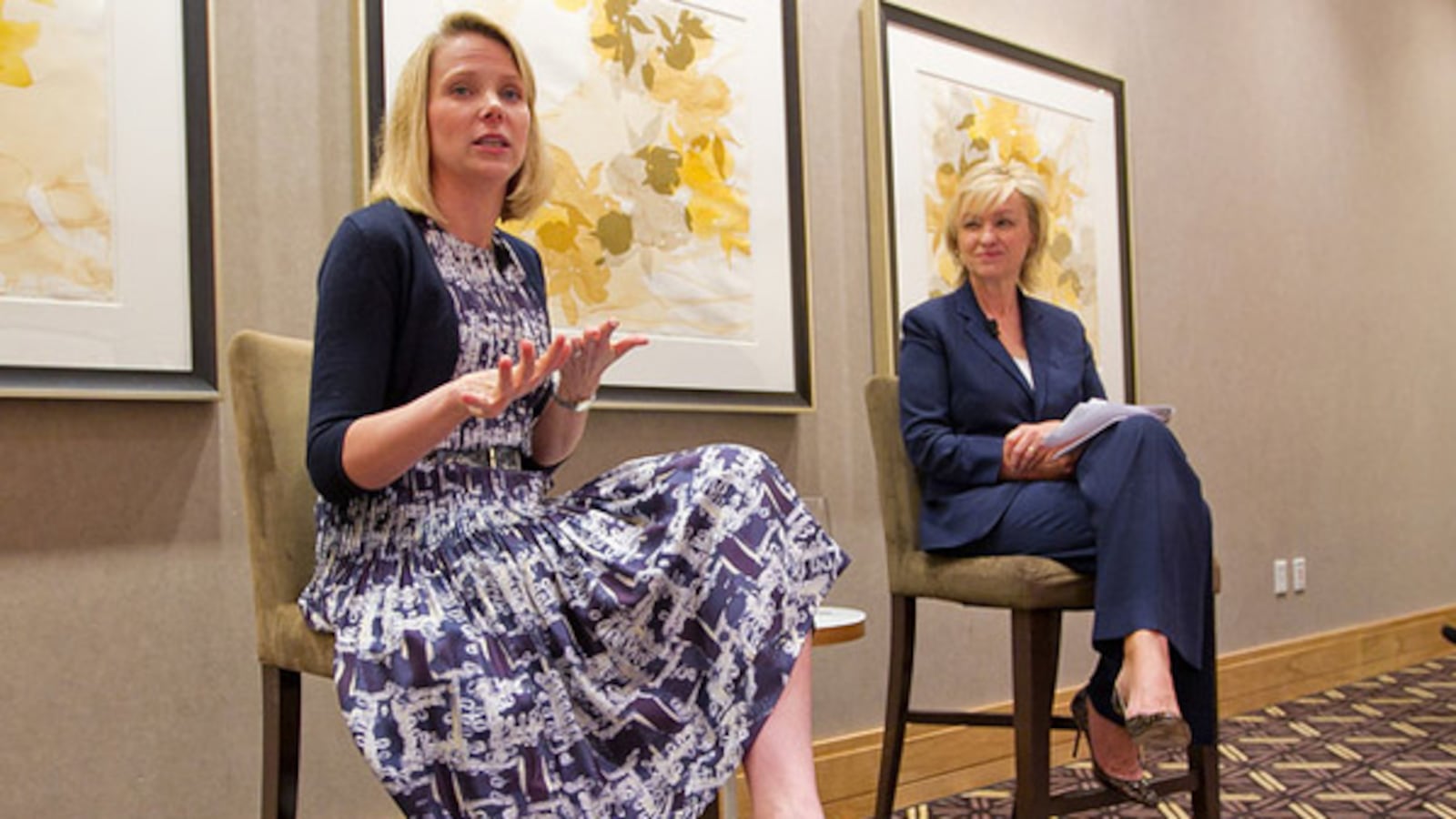
“She’s been at the forefront of revolutionizing our relationship with the web and with each other,” said editor in chief Tina Brown, who hosted a conversation with Mayer in Menlo Park, Calif., on Monday—the latest in a series of discussions organized by Credit Suisse and Newsweek/The Daily Beast.
Mayer was the first female engineer hired at Google, but she is not particularly interested in questions about the dearth of women in high-tech. “I actually think it’s the wrong question,” she told Brown. “It’s a question that hangs us up and causes the progress to be slower. The truth is we’re not producing enough computer scientists, period.”
As an example, Mayer noted that while the Advanced Placement calculus exam is taken by 200,000 high-school seniors each year, the Advanced Placement computer-science exam is taken by a mere 14,000. Part of the problem, she said, is that people tend to think too narrowly about who computer scientists are, assuming that they are “pasty, with a pocket protector.” While she confessed that she herself can be rather pale, she insisted that pallor isn’t a requirement, nor is stereotypical tongue-tied geekiness.
“One of the more interesting things they’ve found is that programming aptitude and excellence is more tied to verbal SAT scores than to math SAT scores,” she explained. “Beyond basic mathematical aptitude, the difference between good programmers and great programmers is verbal ability.”

Clarity of expression is something Mayer prizes so dearly that she uses it as a litmus test when evaluating new ideas. Disruptive technology should solve big problems and have widespread applications, but it should also be easy to understand. “I think about my mom,” she told Brown. “She’s very smart. She’s a little intimidated by technology. So when a new idea comes up, I think, ‘How would I explain it to her?’”
Of course, not every problem can or should be solved by technology. Asked about challenges, Mayer reflected on one of her biggest failures, the aborted plan for Google Health. The idea was to have users upload their medical records, so that they could be available at any time. The plan was consistent with the company’s philosophy that “your data belongs to you,” Mayer said, but she didn’t foresee the logistical hurdles posed by the medical field’s carefully calibrated system of privacy protections, or the alarms that the notion of online medical records might set off. “It was ahead of its time,” she said with a laugh.
Mayer’s faith that the problems with Google Health were logistical rather than ethical is consistent with her view of technology. When Brown asked if she had any concerns about how the increased speed of the Internet-enabled world is affecting the quality of our lives, Mayer seemed almost puzzled by the question.
“To me, speed is really about convenience,” she said, recalling a summer when she was a child in Wausau, Wisc., and she and some other neighborhood kids decided they wanted to build a backyard baseball diamond. “We got into this really big argument about the spaces between the bases—was it 88 feet or was it 90 feet?” she recalled. “In the mid-1980s [finding the answer] was a half-hour trip to the library, looking it up in the encyclopedia. Today, that’s someone running back to the house and typing 20 characters into Google.”
By the same token, Mayer isn’t particularly taken with conventional notions of work-life balance. “I don’t believe in balance, not in the classic way,” she said. The idea that everyone needs eight hours of sleep, three meals a day, and time with their families, she contends, doesn’t allow for individual rhythms and priorities.
“The first sign of burn-out, I’ve found, is resentment,” she said. People feel resentful when work gets in the way of the things they value most. For one person, that might be sleep; for another, it might be dinner with friends. She cited the example of a woman who might not mind being on the phone with her team in India at 1 a.m., as long as she doesn’t miss her children’s soccer game the next afternoon.
Mayer thinks technology can help us find that personalized balance. When she looks into the future, she envisions our phones guiding us through the world by offering us situationally-relevant information, whether it’s the architectural history of a nearby building or the fact that the store on the corner carries the kind of toaster we’ve been searching for. “You can imagine all the different objects in the world broadcasting interesting things about themselves, and your phone acting as a tuner to pull your preferences to you,” she said. “I actually think that a device like that could help us tune out some of that noise so it’s really what you want to know about when it’s most useful to you and at the volume and pace that you want.”
As she described this hypothetical scenario, Brown suggested there might be a down side. “That means that once again I’ll be walking down the street like this,” she said, staring at the screen of an imaginary phone. “I’ll fall into a manhole,” she added, as the audience laughed. “And it’ll be your fault.”