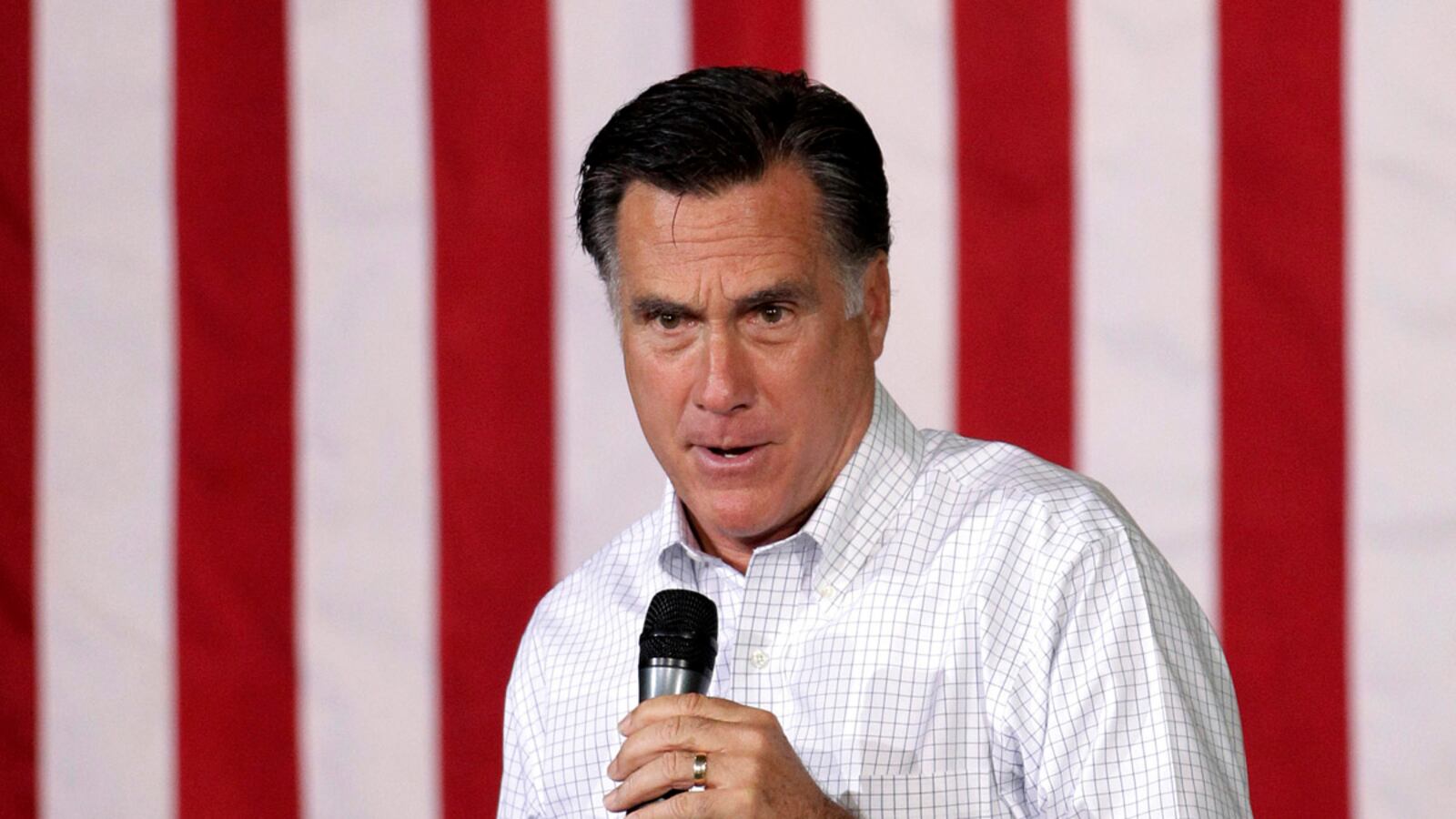
It’s the kind of thing that usually happens near the end of a campaign, when all hope is lost: Mitt Romney’s foreign-policy team is trashing him to the press. On Afghanistan, one adviser told David Sanger of The New York Times, “None of us could quite figure out what he was advocating.” Another acknowledged that when it comes to Iran, “I’m not sure that anyone knows if the candidate has a strong view of his own.” A third admitted that “Romney doesn’t want to really engage these issues until he is in office.”
What’s going on? Part of it is simply Romney, whose lack of foreign-policy experience and apparent lack of strong foreign-policy convictions are inviting internecine warfare among his staff. But the problem goes deeper. Republican foreign policy may be crashing against reality’s shoals.
Once upon a time, leading figures in the GOP foreign-policy establishment thought a lot about the limitations on American power. The guiding assumption of Richard Nixon and Henry Kissinger’s foreign policy was that the United States no longer had the money or will to wage war against communist movements across the world and would thus have to make deals with the Soviet Union and communist China in hopes of getting them to restrain those movements themselves.
Realists like Brent Scowcroft, Kissinger’s former deputy in Nixon’s National Security Council, dominated Republican foreign policy as late as the George H.W. Bush years. And even Kissinger’s ideological foes—the original neocons who rallied around Ronald Reagan—largely understood that in the wake of Vietnam, the American public had little appetite for military force. Although Reagan funded anticommunist regimes and insurgencies from Central America to Central Asia, he was deeply cautious about deploying U.S. ground troops overseas. In his final year in office, in fact, Reagan adamantly refused to invade Panama, on the ground that it could turn into another Vietnam.
Since the Cold War, Kissingerians have largely gone the way of the dodo bird inside the GOP. As on domestic policy, the party has moved further and further right—not just to the right of Nixon and Kissinger, but to the right of Reagan as well. The Gipper, it’s worth remembering, sanctioned Israel for bombing Iraq’s Osirak nuclear reactor in 1981. Today, by contrast, Republican foreign-policy advisers not only support Israel bombing nuclear facilities in Iran; they urge the U.S. to do the job itself.
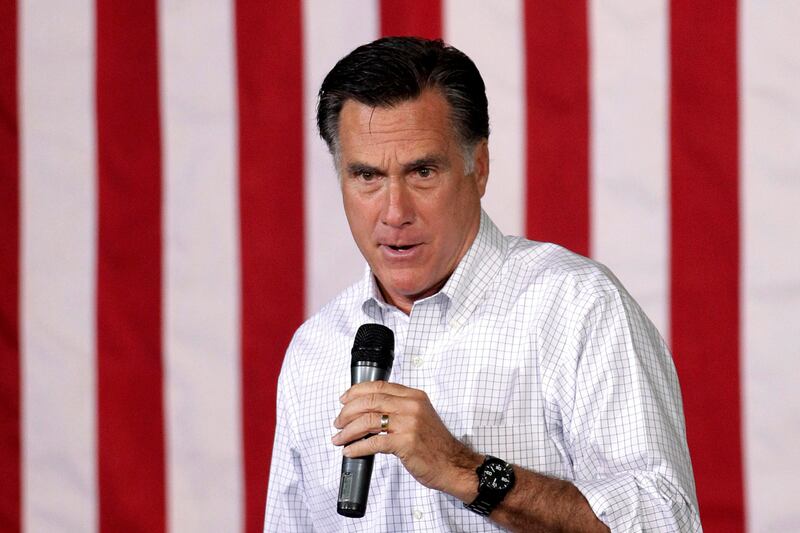
Supporting an aggressive U.S. military posture is today almost as central to Republican foreign policy as cutting taxes, spending, and regulation is to Republican domestic policy. And yet that posture has never been more at odds with the existing limitations on American power. As much as many GOP foreign-policy hands want to accuse Barack Obama of surrendering in Iraq and Afghanistan, fewer and fewer Americans see those wars as anything but a waste. As much as prominent Republican foreign-policy hands urge bombing Iran, the leadership of the U.S. military appears deeply opposed. And with the federal government facing increasingly savage budgetary tradeoffs, the Republican insistence on ever-higher defense spending looks increasingly delusional.
Beneath the fratricide in the Romney foreign-policy camp lies the deeper problem that, at least since Sept. 11, GOP foreign policy has largely assumed that limitations of public money and public will should not constrain American foreign policy. And during the primaries, when Romney advocated bombing Iran and rejected negotiations with the Taliban, he embraced those assumptions, too.
But now, forced to lay out their candidate’s views in greater detail for a more attentive press corps and a more skeptical general-election audience, the Romney camp is struggling. And they’re going to continue to struggle because ultimately, the problem isn’t Romney. The problem is a Republican foreign-policy narrative that pretends that the wars in Iraq and Afghanistan and the financial crisis have not imposed serious new limitations on American foreign policy.
Foreign-policy strategy, I once heard the historian John Lewis Gaddis explain, involves reconciling goals—which can easily expand—with means, which cannot. In that sense, today’s GOP has a foreign-policy orientation, but no foreign-policy strategy, and Mitt Romney is unlikely to provide it one. It’s going to be a rough few months till November.