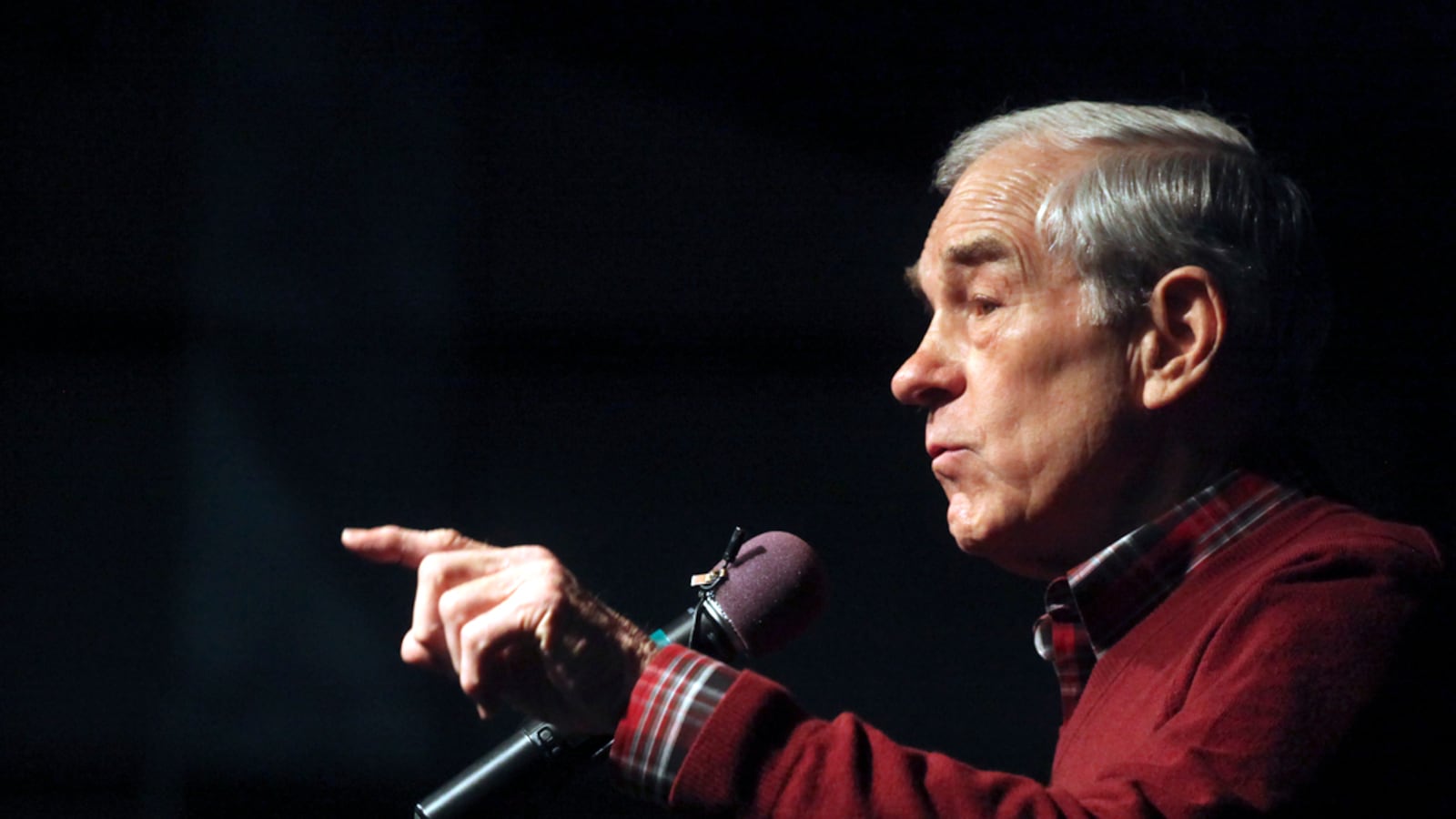
Ron Paul’s campaign may have undertaken the most passive-aggressive political maneuver in modern political history. While he isn’t dropping out of the GOP primary—or “suspending his campaign” in the current parlance—he announced Monday he “will no longer spend resources campaigning in primaries in states that have not yet voted.” He will still try to win delegates through “the state convention process.”
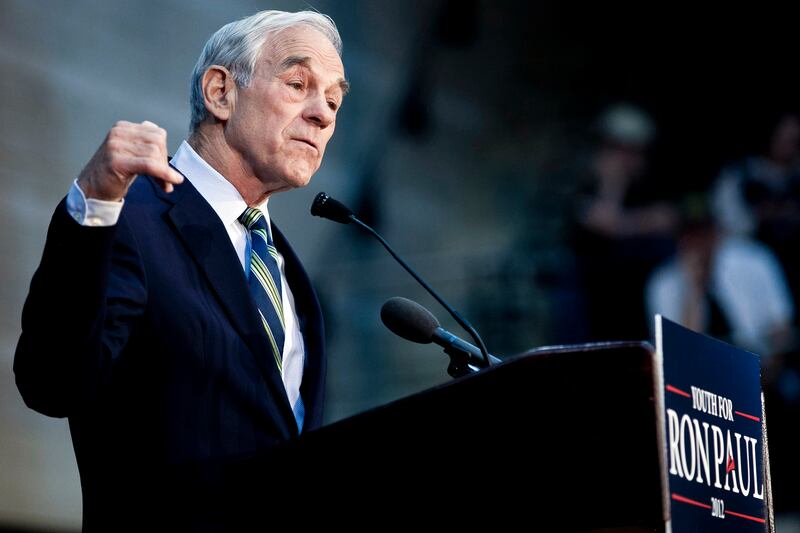
This may seem like an oxymoronic concept; after all, how can one win delegates without winning votes? But the strategy will allow Paul to continue justifying his often raucous efforts to pack state conventions to win delegates for the Republican convention in Tampa and have a minimal impact on the Texas congressman’s efforts to win new converts to his “Campaign for Liberty.”
Although the libertarian gadfly briefly led the GOP field in the tumult before the Iowa caucuses in 2011, Paul was never going to win the Republican nomination. Instead he was running to push the Republican Party further toward his brand of libertarianism. In this, Paul has been highly successful. His share of the total vote in the GOP primary is twice what it was in his 2008 campaign.
Still, this has not been enough to propel Paul to victory in a single statewide contest. Since Super Tuesday on March 6, Paul has surpassed 20 percent of the vote in only one state, Rhode Island on April 24. His success has come in caucus states like Missouri and Iowa, where Paul acolytes have taken over the state party.
Paul’s strength does not come from a well-oiled political machine but a dedicated core of supporters who tend to organize via decentralized means. (Famously in 2008, they independently raised money to send across the country a blimp emblazoned with the slogan “Google Ron Paul.”) These aren’t voters who are discouraged easily. They rage against the dying of the light on online forums. Devoted though they may be, his adherents are not the most numerous, so while Paul can muster enough supporters to take over the party machinery, he is hard-pressed in many states to get 15 percent of the vote.
This actually isn’t a problem in most states. In some, like Oregon’s all vote-by-mail primary Tuesday or Texas’s on May 29, delegate apportionment is roughly proportional, with very low thresholds. Under such a system, even Paul will win some delegates no matter what. Likewise, in states like California, which is winner take all by congressional district, or New Jersey, which is winner take all statewide, Paul wouldn’t get any delegates regardless. But there is one comparatively delegate-rich state where Paul’s getting 15 percent would have a big impact. Kentucky, which holds its primary Tuesday, requires candidates to receive 15 percent to receive any delegates. It also is a state represented in the U.S. Senate by Paul’s son Rand.
Although Ron Paul wouldn’t be a native son in the Bluegrass State, he would be the closest thing to it. And unlike in other states, a poor finish in Kentucky wouldn’t just reflect poorly on Ron Paul but his son as well.
Rand Paul is the presumptive heir to Paul’s political legacy. He has maintained his father’s libertarian bona fides without developing the same reputation for apostasy. If Ron Paul actively stayed in the race and didn’t win any delegates in Kentucky, he would damage his son’s political stock in a state where, despite being a U.S. senator, Rand Paul is still a political outsider. But if Ron Paul simply dropped out, his delegates would no longer be bound to him, foiling his strategy to gain control of the GOP platform in Tampa.
By “no longer spending resources,” Paul avoids this trap. His name is still on the ballot, he’s still accumulating delegates who will be bound to him in Tampa, but he avoids any responsibility for his electoral performance. If he does well, it’s a sign of the popular appeal of his message. If he doesn’t, well, he wasn’t really trying. Paul can escape blame for poor electoral results while continuing to help his fans take control of the party machinery state by state. The strategy may be passive aggressive, but it just could allow him to obtain the most elusive prize in electoral politics: power without responsibility. Not that there’s anything wrong with that.