Florida prosecutors on Thursday released a vast trove of evidence in the murder case against George Zimmerman. The material—some of which is graphic—shines new light on what happened the night Zimmerman shot Trayvon Martin, an unarmed 17-year-old African American who he believed was acting suspiciously as he walked through Zimmerman’s townhouse community near Orlando. But the new evidence also leaves some key questions unanswered.
The special prosecutor’s office released the information under Florida’s Open Records Act. Until now, virtually all the documents concerning the controversial shooting were sealed.
The release includes 183 heavily redacted pages of documents, including Martin’s autopsy report, witness statements, and police reports. In addition, prosecutors released photos taken by police at the scene of the killing, and audio recordings of 911 calls made by neighbors during and after the fight that resulted in Martin’s death.
Zimmerman, 28, claimed self-defense and was initially not charged in the Feb. 26 shooting, resulting in widespread national protests. On April 11, prosecutors charged him with second-degree murder.
Among the details released Thursday, the police officer who approached Martin after he was shot stated in a report that he could detect no pulse, but said as he started CPR, “I noticed bubbling sounds” from the fatally injured teenager.
One piece of evidence likely to anger those who felt Zimmerman should have been charged sooner was a police report by the original investigator, saying that Zimmerman should be arrested and charged with manslaughter because “the encounter between George Zimmerman and Trayvon Martin was ultimately avoidable by Zimmerman.” That report was dated March 13, nearly a month before Zimmerman was charged.

THE FIGHT
The documents also reveal important new details about the central question in the case: Did Zimmerman have a reasonable belief that his life was in danger? There is no dispute that Zimmerman and Martin scuffled before the shooting, but the nature of that scuffle has remained unclear.
For his defense, Zimmerman has relied on Florida’s Stand Your Ground law, which permits the use of deadly force if a person “reasonably believes it is necessary to do so to prevent death or great bodily harm to himself or herself or another or to prevent the commission of a forcible felony.”
According to the newly released reports, at least one witness told police that the man in the “red sweatshirt”—Zimmerman—was on the bottom during the fight. This witness “elaborated by saying the black male was mounted on the white or Hispanic male and throwing punches MMA (mixed martial arts) style.”
This corroborates Zimmerman’s account of the incident, which is that he fired his 9mm pistol only after Martin was on top of him, pummeling him, and he felt his life was in danger.
But another witness could not say who was on top. “Who was on the top and who was on the bottom?” she was asked, according to the documents. “I could not tell,” she said.
THE CRIES FOR HELP
Another key question has been the identity of the voice heard yelling for help on the 911 calls witnesses made that night. Martin’s mother has said it was her son’s voice, and the special prosecutor's office cited her in their affidavit when they charged Zimmerman.
The newly released records reveal complicated and contradictory new information about the cries for help: the police initially believed it to be Zimmerman’s voice, and FBI forensics experts could not make a determination.
In a March report, Sanford police investigator Christopher F. Serino wrote, “This voice was determined to be that of George Zimmerman, who was apparently yelling for help as he was being battered by Trayvon Martin.”
But an FBI analysis found that ”the screaming voice of the 911 call is of insufficient voice quality and duration to conduct a meaningful voice comparison with any other voice samples.”
And contradicting the police account, an eyewitness to the shooting also heard the yelling, which she described as “horrifying.” When she was asked later, “Who do you think asked for help?” she answered, “the boy.”
“It sounded like a young boy voice,” she said.
Another witness stated that she told police she had been extremely upset by the cries and wished she could have helped. She then stated that “an investigator by the name of Chris told me, ‘If it makes you feel any better the crys [sic] for help were not the person that died.’”
Confounding the matter even further, Serino wrote that in the days after the shooting, he played the 911 tapes for Martin’s father, Tracy, and asked him if he thought screaming voice was Trayvon’s. Tracy, “clearly emotionally impacted” by listening to the tapes, “quietly responded, ‘no.’”
ZIMMERMAN’S INJURIES
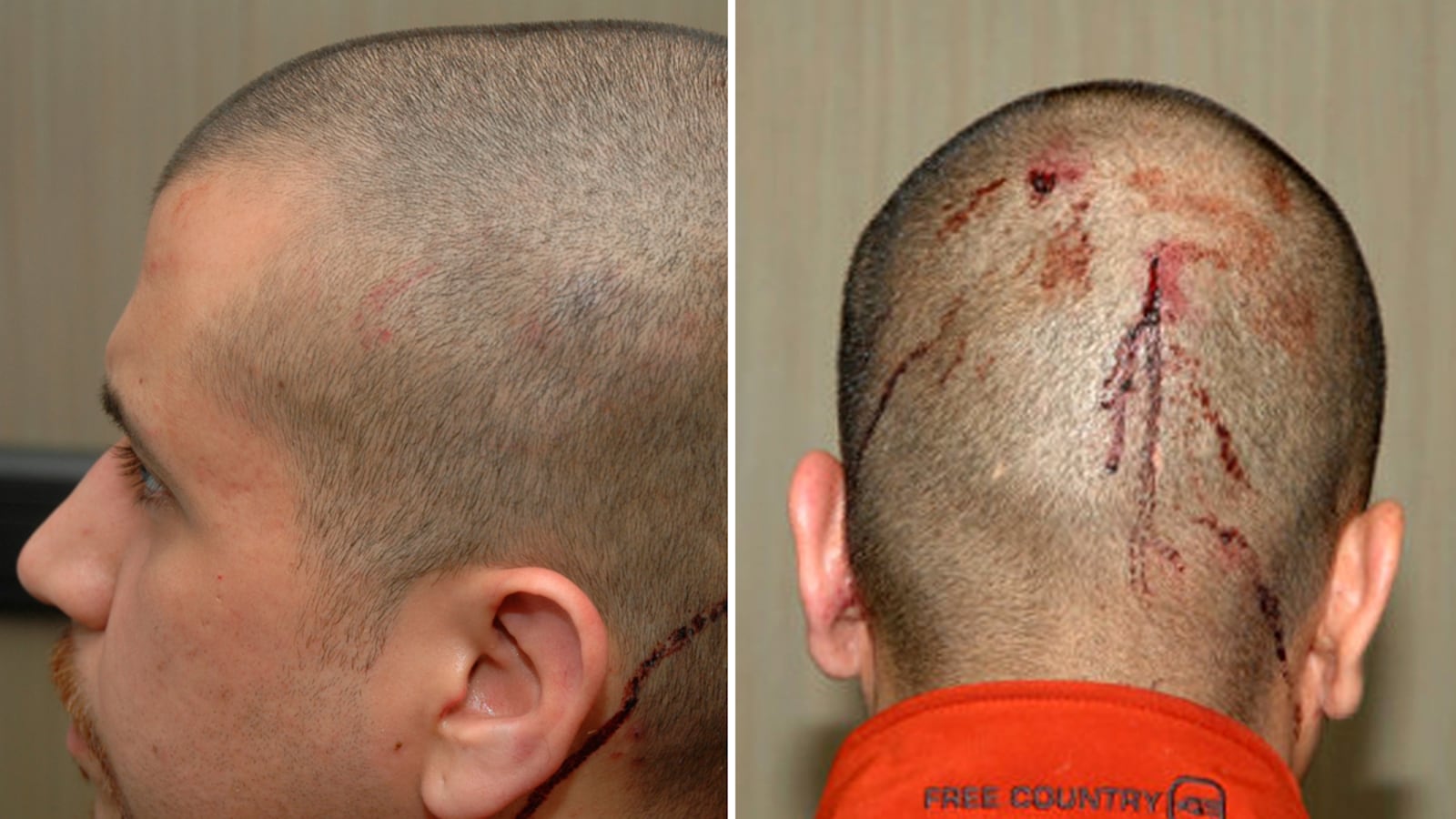
The new material is more definitive when it comes to the extent of Zimmerman’s injuries. Legal experts say that Zimmerman’s self-defense case would be bolstered if he can show that he sustained serious injuries in the fight, because it would lend credence to his claim that he feared for his life.
The new material includes a photograph from the scene of the shooting that appears to show Zimmerman’s face with a swollen nose dripping blood. The photo is the first visual evidence that has emerged of the extent of the injuries that night to the front of Zimmerman’s face.
A paramedics’ report corroborates the photograph, identifying “abrasions to his forehead,” “bleeding/tenderness to his nose, and a small laceration to the back of his head. All injuries have minor bleeding.”
The story of Martin’s injuries was less complicated. The paramedics’ report identifies a single gunshot wound to the chest. The emergency crew started “doing mouth-to-mask breathing and chest compressions.” Then, the report said, he was placed on a monitor. At 7:30 p.m., the report says, paramedics called “no vitals.”
The autopsy report reveals Martin suffered a single shot that caused immense and fatal damage, striking his heart and causing the collapse of both lungs. It was, the report said, “consistent with a wound of entrance of intermediate range.”