Content Section

U.S. Suspends Sanctions on Burma at the Risk of Losing Leverage for More Reform

U.S. sanctions on Burma helped set the stage for Aung San Suu Kyi’s party’s dramatic election win last month, but by abruptly lifting those sanctions now, Peter Popham writes, the State Department loses crucial leverage over a country that has far to go toward full democratization.

Since their historic first meeting in Rangoon last December, Hillary Clinton and Burmese opposition leader Aung San Suu Kyi have been moving in lockstep.
Clinton Burma

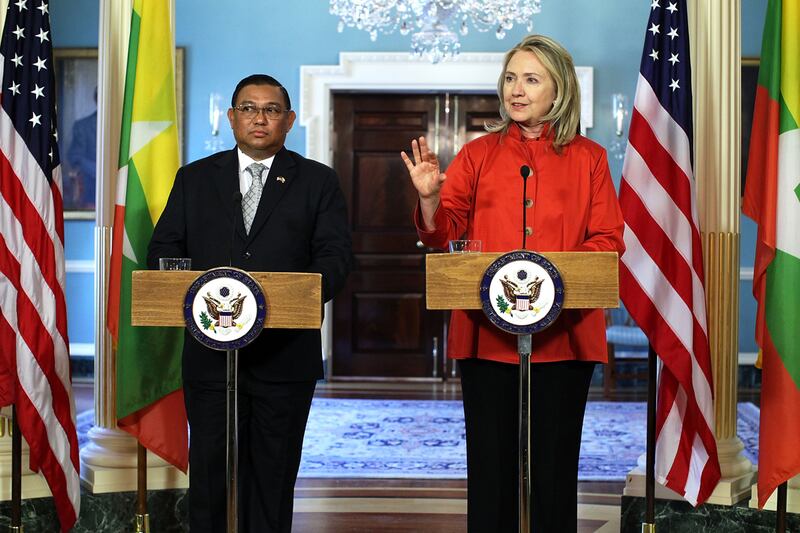
U.S. Secretary of State Hillary Clinton (R) and Burmese Foreign Minister U Wunna Maung (L) participate in a joint news conference at the State Department May 17, 2012 in Washington, DC. President Barack Obama has announced to nominate Derek J. Mitchell to become ambassador to Burma, the first one in more than 20 years. (Alex Wong / Getty Images)

Last month Suu Kyi seized the opportunities offered by the new wind of reform blowing in Southeast Asia’s poorest nation to lead her party, the National League for Democracy (NLD), to a triumphant election result. She and her colleagues won several dozen seats in parliament. Meanwhile Secretary Clinton offered strong American backing to Suu Kyi herself and to President Thein Sein, the man chiefly responsible for dragging Burma out of the shadows.

But on Thursday they parted company.

That was the day that the secretary of State, with bipartisan support from Congress, announced that the U.S.’s tough sanctions on Burma were to be suspended. These varied and complex measures, many of which have been in force since 1990, cannot be eliminated at a stroke, but President Obama did the next best thing, suspending the enforcement of most of them. For the first time in more than 20 years, this impoverished but resource-rich land of more than 50 million people comes within the purview of American business. The opportunities could be staggering.

Justifying the new policy, Clinton said, “This is a moment for us to recognize that the progress which has occurred in the last year towards democratization and national reconciliation is irreversible.”

But earlier in the week, Suu Kyi told a conference in Washington by video link, “You have to remember the democratization process is not irreversible.”

On Thursday, sitting alongside Burmese Foreign Minister U Wunna Maung Lwin in the State Department’s Treaty Room, Clinton said, “Today we say to American business: invest in Burma, and do it responsibly.” She went on, “We are suspending sanctions. We believe that is the appropriate step for us to take today. We will be keeping the relevant laws on the books as an insurance policy, but our goal and our commitment is to move as rapidly as we can to expand business and investment opportunities.”

By suspending sanctions except those that relate to Burma’s armed forces, Clinton echoed the policy announced last month by British Prime Minister David Cameron, standing beside Suu Kyi in the garden of her villa in Rangoon, Burma’s largest city and former capital. Suu Kyi herself endorsed the new line. But in recent days she has been at pains to express a more nuanced view.

“I’m not against the suspension of sanctions as long as the people of the United States feel that this is the right thing to do at the moment,” she told the Washington conference on Tuesday. But, she went on, “I believe sanctions have been effective in persuading the government to go for change.”

Suspending sanctions is, she conceded, “a way of sending a strong message” of support for the reforms that are under way. The reforms so far enacted include the release of the most high-profile political prisoners, the loosening of media censorship, and the legalization of trade unions.

But the democracy icon went on to warn that the reforms were “not irreversible” until the country’s military leaders were “solidly and officially committed to democratization.” As one example of the work that remains to be done, she said, “There should be no political prisoners in Burma if they really aim for democratization.”

Suu Kyi, who spent more than 15 years under house arrest before being re-admitted to Burma’s political life last year, finds herself walking a delicate line.

On the one hand, thanks to President Thein Sein’s reforms, Suu Kyi’s party has moved rapidly from being an outlawed pariah constantly in danger of being brutally extinguished to by far the most important and significant opposition voice in the country. She herself won a seat in parliament and there is talk that she may be offered the role of speaker in it, which would elevate her at a stroke to the top table, with real potential influence on regime policy.

On the other hand, as Suu Kyi is painfully aware, the reforms are still only halfway there. The country is still at war: a bitter conflict with the insurgent Kachin Independence Army (KIA) in the north of the country that broke out last year, ending a 17-year ceasefire, is getting worse not better, with both sides blaming the other for recent escalation. The suspension by the president of work on a highly unpopular dam over the Irrawaddy river may yet be thrown into reverse: Chinese state media reported on Wednesday that the project is being evaluated by experts from the NGO the International Commission on Large Dams.

‘There should be no political prisoners in Burma if they really aim for democratization.’

Most crucially of all, the nation’s constitution, which guarantees the military a decisive role in the executive, remains unchanged: a quarter of parliamentary seats are still reserved for the armed forces, and Burma’s Defense Council has the power to shut down the civilian government and re-impose martial law at will.

To armor plate Burma’s nascent and still-fragile democracy from military interference, Suu Kyi and her party are determined to bring about radical constitutional reform. Whether the suspension of sanctions will speed this process or, by relinquishing the only real weapon the West possessed, render it impossible, remains to be seen.

You Might Also Like

2013 Women in the World Speakers

2013 Women in the World Speakers

Inspiring women from around the globe will convene in April for the 2013 Women in the World Summit. See who’s coming!

International Women's Day

Through Her Lens

Through Her Lens

From invisible Iranians to dealing with an overweight body, see works from female photographers to watch.

FINANCIAL INCLUSION

Turning Poor Kids Into Savers

Women in the World

How to End Violence Against Women

Secret Weapon

The Woman Behind ‘Girls’

Women’s Advocate

Climate Change’s Gender Gap

Women in the World: It’s On!

Women in the World: It’s On!

Newsweek and The Daily Beast are excited to announce the 2013 Women in the World Summit on April 4 and 5. Get your tickets today.

Why I Choose to Be Child-Free

Why I Choose to Be Child-Free

DINKs, DILDOs, and other readers respond to Joel Kotkin and Harry Siegel’s Newsweek story about America's declining birthrate and share their reasons for remaining child-free.

Beyond Betty Friedan

Beyond Betty Friedan

Gail Sheehy looks at the new, strategic feminism, as PBS prepares to air the documentary ‘Makers: Women Who Make America’ tonight.

‘We Were Really Naïve’

‘We Were Really Naïve’

The mother of a domestic abuse victim speaks out

The Next Women’s Ambassador

The Next Women’s Ambassador

As Melanne Verveer departs, who could be Obama’s new champion for women and girls? By Katie Baker.

Robin Roberts to Be Honored at DVF Awards

Diane von Furstenberg joins GMA's Robin Roberts to talk about the annual DVF Awards and reveals the courageous anchor will be honored at this year's event on April 5th.

  1. Welcome Back, Robin! Play

    Welcome Back, Robin!

  2. Mobama: Bangs Are 'My Midlife Crisis' Play

    Mobama: Bangs Are 'My Midlife Crisis'

  3. R.I.P. Mindy McCready Play

    R.I.P. Mindy McCready

The Plus-Size Blogging Craze

The Plus-Size Blogging Craze

“Fatshion” is a popular community on Tumblr, where plus-size bloggers post pictures of themselves as a way of celebrating their size. Judy McGuire reports.

The Power in ‘Girl Rising’

The Power in ‘Girl Rising’

The film, which will be released March 7, advocates for the education of girls around the world. Eliza Shapiro reports.

‘Feminine Mystique’ at 50

‘Feminine Mystique’ at 50

Three feminists from different generations revisit Friedan’s classic. By Jessica Bennett, Letty Cottin Pogrebin, and Alisa Solomon.

Breastfeeding Wins Another Round

Breastfeeding Wins Another Round

A new CDC study is just the latest news to buoy the pro-breastfeeding camp, reports Eliza Shapiro.

The Book China Hates

The Book China Hates

Ping Fu talks to Katie Baker about the online backlash to her new memoir, ‘Bend, Not Break.’

The World After Hillary

The World After Hillary

She changed the game irrevocably, and now she’s about to transform it again—by walking away. Plus, read the full transcript of her farewell speech.

Malala Speaks!

Malala Speaks!

Tina Brown and Angelina Jolie announce gathering strength for an education fund in her honor.

women-in-the-world-foundation

Calling Out Victoria’s Secret

Calling Out Victoria’s Secret

How two women’s online plea is pushing the lingerie giant to the ‘survivor bra’ market. By Nina Strochlic.

Taking Stock

Roe v. Wade Turns 40

Interactive: The Geography of Abortion Access

Interactive: The Geography of Abortion Access

See locations of the country’s 724 clinics and distance to the closest clinic in different areas. By Michael Keller and Allison Yarrow.

STARTING OVER

Ground Zero of the Abortion War

Word Play

Call It By Its Name: Abortion

Roe v. Wade

Readers Share Their Abortion Stories

A Day in the Life

Inside an Oklahoma Abortion Clinic

Why Investing in Women Works

Why Investing in Women Works

When companies support women, write Melanne Verveer and Kim Azzarelli, their businesses and communities win.

Way to Go, Panetta!

Women on the Frontlines

The Female Fighter I Knew

The Female Fighter I Knew

Veteran Anthony Woods recalls a brave lieutenant who lost her life in Afghanistan.

Military Progress

Fully Integrated, Finally

WOMEN IN COMBAT

Bravery and Beauty

The Sperm Donor Trap

The Sperm Donor Trap

After gifting his DNA via Craigslist, a Kansas man may be on the hook for $6,000 in child support. Fair?

witw-1200-800-tease

150 Women Who Shake the World

They're starting revolutions, opening schools, and fostering a brave new generation. From Detroit to Kabul, these women are making their voices heard.