America, permit those of us in the commentariat to take just a moment away from flambéing Facebook investors to return to one of our favorite pastimes: picking on the politicians.

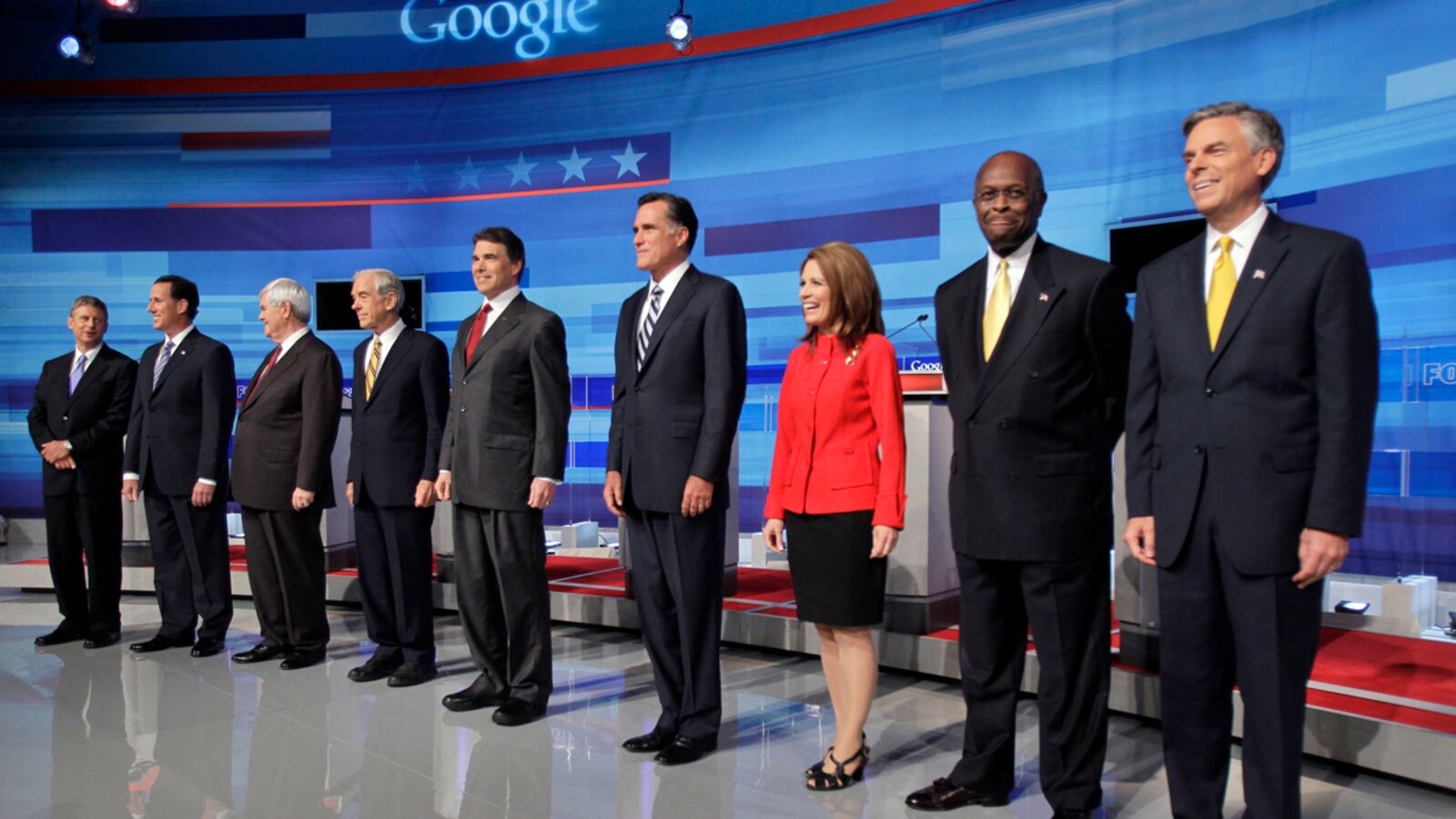
The latest politico making a return appearance in our crosshairs is Congresswoman Michelle Bachmann (R-Minn./Switzerland),who apparently owes $1 million to campaign vendors and others that her campaign cannot repay. Representative Bachmann now finds herself, with all respect to her gender, the latest in a growing list of the “deadbeat dads” of the 2012 campaign, joining Rick Santorum (who reportedly owes $2.3 million), Jon Huntsman ($3.7 million), and Newt Gingrich, who is once again in the headlines for his sizable $4.8 million debt (insert Tiffany’s joke here).
“Deadbeat dad” is one name you can’t call former senator John Edwards, however. He was smart enough to get other people to pay his bills.
I can see why debt-ridden also-rans is such a delicious story. Who’d ever heard, after all, of a politician being unable to balance a budget? How on earth, we ask righteously, were these people going to balance our federal budget if they couldn’t manage the bills from their own campaign? George W. Bush and Barack Obama both kept their campaigns out of debt—and just look how that financial know-how translated to the rest of our economy.
As someone who made a brief sojourn in presidential politics (full disclosure: I briefly advised the Gingrich campaign, and, like all consultants, only offered the advice that worked), allow me to say that the story is a bit more complicated than a bunch of candidates flying around the country and cackling hysterically at the poor suckers paying their bills. With the exception of Congressman Ron Paul, no one announces their bid for the presidency thinking they are going to lose the nomination. And let’s be fair: for a while it looked like almost anyone might be this year’s GOP nominee. We can pretend like it never happened—sort of like Lisa Lampanelli’s time on this season’s Celebrity Apprentice—but there in fact was a moment, a long moment, when it looked like the head of a pizza company might be the Republican Party’s nominee for president of the United States. (That’s not to say we haven’t done worse, by the way.)
When a candidate starts to think this is his or her year, when people across America give money to you, root you on, believe in you, tell you that it is going to happen, beg you not to quit, tell you to ignore all the polls, hang on your every word, it is hard to turn all that off—if you’ll forgive the pun, and cliché—on a dime. Last fall Bachmann was rising in the polls, then Perry, then Cain, then Newt, then Rick. None of them had the luxury that Mitt Romney had from the outset: a deep reservoir of well-to-do party bigwigs and former colleagues on Wall Street who for four years were being coddled and courted and asked to envision what their view would be once they moved into the Romney White House. We could of course decide that our party’s nominations only belong to people, like Romney, who can pay their own way; what a treat we’ve missed without Presidents Ross Perot and Donald Trump. But Americans have this corny idea that anybody, even people without a Rolodex of big-money donors, ought to have a shot at the highest office in the land. That approach has its risks.
Sometimes presidential candidates go into debt—and it pays off. In 2004, for example, John Kerry was basically living off his American Express Gold and a $10 gift card to Jiffy Lube by the time he rolled into Iowa for the caucuses. He ended up the nominee, easily able to repay the vendors who stuck with him. Hillary Clinton was in such financial trouble in 2008 that she loaned herself $10 million to come in second. No vendors are complaining about her.
As far as I can tell, candidates like Michelle Bachmann are trying to find a way to erase their debts. But there aren’t a lot of people waiting to throw money at ex-candidates who are only go to see the White House at the annual congressional picnic. John Glenn, the celebrity astronaut and one-time Ohio senator, famously took decades to pay off the debt from his once-promising 1984 campaign. But he did pay it off.
Of course, some presidential candidates are not going to work that hard. A couple of them probably don’t care all that much. That’s reprehensible. But politics is a gamble, not just for candidates but also for the vendors and aides who work for them as well.
Do I feel bad for the small-businesspeople, those who printed signs, buttons, and bumper stickers, those who provided transportation and other support for “the next president of the United States” and are now finding themselves stiffed? I do. They deserve to be the first people these campaigns reimburse. Am I ticked that I’m still owed money as an adviser? Yeah, maybe a little. Do I feel bad for the millionaire pollsters and consultants who’ve been stiffed? Eh, that one is a little bit harder. But a few of them, especially those who’ve been in politics for years, aren’t all that embittered. Sometimes the cause is more important than the cash.
For those who don’t feel that way, as Mike Brady might say, maybe this will teach you a lesson. Get as much cash up-front as possible. Or don’t ever do any work for a politician. They just can’t help themselves.