Rather surprisingly, the Austrian director Michael Haneke’s Amour, which premiered Sunday at Cannes, has proved to be among the most popular films to screen so far in the festival’s official competition. It’s surprising because many of Haneke’s earlier films have been labeled “difficult,” “confrontational,” or even “endurance tests.” Films like Funny Games (1997), in which thugs torture a middle-class family (Haneke directed a shot-for-shot U.S. remake with Naomi Watts in 2008) or The Piano Teacher (2001), which features Isabelle Huppert in the title role as a masochist enamored of sexual self-mutilation, were deliberately designed to make audiences uncomfortable.
As Haneke told The Daily Beast when I sat down with him and Amour’s star, the veteran French actor Jean-Louis Trintignant, “Art deals with daily life and life is difficult; it’s our duty as artists to step on people’s toes.”
Although Amour deals with unquestionably somber topics—the shock of seeing a loved one’s body and mind deteriorate, the validity of choosing euthanasia as a respite for suffering— the film is accessible to anyone who has ever coped with a partner or parent’s terminal illness. “Like almost everyone I know, I’ve been confronted with the illness of someone I loved deeply. It’s a very painful experience to look on helplessly,” explained Haneke.”
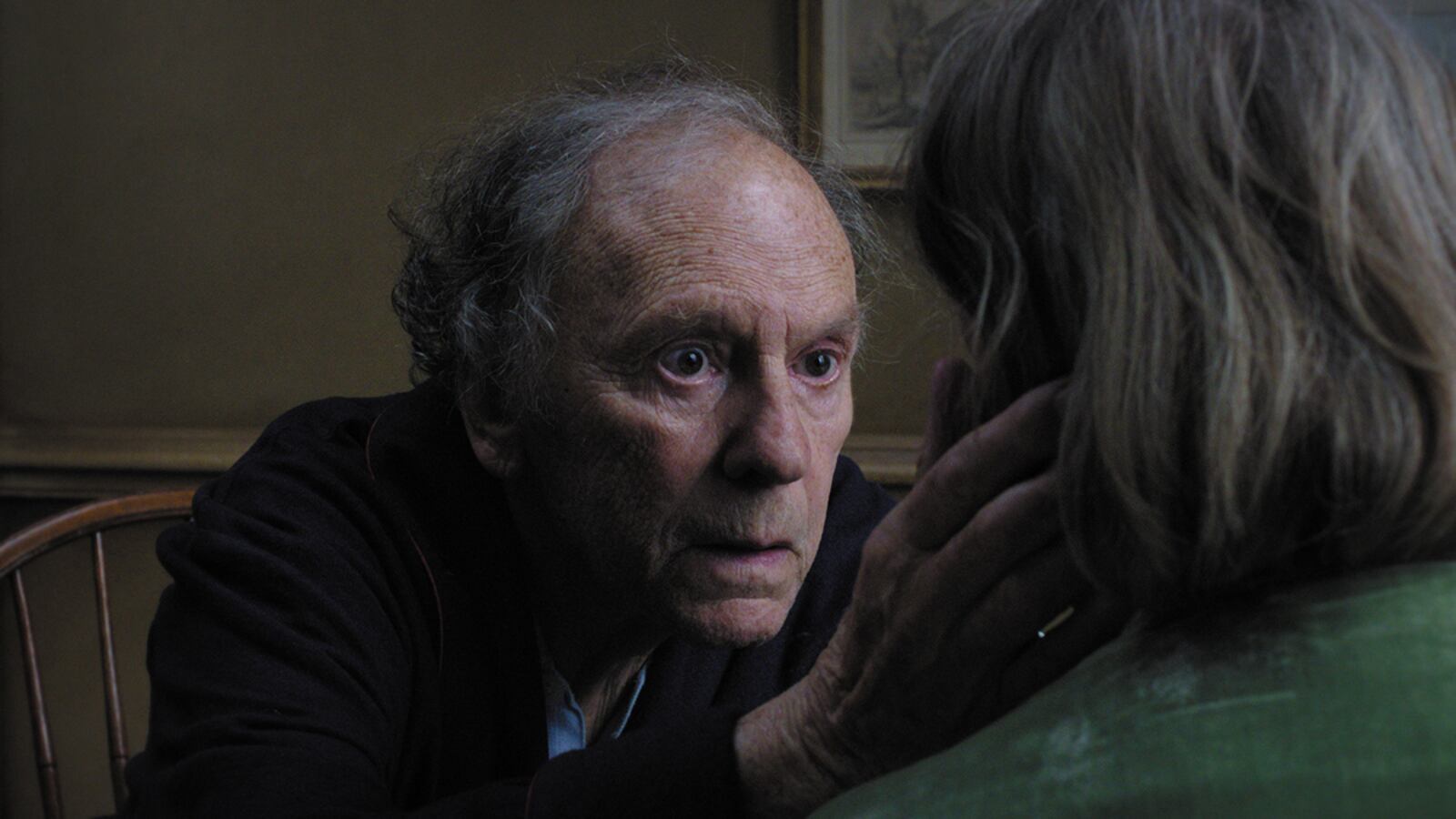
The plot couldn’t be simpler. Georges (Trintignant) and Anne (Emmanuelle Riva) are retired classical-music teachers who still relish each other’s company and the daily pleasures of meals and attending concerts. When Anne falls victim to a stroke, their world is turned upside down. Their middle-aged daughter, Eva (Isabelle Huppert), returns from London to Paris with her English husband but is appalled by her once vibrant and lucid mother’s sad transformation. At one point she remarks to her father, “She’s speaking gibberish … what’s next?” He replies that her condition “will go steadily downhill until it’s worse.” While there’s no facile sentimentalism in Haneke’s portrait of old age, the critics in attendance at Cannes, many of whom could not stomach his earlier films, are apparently responding to the purity of the love shared by a couple who appear totally devoted to each other.
Although Haneke does not make conventional “message movies,” Amour’s seeming endorsement of euthanasia certainly will prove controversial in some circles when Sony Classics releases the film in the United States. That’s fine with Haneke, who commented: “My American distributor thought that the film might provoke hefty debate; that’s exactly what films are supposed to do.” Trintignant adds: “I’m personally for euthanasia. When Anne first really wants to die, Georges stops her. But later, in a calm moment, he helps her by killing her.”

Haneke took on a formal challenge by confining, with several brief exceptions, the action to the couple’s apartment—the center of their long-lasting marriage. For this resourceful director, “the classical approach of the unity of time, space, and action set an aesthetic challenge that wasn’t very easy … the task was to have two people in a single set for over two hours without it becoming boring.”
As with Ingmar Bergman, the most celebrated European art-house director of an earlier generation, one of Haneke’s major themes has been the struggle of modern, middle-class Europeans to live in a world where time-honored religious values have eroded. Some early reviews of Amour claim that George’s and Anne’s love for music is redemptive and serves as a surrogate for traditional religious belief. But when I asked Haneke if he agrees with this argument, he coyly replied, “If you like.”
While Haneke is famous for refusing to offer interpretations of his own work, he later elaborates, “Theologians have written long essays on my work” and offhandedly mentions that Trintignant “plays a Bach chorale and interrupts his rendition because he’s troubled by its title, I Pray to You, Lord Jesus.” This hesitation, according to one’s particular response, might either exemplify the character’s rejection of religious convictions or a need to come to terms with God. It’s indisputably true that, while the works of Schubert and Bach have positive connotations in Amour, they also appeared to be an integral component of Isabelle Huppert’s sexual masochism in The Piano Teacher. Again refusing to force an interpretation of this seeming contradiction, Haneke just provides this gloss: “The very simple reason that Bach and Schubert keep coming back in my films is that they’re my favorite composers. Schubert’s music is magnificent but very sad”—a sadness that is perfectly congruent with the film’s downbeat orientation.
For film buffs, one of Amour’s primary pleasures is the opportunity to see two legendary French screen actors—Trintignant and Emmanuelle Riva (who is most famous for her starring role in Alain Resnais’s 1959 Hiroshima mon amour) in what may be their last performances. In recent years Trintignant—who made his mark in European cinema with impressive performances in Claude Lelouch’s A Man and a Woman (1966), Eric Rohmer’s My Night at Maud’s (1969)—and, especially, his bravura turn as a closeted gay fascist in Bernardo Bertolucci’s The Conformist (1970)—has worked primarily in theater. Haneke wrote the role of Georges with Trintignant in mind and claims that he wouldn’t have attempted to make the film if the actor wasn’t available.
Trintignant ‘s view of Haneke borders on the reverential: “I don’t think there are many directors today on the level of Fellini and Bergman. But I was very impressed by Haneke and think he’s the greatest director working today.” When I asked him to compare Haneke’s working method with, say, Rohmer and Bertolucci, he insists that Haneke is “more of a total filmmaker. He’s familiar with all aspects of filmmaking, including lighting, performance, editing, cinematography.” I wondered if he found Haneke, who has a reputation for asking actors to put up with multiple takes, demanding.” According to Trintignant, “He has a reputation for being difficult. But I came to him and said that I don’t like to do many takes. And he respected that. Sometimes we only did one take. It’s good when a director doesn’t put pressure on us.” He seems satisfied that Amour might become known as his crowning achievement: “The Conformist used to be my favorite film, but I now think that Amour is the best film I’ve ever made.”
When the Cannes jury announces its choice for best actor on Sunday, we’ll see if they think Trintignant is worthy of their award. In addition, although predictions are precarious, Amour certainly seems to be among the frontrunners for the Palme d’Or.
If Amour scores the top award, it would follow a Palme d’Or for Haneke’s The White Ribbon in 2009.