
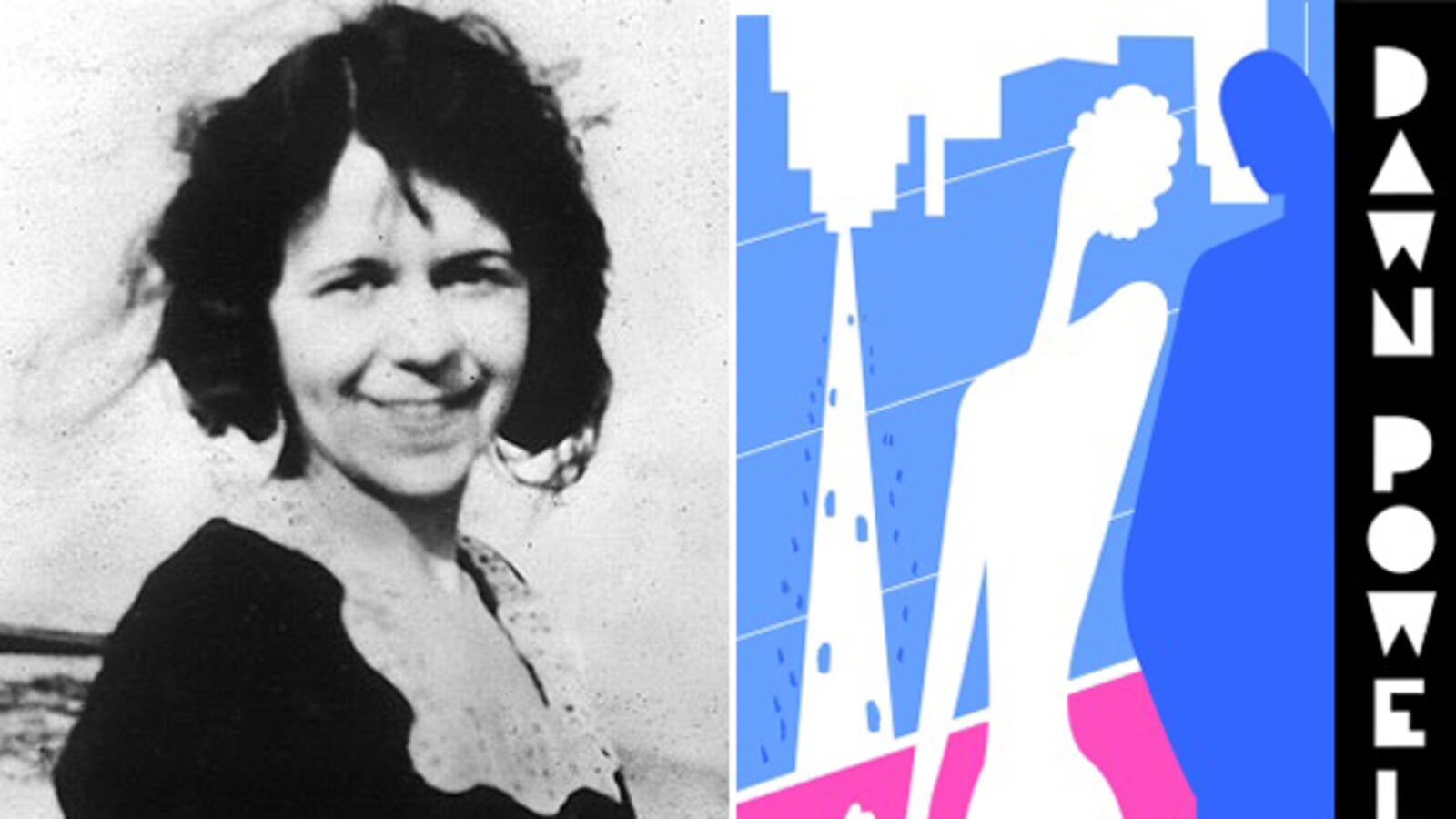

Dawn Powell’s A Time to Be Born is one of the most enjoyable novels written about World War II despite the fact—or is it thanks to the fact?—that not a single battlefield appears anywhere in it, nor any weapon more deadly than an ice pick. This is because Powell takes as her subject the war as experienced not over there, but over here. More specifically, A Time to Be Born is populated by the type of people who plotted the war from the safety of oak-paneled conference rooms, wrote searching essays about military strategy in the nation’s popular magazines and newspapers, and debated its finer points in the most exclusive Manhattan restaurants and hotel bars, over the best martinis. In Powell’s novel, the war serves as a brilliant excuse to throw a party.
The life of this party is the pretty Amanda Keller, the young second wife of a great newspaper magnate named Julian Evans. The Evanses are loosely based on the Luces—Clare Booth and Henry, publisher and founder of Time, Life, and Fortune. They knew “every one,” writes Powell, in a rare address to the reader, “and by ‘every one’ I certainly do not mean you or me or any one we knew.” Amanda, with the assistance of the best writers Julian can buy, publishes a diverting “sword-and-lace romance” designed to “comfort a public about to be bombed.” This novel, praised wildly by all of Julian’s newspapers, becomes a massive bestseller, and Amanda is transfigured by her success into a sober intellectual authority on all matters geopolitical and economic. “She made a heyday of the world’s confusion,” writes Powell. “She rode the world’s debacle as if it was her own yacht.”
Amanda delivers lectures at ladies’ clubs and publishes essays in Evans’s publications, with titles like “What’s Wrong With England,” “What’s Wrong with Russia,” and “What is the Future of America”—her copy again provided by assiduous staffers. She hosts lavish dinner parties and poses for photographs in dripping emeralds and barebacked gowns of silver brocade. And at night, after all the diplomats and movie stars have left the Evans’s graystone mansion off of Fifth Avenue, she tries, with great ingenuity, to avoid having sex with her short, ugly old husband.
But Amanda has a secret. Though her biography in Who’s Who suggests she has royal blood, and lists France and Switzerland as the scenes of her early education, the truth is that her father was a haberdasher with a gambling problem, and she grew up in an apartment above a store in the inconsequential burg of Lakeville, Ohio. Amanda is presented with a reminder of her humble past at the very beginning of the novel, in the form of Vicky Haven, a floppy, downtrodden childhood friend who has moved to Manhattan with hopes of finding love. Vicky soon does find love, in the form of Ken Saunders, Amanda’s own secret lover. This creates an awkward love triangle, which later turns into a quadrilateral, then pentagon, before settling into a love hexagon—the multiplication of sexual partners a byproduct of the countless parties, and the countless cocktails.
Meanwhile, Europe simmers. The novel takes place almost exactly when it was written—in 1941—in the months before America’s declaration of war: “Paris was gone, London was under fire, the Atlantic was now a drop of water between the flame on one side and the waiting dynamite on the other.” The war is an entrancing possibility, but not yet a reality, and it remains that way throughout the novel. The political situation is only discussed at any length in the novel’s opening pages, after which it recedes, almost entirely, from sight. What follows is essentially a comedy of manners. As Edmund Wilson, in one of the few serious critical appreciations of Powell published in her lifetime, wrote, Powell’s “real theme is the provincial in New York.” Amanda is the assimilated provincial trying to conceal her humble past; Vicky, fresh from the provinces, struggles to decode the baffling language of Manhattan society. For the most part Powell’s characters behave ignobly, pathetically, and shamelessly, which is why they are so vivid, and so funny. This is also one of the reasons why her novels never found a large popular audience. Her heroines are not admirable, in any conventional sense. They are desperate, and they settle for what they can get. When Ken Saunders, spurned by Amanda, settles for Vicky, Vicky accepts him unhesitatingly: “You had to take leavings, if you didn’t get served the first time. You had to fight for even those.”
When the war does intervene, it serves as a source of dramatic irony. “The ambition to write novels seemed the silliest work in the world for a grown man, with war on every side,” writes Powell, assuming the perspective of Ken Saunders, a failed novelist. Elsewhere, referring to characters like Vicky and Ken, she writes: “What unimportant people they were, certainly, in this important age!” The novel’s very first sentence strikes the tone: “This was no time to cry over one broken heart.”
But of course Powell did write a novel about a broken heart, in which the war has no significant role, and this is what distinguishes A Time to Be Born from so much of war literature. She understood that in war, just as in peace, people behave shabbily, selfishly, and lasciviously, and that the most important people in the world are no less petty than the most unimportant. And even in wartime—especially in wartime—we need novels to make sense of the conflagration around us. Besides, conflicts of the human heart have always made for better fiction than the conflicts of nations, which are more easily resolved. As Julian Evans exclaims, at his highest point of exasperation, “Ah, these human problems! They’re the ones that defeat a man!”
Other notable novels published in 1942:
The Moon is Down by John Steinbeck
Dragon’s Teeth by Upton Sinclair
The High Window by Raymond Chandler
Donovan’s Brain by Curt Siodmak
Pulitzer Prize:
In This Our Life by Ellen Glasgow
Bestselling novel of the year:
The Robe by Lloyd C. Douglas
This monthly series will chronicle the history of the American century as seen through the eyes of its novelists. The goal is to create a literary anatomy of the last century—or, to be precise, from 1900 to 2012. In each column I’ll write about a single novel and the year it was published. The novel may not be the bestselling book of the year, the most praised, or the most highly awarded—though awards do have a way of fixing an age’s conventional wisdom in aspic. The idea is to choose a novel that, looking back from a safe distance, seems most accurately, and eloquently, to speak for the time in which it was written. Other than that there are few rules. I won’t pick any stinkers.
Previous Selections:
1902—Brewster’s Millions by George Barr McCutcheon
1912—The Autobiography of an Ex-Coloured Man by James Weldon Johnson
1922—Babbitt by Sinclair Lewis
1932—Tobacco Road by Erskine Caldwell