Content Section

Peace Activist Mossarat Qadeem Enlists Mothers to Fight Terrorism in Pakistan

Activist Mossarat Qadeem is fighting extremism in Pakistan one child at a time—with the help of their moms.

Her phone rang at 9 p.m. “Can you come tonight? He’s home.” The voice was anxious. “My son left those extremists he took up with, but maybe just for the night.”

kids-terrorists-swanee-hunt-article1

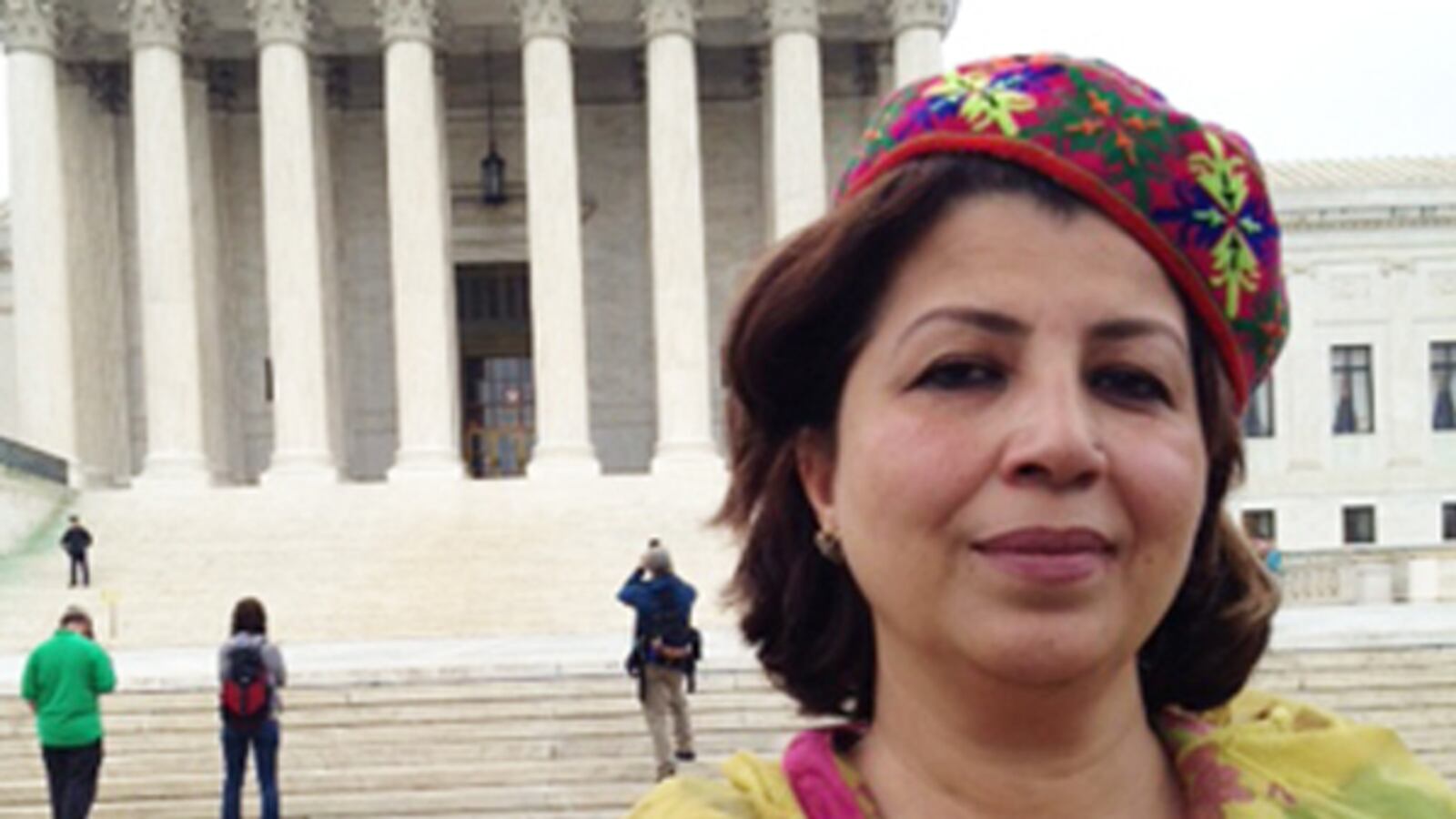
Mossarat Qadeem on a recent visit to Capitol Hill.

Mossarat Qadeem, a peace activist in Pakistan, considered the dangerous four-hour drive through checkpoints and dark mountain roads into the northern region of the country. “I’ll be with you for breakfast,” she said. “Try to keep him home until morning.”

At 4 a.m., before first light, Qadeem was driving north from Islamabad, through rough rural roads into an area so dangerous that U.N. workers and U.S. soldiers are prohibited from entering. Her goal: to save a boy’s future.

Qadeem is fighting extremism in Pakistan one child at a time, meeting with mothers and their children to discuss the dangers of radical groups. To do so, she left academia several years ago, giving up 13 years of political-science teaching at the University of Peshawar, and focused on gaining the trust of mothers living on the front lines of extremist recruitment. She now runs an aid group called Painam, or “Promise,” to talk with kids and steer them into jobs and away from the false promises of radicals in the Taliban and other groups.

She recently visited Capitol Hill, meeting with congresswomen, aid groups, and world leaders, including Secretary of State Hillary Clinton. I had the pleasure of sitting down with Qadeem and talking to her about her important work.

She told me about meeting the young man and his mother in northern Pakistan, a typical scenario. Wrapped in a red cotton shawl, she recalled, she entered their home and settled onto a straw mat they’d laid out for her. “Is there anything I can do for you, Azam?” she asked the young man, dressed in all white. “Help me understand why you joined them.” She remembers his piercing gaze.

Crouched on the mud floor, Azam was soft-spoken but direct. He held up a piece of bread. “What can you do for me?” he asked impatiently. “Before I joined them, I couldn’t even supply my family this bread.”

“If you’re killed,” Qadeem countered, “you won’t be able to help them.”

Azam shrugged, “But I’m doing jihad.”

The boy didn’t fear suicide; his teachers had told him that his family would go to heaven.

She asked what that meant.

“Killing infidels,” he answered without hesitation. “Those you’re siding with.”

“The Qur’an says that we should never kill,” she replied.

Azam argued with her, but there was innocence in his answers. He didn’t fear suicide; his teachers had told him that his family would go to heaven.

“But now your family is living in hell,” Qadeem reminded him. “Why don’t you do something about that?”

Azam gave her his mobile number and took three days to decide. Like the 78 other young men Qadeem has worked with, he ultimately chose to turn away from the path he’d been led down with false promises and addiction—hashish mixed with opium to weaken resistance.

As recently as 2003, this level of extremism was unthinkable in Pakistan, Qadeem told me. Yet 33,000 people have been killed since then, and a stunning 5 million displaced by the violence. Money is stolen, children taken by force, girls’ schools blown up, and women prevented from leaving home. How did this happen?

Qadeem explained that those who could not read the Quran accepted the teachings of mullahs they believed would never lie.

If misplaced trust is the roadblock, Qadeem has found a way around it. She humanizes the extremists, recognizing that they often are minors, and identifies a path to transformative influence for the young recruits: their mothers.

“If you want to carry out jihad,” she tells the boys, “carry it out against corruption, social ills, and political dishonesty.”

kids-terrorists-swanee-hunt-article2

Qadeem meets officials at the State Department.

Encouraged by their mothers, the young men Qadeem has met with are now receiving social counseling and job training: mobile-phone repair, driving, plumbing, electrical work. Azam has opened a shop, and today he makes a living for himself and his family.

Qadeem is one among a nonviolent army of women promoting collaboration over confrontation as they lift up the moderate voices drowned out by radicals in Pakistan. Her work is art, not science. “Extremism is a state of mind,” she says. “You can’t define love; you must feel it. And so you must feel extremism.”

Secretary Clinton said recently that “true peace requires reconciliation and justice. It requires opportunity and sustainable security for all citizens…and women can be a powerful force for peace across all these dimensions.”

Policymakers in D.C. are taking notice, recognizing that this Pakistani peace activist could be the future of American foreign policy. Smart power is betting on Mossarat Qadeem.

You Might Also Like

2013 Women in the World Speakers

2013 Women in the World Speakers

Inspiring women from around the globe will convene in April for the 2013 Women in the World Summit. See who’s coming!

International Women's Day

Through Her Lens

Through Her Lens

From invisible Iranians to dealing with an overweight body, see works from female photographers to watch.

FINANCIAL INCLUSION

Turning Poor Kids Into Savers

Women in the World

How to End Violence Against Women

Secret Weapon

The Woman Behind ‘Girls’

Women’s Advocate

Climate Change’s Gender Gap

Women in the World: It’s On!

Women in the World: It’s On!

Newsweek and The Daily Beast are excited to announce the 2013 Women in the World Summit on April 4 and 5. Get your tickets today.

Why I Choose to Be Child-Free

Why I Choose to Be Child-Free

DINKs, DILDOs, and other readers respond to Joel Kotkin and Harry Siegel’s Newsweek story about America's declining birthrate and share their reasons for remaining child-free.

Beyond Betty Friedan

Beyond Betty Friedan

Gail Sheehy looks at the new, strategic feminism, as PBS prepares to air the documentary ‘Makers: Women Who Make America’ tonight.

‘We Were Really Naïve’

‘We Were Really Naïve’

The mother of a domestic abuse victim speaks out

The Next Women’s Ambassador

The Next Women’s Ambassador

As Melanne Verveer departs, who could be Obama’s new champion for women and girls? By Katie Baker.

Robin Roberts to Be Honored at DVF Awards

Diane von Furstenberg joins GMA's Robin Roberts to talk about the annual DVF Awards and reveals the courageous anchor will be honored at this year's event on April 5th.

  1. Welcome Back, Robin! Play

    Welcome Back, Robin!

  2. Mobama: Bangs Are 'My Midlife Crisis' Play

    Mobama: Bangs Are 'My Midlife Crisis'

  3. R.I.P. Mindy McCready Play

    R.I.P. Mindy McCready

The Plus-Size Blogging Craze

The Plus-Size Blogging Craze

“Fatshion” is a popular community on Tumblr, where plus-size bloggers post pictures of themselves as a way of celebrating their size. Judy McGuire reports.

The Power in ‘Girl Rising’

The Power in ‘Girl Rising’

The film, which will be released March 7, advocates for the education of girls around the world. Eliza Shapiro reports.

‘Feminine Mystique’ at 50

‘Feminine Mystique’ at 50

Three feminists from different generations revisit Friedan’s classic. By Jessica Bennett, Letty Cottin Pogrebin, and Alisa Solomon.

Breastfeeding Wins Another Round

Breastfeeding Wins Another Round

A new CDC study is just the latest news to buoy the pro-breastfeeding camp, reports Eliza Shapiro.

The Book China Hates

The Book China Hates

Ping Fu talks to Katie Baker about the online backlash to her new memoir, ‘Bend, Not Break.’

The World After Hillary

The World After Hillary

She changed the game irrevocably, and now she’s about to transform it again—by walking away. Plus, read the full transcript of her farewell speech.

Malala Speaks!

Malala Speaks!

Tina Brown and Angelina Jolie announce gathering strength for an education fund in her honor.

women-in-the-world-foundation

Calling Out Victoria’s Secret

Calling Out Victoria’s Secret

How two women’s online plea is pushing the lingerie giant to the ‘survivor bra’ market. By Nina Strochlic.

Taking Stock

Roe v. Wade Turns 40

Interactive: The Geography of Abortion Access

Interactive: The Geography of Abortion Access

See locations of the country’s 724 clinics and distance to the closest clinic in different areas. By Michael Keller and Allison Yarrow.

STARTING OVER

Ground Zero of the Abortion War

Word Play

Call It By Its Name: Abortion

Roe v. Wade

Readers Share Their Abortion Stories

A Day in the Life

Inside an Oklahoma Abortion Clinic

Why Investing in Women Works

Why Investing in Women Works

When companies support women, write Melanne Verveer and Kim Azzarelli, their businesses and communities win.

Way to Go, Panetta!

Women on the Frontlines

The Female Fighter I Knew

The Female Fighter I Knew

Veteran Anthony Woods recalls a brave lieutenant who lost her life in Afghanistan.

Military Progress

Fully Integrated, Finally

WOMEN IN COMBAT

Bravery and Beauty

The Sperm Donor Trap

The Sperm Donor Trap

After gifting his DNA via Craigslist, a Kansas man may be on the hook for $6,000 in child support. Fair?

witw-1200-800-tease

150 Women Who Shake the World

They're starting revolutions, opening schools, and fostering a brave new generation. From Detroit to Kabul, these women are making their voices heard.