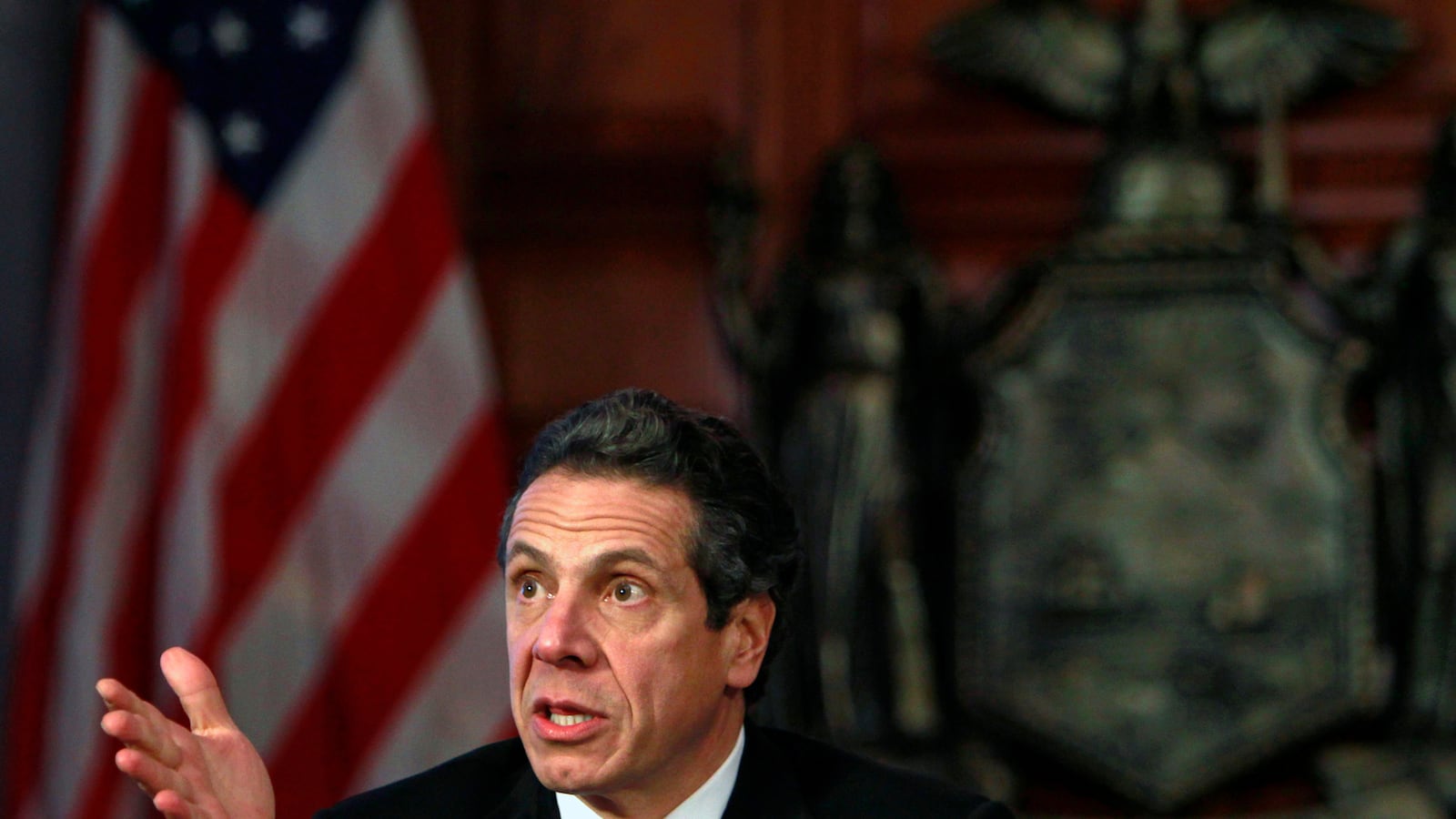
Democratic Governor Andrew Cuomo’s decision this week to call for a loosening of the state’s marijuana laws may have been motivated by local concerns, but it again positions the popular executive and oft-rumored 2016 presidential candidate at the vanguard of his party’s rapidly shifting views on social issues.
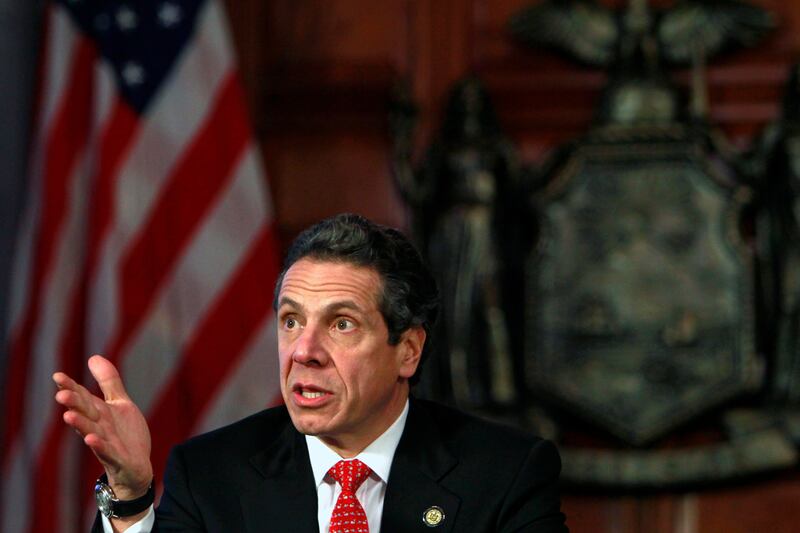
Like his aggressive and ultimately successful effort to pass same sex marriage last spring—when Barack Obama was still “evolving” on the issue—Cuomo’s pot stance represents another area where his views have moved past those held by the president. The governor, who has declined to address speculation about his own national ambitions, has been seen as a reluctant surrogate for Obama, perhaps hesitant to exhaust his ample political capital on behalf of a polarizing White House reelection bid.
Wading into the furor over New York City Mayor Michael Bloomberg’s stop-and-frisk policy and the alarming number of African-Americans and Latinos—mostly young men—who have been arrested for public possession of marijuana after being ordered to empty their pockets, Cuomo on Monday called on the state legislature to act. While New York decriminalized personal possession of marijuana in 1977, making it a ticket violation, public display has remained a misdemeanor—and has become the most common reason for arrest in New York. Which means either the whole city is walking around with nickel bags in hand, or that stopped suspects are “encouraged” to pull out their pockets and, after complying, end up in cuffs and with a record.
“There’s a blatant inconsistency. If you possess marijuana privately, it’s a violation. If you show it in public, it’s a crime,” Cuomo said at an Albany press conference. With New York City Police Commissioner Ray Kelly at his side, he urged the state legislature to amend the law that decriminalized marijuana to include pot in public view.
"It's a bold move by Cuomo and gives him strong credentials with progressives for the future," said Mark McKinnon, the GOP strategist who masterminded both of George W. Bush's presidential campaigns. "It's a bit of dice roll but it's one of those issues like gay rights where the public support is only likely to improve and unlikely reverse."
But Drug-reform advocates, while pleased to have the extraordinarily popular governor of one of the largest states in America on board, see Cuomo responding to a shift in public opinion more than anything else.
“Governor Cuomo is definitely no friend to marijuana reform,” said Morgan Fox, a spokesman for the Marijuana Policy Project. But “politicians are starting to realize they can’t be behind the times on this any longer.”
Changing state law to work with the city’s crime-control tactics is a pragmatic move, as it leaves intact the forceful stance toward petty crime that has been a trademark of New York City since the Rudy Giuliani era began in the early 1990s. Until Cuomo’s announcement, Kelly and Bloomberg had emphatically resisted any change in the law, though the commissioner quietly issued an operational memo last year reminding officers that possession, unlike display, was not a criminal act. Arrest numbers, however, continued their upward climb even after the memo’s distribution.
“If aggressive policing is enormously costly, it’s a double-edged sword, because the evidence is pretty clear it’s been beneficial” at bringing the crime rate down, said Franklin E. Zimring, a professor at the University of California at Berkeley Law School and author of The City That Became Safe: New York’s Lessons for Urban Crime And Its Control.
Whatever Cuomo’s motivations, a high-profile embrace of marijuana decriminalization helps draw attention away from his economic approach, which has included steep cuts to the state budget and has often put the governor at odds with the Democratic Party’s traditional constituency of organized labor.
“It’s a carefully calculated pattern,” said Richard Brodsky, a senior fellow at the think tank Demos and a former member of the New York State Assembly. Cuomo and his political team have concluded “that you can appeal to the progressive wing of the Democratic Party by adopting its social philosophy and rejecting its economic philosophy.”
The pot move continues what has become a habit for Cuomo of pushing the debate on social policy to the left, boosting his credibility with the Democratic base even as he’s governed as a fiscal conservative. Though few would have predicted it a few years ago, the former attorney general is now way out front of Barack Obama on drugs.
“He’s been so incredibly silent on the issue of mass, racial incarceration,” Ethan Nadelmann, executive director of the Drug Policy Alliance, said of the president. “The one thing he did was to make good on his campaign commitment to reform the crack powder laws. And that’s a small piece. His reticence on this issue has been striking.”
Until 2010 possession of five grams of crack meant a mandatory prison sentence of five years, and one had to possess 500 grams of powder cocaine to trigger the same punishment. The president secured congressional approval for a reduction in the sentencing disparity from 100–to-1 to 18-to-1, a modest victory for an often-marginalized cause.
Since then, the Department of Justice has embarked on an unprecedented campaign against medical marijuana, setting Obama on course to surpass George W. Bush’s record number of facility closures in his second term. This antagonistic approach could cause the president some trouble in Colorado, a swing state key to his reelection hopes, where many of the same activists who worked for his 2008 campaign led the charge to make sure pot legalization is on the ballot in November.
What’s more, a Gallup poll last year found for the first time that a majority of Americans support outright marijuana legalization. Just last month, Democratic primaries in Texas and Oregon saw the pro-pot candidates win, despite their opponents savaging them for being soft on crime.
Cuomo’s embrace of marijuana decriminalization comes at a key moment, then, and could serve as a signal to fellow Democrats unhappy with present drug policies but concerned about the political danger of moving on the issue.
“Cuomo is setting a tone that I think others will follow,” Albany County District Attorney P. David Soares, who shocked the local political establishment by winning as the drug-reform candidate in his first race eight years ago, told The Daily Beast.
And making his move on pot reform now gives the governor some credibility with party activists down the line.
“It’s a powerful position for someone who wants to develop a very strong following in the base of the Democratic Party,” said Tad Devine, a veteran Democratic political consultant who was a top adviser to the presidential campaigns of Al Gore in 2000 and John Kerry in 2004.