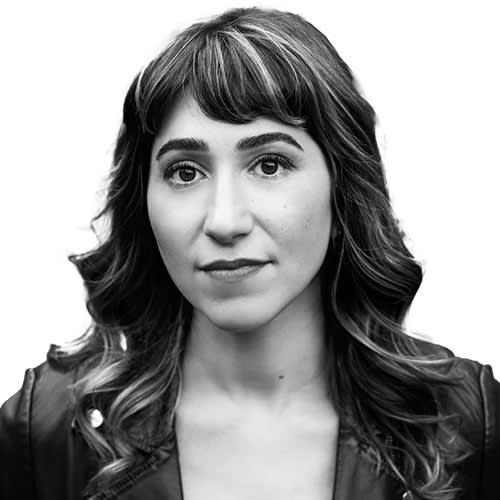

Cindy Chang was driving from Southern California to a childhood friend’s wedding in Arizona in early March when she was pulled over at an immigration checkpoint and asked if she was a citizen of the United States. She said no, and offered her South Korean passport.

“They told me I was going to get deported,” Chang said of the border-patrol officers she encountered on the outskirts of Yuma. “I kept insisting, ‘Please check again. Please check again.’ What they were telling me was that I don’t belong there [in the U.S.].”
Arizona is notoriously inhospitable to immigrants, and birthed aggressive “paper’s please” legislation bound for ruling in the Supreme Court.
An eight-year-old deportation order that Chang—who came to the U.S. when she was 7—was seeing for the first time had caught up with her. Chang knew she wasn’t here legally, but had thought her application was still pending, and her status thus unresolved.
At border patrol, Chang called her dad and texted friends. Everyone who knew and loved her flew into action. But they couldn’t move quickly enough to prevent her from boarding a bus to Eloy Detention Center, where she surrendered her own clothes and says she was demeaned by guards until they realized she spoke perfect English. She said Eloy staff spent time “barking orders” at detainees and “giving us the death glare to eat faster, walk faster. I don’t know why they can’t say please or thank you,” Cindy said.
She was detained at the facility many have compared to jail, with no clear timetable for how long she’d be there and the looming prospect of imminent deportation to a country she hadn’t seen in 20 years, and whose language she barely speaks.
With help from the Methodist church community where she teaches Sunday school, her Congressman Mike Honda, the Asian Law Caucus, and a petition with more than 2,000 signatures from change.org, the San Jose resident was granted an extremely rare temporary stay of removal and was freed from Eloy, which can hold more than 1,500 female detainees at one time, after just three weeks.
The detention center is the last stop in the U.S. for most of the people held there, according to Chang’s attorney at the Asian Law Caucus, Anoop Prasad, who has 30 clients currently detained.
Chang—who attended elementary, high school and a two-year college in the United States, has a clean record and a job managing accounts and answers phones at an insurance agency—seems like the model immigrant for President Obama’s executive order on immigration announced Friday, which he says “lifts the shadow of deportation,” from young people like her, and instead concentrates efforts on extraditing illegal criminals.
“It makes no sense to expel talented young people who, for all intents and purposes, are Americans,” the president said in his announcement.
Advocates and coalitions of youth who staged protests and sit-ins at Obama campaign headquarters and at Romney campaign events before the announcement applauded the administration’s move, but there are many loopholes. Though he is glad for the order’s historic potential, Dream Act lobbyist Cesar Vargas admits it falls short.
“The whole package is a path to citizenship,” said Vargas, who helped place protestors at Romney events, and told his own story of undocumented status at a conference held by Illinois Senator Richard Durbin. The policy is definitely not that path. Chang and others ensconced in removal proceedings face a review by Immigration and Customs Enforcement (ICE), and if they are deemed eligible, the case to deport will pause for two years, but could resume again after that time. Also, a “significant misdemeanor” or other infraction could disrupt their stay. And a new administration might opt to discard the policy all together.
Chang has not been reviewed, and her fate is unclear, since the new move gives prosecutors “discretion” to choose not to deport “dreamers,” a clear allusion to the Dream Act, who came to the U.S. before they were 16 and don’t have criminal records or other indicators that they’d post a security risk here. But discretion is just that, not a protection guarantee, so Chang remains in legal limbo.
The timing of the new policy may have been politically motivated. It was executed by the executive branch without needing action from Congress and announced by Obama just days before both he and Mitt Romney addressed the annual conference of the National Association of Latino Elected and Appointed Officials It also heads off an expected proposal for legislative action by Florida Republican senator and vice presidential possibility Marco Rubio that was expected to cover similar ground. Still, voters applauded the move. A Bloomberg News poll Tuesday showed potential voters supporting the order outpaced opponents two to one.
But even after being released, Cindy remains embroiled in removal proceedings. She must check in monthly with a branch of the ICE, the wing of Department of Homeland Security that calls itself the “second-largest investigative agency in federal government.” Like many young undocumented people, Chang hadn’t known her status before entering Arizona. Instead, she had been waiting “for green-card judgment to fall,” and says she was beyond alarmed to learn she had never received a 2004 notice demanding she appear in court across the country from her home.
Prasad believes that had she been born in Mexico, she would have been deported there immediately. Travel arrangements to South Korea take far longer to coordinate, which bought her time, he said.
The “prosecutorial discretion” mandated by the president to apply to cases like Chang’s had been required and perhaps even deployed to some extent already by ICE, particularly after a memo asking for its deployment by the head of ICE, John Morton, in a memo issued last June (PDF). Expend resources rooting out undocumenteds who were drug dealers and criminals, not Sunday school teachers and other productive society members, so the idea went. An executive order may be stronger than an ICE internal memo, but “some offices will be hostile to the new policy,” said Prasad. “They won’t want to implement it.” And with such a long outstanding deportation order, and a rare stay of removal granted to free her from detention, Chang’s case isn’t exactly straightforward.
For starters, she’s Asian, rather than Mexican or Latin American, two communities that have borne the brunt of immigration battles, and until this year accounted for the bulk of all new arrivals. In her community, undocumented status is stigmatized and hardly discussed many times leading to a lack of education, and in Chang’s case, near removal. Chang stressed that her detention was far worse for her monolingual Korean parents than for herself. “I think it had to do with the guilt on their part that they couldn’t resolve it, that it had gotten to that point.” Asians comprise roughly 1.5 million of the 12 million undocumented immigrants in the U.S. according to the National Council of Asian Pacific Americans.
Two decades ago, Cindy relocated to the U.S. with her parents. Her father’s parents and siblings were already there, and had found an employer to sponsor him at a turkey processing plant in North Carolina. He applied for a green card there, but changed jobs and moved to California while waiting to hear back on his application. The denial, because he had changed jobs, eventually arrived at his old address and never caught up with him. Similarly, Cindy’s 2004 deportation notice was also sent to an address associated with her parents, and never reached her, according to her attorney.
Chang’s Congressman Mike Honda, whose office worked to block her deportation, commends the executive order’s ability to “allay immediate anxiety that young people have” and to provide the time and challenge for “us to put another bill in front of him.”
“I have the audacity of hope that the legislature can come to their senses and do the right thing,” says Honda of passing a Dream Act, which would provide the path to citizenship the executive order lacks. Meantime, many Dream Act supporters fear that a new administration may not honor the policy, and that non-threatening undocumented youth may regress on their path to staying in the country they call home.
What could happen to Cindy and others with cases like hers is that ICE will “defer action against the individual for a period of two years” allowing her to stay in the states for at least that long, according to a DHS official. Yet, DHS can “revoke the grant of deferred action,” at any time, not inspiring confidence in those working on Chang’s behalf.
Right now, she still has a May 2013 court date, after which she could be deported or given 120 days to leave and forbidden from visiting for a decade, according to Prasad. Chang’s younger sister, a natural-born U.S. citizen, could petition for her residency, but Prasad believes this would take more than a decade, judging by the fact that visas issued now correlate with sibling petitions filed before January 2001 (PDF). “The number of people applying and petitioning relatives goes up every year, but the number of visas available never does,” Prasad said.
He guessed that Chang would be granted the two-year relief, and a temporary work permit “that she can use to get a state ID or driver’s license.” After the two-year windfall, she and others like her would need to reapply for another two-year period of deferred action, according to the DHS.
When Chang heard about the administration’s new policy on National Public Radio, she immediately called her lawyer to find out if she fit the bill, and to get the process moving. DHS has yet to provide them with a timeline, Prasad said. So now, an optimistic Chang waits.
“Now that it’s becoming a reality, I haven’t quite thought it through,” she said of the possibility that she could stay in the U.S., though a degree from a 4-year college has been a longtime dream. “It was more of living day by day. I’m able to see a broader picture now. I’m able to hope for things a bit bigger.”