
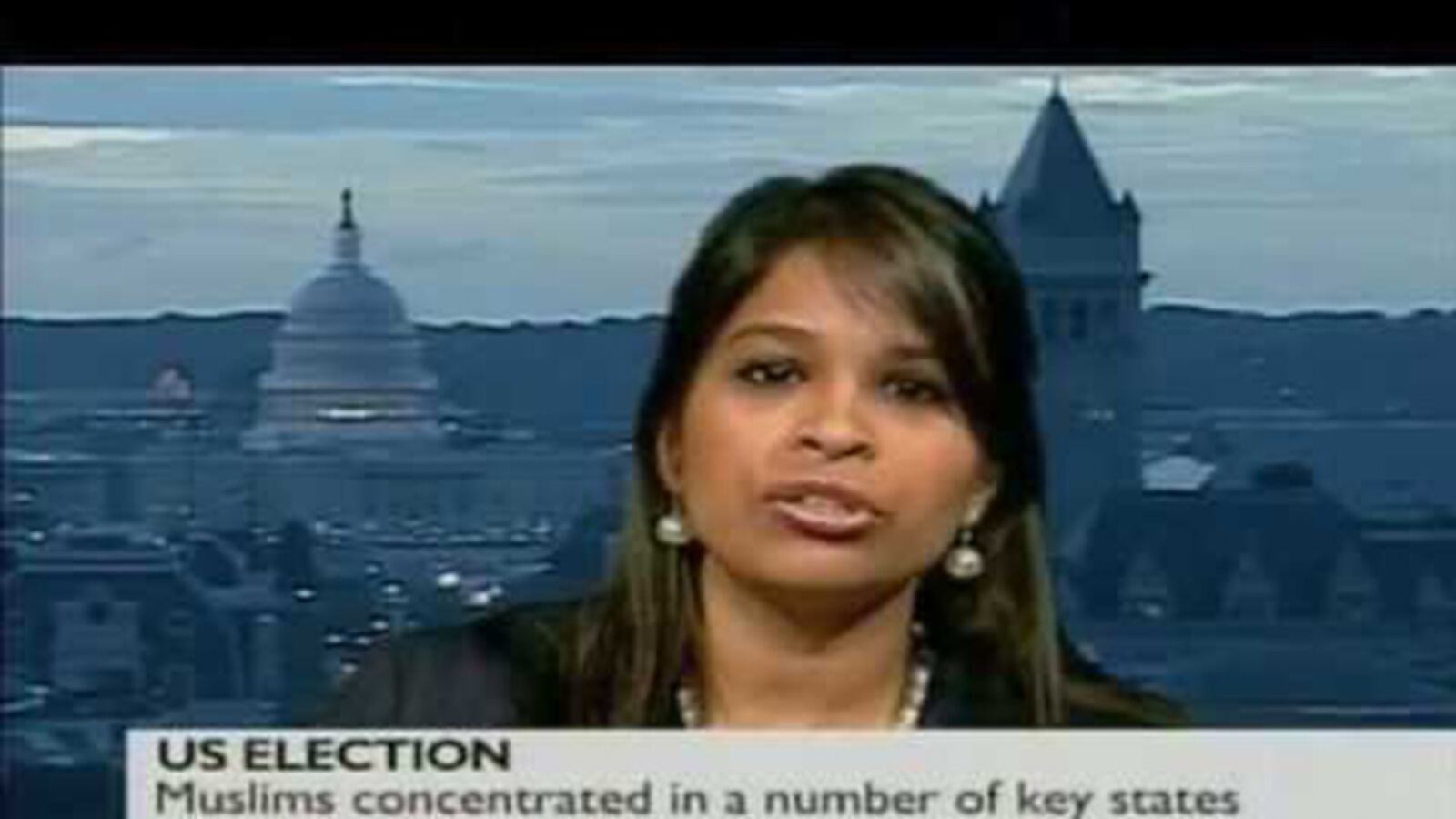
Safiya Ghori-Ahmad is one of those overqualified types that Washington, DC, seems to attract. At 31, she is fluent in Urdu and Hindi, and holds both a law degree and a master’s in international development. She was born and raised in Arkansas to a family who had emigrated from India. You probably wouldn’t have heard of her, except that earlier this month she filed suit in federal court, claiming that a job she was offered at a government agency was taken away from her because she’s Muslim. The kicker? The agency that rescinded the offer was created to fight religious discrimination around the world.
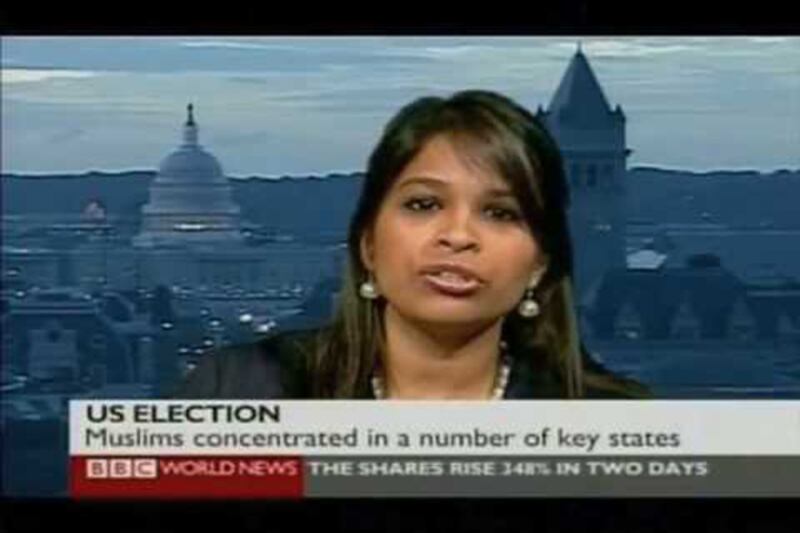
Back in 2009, Ghori-Ahmad was offered a position as a South Asia staff analyst for the United States Commission on International Religious Freedom. But, her complaint says, commissioners there rescinded the offer when they learned of her heritage. Among other things, she claims, she was asked to minimize her work in the Muslim world, because several commissioners were uncomfortable with Muslims. In the suit, Ghori-Ahmad also claims one staffer recommended she “call in sick” to avoid a few of the commissioners on days they’d be in the office.
The suit is the most high-profile attack to date on USCIRF (Yoo-serf inside the beltway), which was created in 1998 under the International Religious Freedom Act, and consists of a slate of unpaid commissioners who travel on fact-finding missions abroad, issue recommendations to the State Department, the President, and Congress, and flag countries where religious persecution is particularly bad, or has recently ticked upward.
The commission is, by mandate, bipartisan, and by DC standards it is tiny: its original operating budget of $4 million was reduced by 30 percent earlier this year. But that hasn’t insulated it from consistent criticism over the years, primarily for using its mandate to promote the religious freedom of Christians before all others, and for what some have called an anti-Muslim bias.
Ghori-Ahmad alleges in her suit that she was first told that she was not being hired due to a hiring freeze, but that other people were hired during the same period. The original job offered to her was eventually divided up, she says, and the bulk of the work was shouldered between two white Christian men, neither of whom had a law degree or proficiency in South Asian languages, even though the job advertisement had requested that applicants have both.
One of the more explosive claims in the suit comes from an internal email that said hiring a Muslim to investigate religious freedom in Pakistan was akin to “hiring an IRA activist to research the UK twenty years ago.”
Ghori-Ahmad contends that this email was sent by USCIRF’s then-Commissioner Nina Shea. In a letter sent to several blogs as well as The Washington Post, Shea claimed she never wrote those words, and has protested the release of the email. In her letter, Shea also said her rejection of Ghori-Ahmad was connected to her work at the Muslim Public Affairs Council, where she was working when she got the offer from USCIRF. (Ghori-Ahmad had already given notice to the Council when USCIRF rescinded its offer.)
After the job fell through, Ghori-Ahmad filed a complaint with the Equal Opportunity Employment Commission. In response, USCIRF commissioners claimed they were within their rights to base their decision on her religion, arguing that the anti-discrimination clause of the 1964 Civil Rights Act did not apply to the commission.
Strangely, the commissioners weren’t entirely wrong. Indeed, it’s possible that Ghori-Ahmad’s suit would not have had as much traction before this past January, when Sen. Richard Durbin succeeded in passing legislation reforming USCIRF. Included in the reforms was new wording that holds the commission accountable for religious discrimination—now and retroactively.
“It is simply unacceptable for a Federal agency charged with promoting human rights to argue that it has the legal right to discriminate against its employees,” Durbin said on the floor of the Senate when presenting his reforms.
Representatives for USCIRF declined to comment for this article.
While Ghori-Ahmad’s case is in the news now, some of the commission’s former staffers told The Daily Beast that from its inception, the commission was viewed warily by the Clinton Administration for being comprised of amateur diplomats playing at—and potentially screwing up—international diplomacy.
In part that was because those who joined the commission from the Republican side were largely, if not wholly, drawn from the ranks of a group of savvy foreign-policy wonks focused on the international persecution of Christians. Prominent among these were Leonard Leo and Nina Shea.
Shea, who served as a USCIRF commissioner for ten years until this past March, is currently a fellow at the Hudson Institute. She was profiled in a 1997 New York Times Magazine article as a founding member of a new and “potent political coalition” in the battle for protecting Christians.
Leo, a commissioner from 2007 until this year, is a conservative Catholic activist, currently the Executive Vice President of the Federalist Society, a conservative legal group, and one of the so-called “Four Horsemen” who helped steer the Bush White House in its selection of federal judges, particularly Supreme Court Justice Samuel Alito and Chief Justice John Roberts.
In early 2010, after Ghori-Ahmad’s original complaint was filed, staff and former commissioners told the Washington Post the organization was “rife, behind-the-scenes, with ideology and tribalism, with commissioners focusing on pet projects that are often based on their own religious background.” In particular, staffers said, “an anti-Muslim bias runs through the commission’s work,” charges Leo denied.
More criticism would come later that year during the controversy over the Cordoba House/Park51 project, also known as the “Ground Zero Mosque” in lower Manhattan. In an op-ed for the National Review, Shea questioned how we could ever be sure radicalism wasn’t the goal of the project. Leo helmed “Liberty Central”, alongside Supreme Court Justice Clarence Thomas’ wife Virginia, which actively protested the building of the mosque. At the time, an article in Mother Jones magazine asked why commissioners at a federally-funded agency fighting religious discrimination were arguing against a mosque in the United States.
Former staffers still say the organization, especially under the chairmanship of Leo, was bent on a particularly Christian mission.
Tom Carter, who was let go in January after three years as USCIRF’s communications director, said the commission put out about 80 press releases and statements each year. Of those, he said, “only 10 or 11 percent focused, as the primary concern, on abuses against non-Christians.
“Christians being persecuted is a legitimate concern, and worthy of US government interest, but Christians aren’t the only religious minorities under the gun,” Carter said.
But Michael Cromartie, a Bush appointee who served as a commissioner from 2004 through 2010, said, “It happens that Pentecostal Christianity is the fastest-growing religion in the world, and a lot of these totalitarian governments see these booming mega churches as a threat to the state, and [practitioners] get locked up.”
Cromartie added that he was concerned the Ghori-Ahmad controversy would overshadow the good he says USCIRF has done around the world. Sen. Durbin’s reforms diminished USCIRF’s budget by 30 percent, capped the term limits of commissioners, and ensured greater transparency by increasing the number of commissioners from five to nine. As of May, all of the former commissioners had been replaced.
But some of their replacements have triggered dissent as well. When M. Zuhdi Jasser, a cardiologist who founded the American Islamic Forum for Democracy, was tapped by Senate Minority Leader Mitch McConnell to join the Commission in April, 64 Muslim groups protested his appointment, lamenting “his consistent support for measures that threaten and diminish religious freedoms within the United States” and arguing that he would undermine “the USCIRF’s express purpose.”
The critics also pointed out that AIFD has received funding from the Clarion Fund, which produces films that stir up anti-Muslim anxiety. Jasser has also said that mosques in America are hotbeds of extremism, and has testified before U.S. Rep. Peter King’s tribunals on Muslim extremism in America.
The nomination of Princeton’s Robert George also raised eyebrows in progressive circles. George is a founding member of the National Organization for Marriage, an anti-gay marriage group, and is on the board of directors of the Bradley Foundation, which has been cited by the Center for American Progress for supporting Islamophobia.
“Safiya’s lawsuit turned a spotlight on bad commissioner behavior and forced the Hill to take notice,” said Carter, the former communications director. “What they did to this woman was wrong, and thanks to the Durbin reforms, she will get her day in court. But the larger significance is that those reforms would not have happened, could not have happened, if Safiya had not taken a stand. The Durbin reforms give USCIRF a do-over. Hopefully, the new commissioners will take the opportunity to get it right this time.”