
Seven months after her controversial reelection, the authority of Ellen Johnson Sirleaf, Liberia’s president and Africa’s first female head of state, is once again being challenged, this time by members of her own political party.
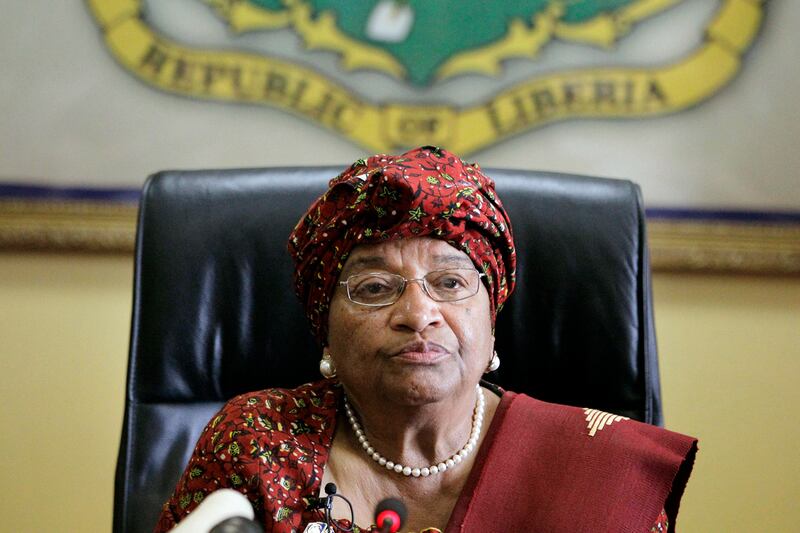
On Wednesday, a few dozen members of Sirleaf’s Unity Party gathered near the president’s house in Sinkor, Monrovia, accusing her of nepotism and calling for her to abdicate her role as party leader. Not long after the protest began, the ranks of demonstrators swelled to roughly 200 people from the party along with a handful of police officers and United Nations peacekeepers, who arrived to quell scuffles between rival factions within the party.
“Nobody should make the mistake and say this is a Unity-Party-led government; this government is a Sirleaf-family-led government,” said Patrick S. Piah, one of the protest’s organizers.
“This is not a tenet of good governance. It is calculated so that Madam Sirleaf can enrich her family [who] have gone to very lucrative and strategically placed positions.”
Sirleaf could not be reached for comment, but in the past she has publicly denied charges of nepotism. She is set to meet with protesters over the weekend to address their concerns.
Long lauded as one of the world’s foremost female leaders, Sirleaf received the 2011 Nobel Peace Prize along with Liberian peace activist Leymah Gbowee and Yemeni journalist Tawakkul Karman.
Yet the recent protests underline growing unease with her administration at home. They mark the first time that she has publicly been criticized by her own party. Coming nearly nine years after a long and bloody civil war, and with Liberia’s political climate still fragile, some analysts say the protests could portend a more significant political challenge.
“This has serious political implications,” says Dan Saryee, director of the Liberia Democratic Institute.
“If the government is sensitive about what is happening they need to address the issue.”
This is not the first time Sirleaf has been charged with nepotism. The president has long been accused by civil society groups and members of the opposition party, of offering jobs to friends and other close associates. The current controversy, however, first erupted in March after she appointed her son Robert Sirleaf, who is also her senior political adviser, to chair the board of the National Oil Company of Liberia. One of Sirleaf’s other sons, Charles Sirleaf, was appointed as Deputy Governor of the Central Bank earlier this year and yet another son, Fumba Sirleaf, has headed the National Security Agency since her first term.
Tensions within the ruling Unity Party have been mounting for some time.
“Within the party there are many people who aren’t comfortable with party-government relations,” said Abdullai Kamara, the chairman of the Center for Media Studies and Peace Building, a civil society organization based in Monrovia.
“[They] feel deeply that the elites dominate and the masses were only incorporated into the party for the election.”
For Kamara, the concentration of power in the hands of a few remains one of the biggest challenges to Liberia’s fledgling democracy.
“What concerns us it that power is concentrated in a very small group of people who are sitting around the same dining table,” he said.
“The problem here is that once they are on the same dining table, they will only make decisions the interest of the group and not in the interests of the larger population.”
President Sirleaf rose to power in 2005 in Liberia’s first democratic election, a contest that followed the end of the country’s armed conflict and the exile of former President Charles Taylor, whom the U.N.-backed Special Court for Sierra Leone recently found guilty of aiding and abetting war crimes in Sierra Leone.
During her first term, Sirleaf received praise for reducing Liberia’s debt while maintaining peace and stability, but faced criticism at home for delays in building infrastructure and failing to address corruption.
Thus far, Sirleaf’s second term has not been a smooth one. During last year’s tense presidential elections her legitimacy was called into question after the main opposition party, Congress for Democratic Change (CDC), then headed by Harvard-educated former diplomat Winston Tubman, called for a boycott of the second round run-off vote in November. Tubman, along with his running mate, the soccer legend George Weah, staged a demonstration, which ended violently as Liberian police fired live rounds on the crowd, killing at least one protester.
The elections were deemed free and fair by international observers, but voter turnout was remarkably low, caused primarily by “fear of further violence,” according to a report by the International Crisis Group. Sirleaf claimed a landslide victory with 90.7 percent of the vote in the second round, a huge leap forward from her first round results, which raised questions about her level of popular support. Nevertheless, the CDC leadership accepted Sirleaf’s victory and attended the inauguration, despite threatening to hold demonstrations in the weeks leading up to the event.
Nepotism and patronage have long defined politics in Liberia, a nation that was founded in 1847 by freed American slaves, who formed an elite class that ruled for more than 100 years and subjugated the natives in the style of their former masters.
Economic disparities and lack of access to opportunity played a major role in fomenting Liberia’s civil crisis and the brutal 14 years of war that followed. The conflict claimed the lives of more than 250,000 people, according to Liberia’s Truth and Reconciliation Commission, the body that investigated human rights violations that occurred between 1979 and 2003 as well as the root causes of the war.
Despite the war’s end, Liberia remains one of the poorest countries in the world, ranking 182 out of 187 on the United Nations Human Development Index. Although the country has witnessed significant economic growth in recent years, three out of four Liberians live below the poverty line according to the World Bank.
Throughout her career, President Sirleaf herself has spoken out against nepotism, corruption, and inequality. In a 1990 speech made to the U.S. House of Representatives’ subcommittee on Africa, Sirleaf, who at the time supported Taylor’s efforts to overthrow the brutal military strongman, Samuel Doe, spoke of the need to ensure a future Liberia “which seeks to promote the creative talents of all its citizens under conditions of equity and equal opportunity can come to pass.” In her inaugural address this year she spoke of the need to create “a Liberia where opportunity is plentiful and available to all.”
Since she has been in office, however, critics argue that Sirleaf has only been concerned with providing opportunities for her family and friends. And as a result, some fear that further instability lies ahead for the country.
“If Madam Sirleaf … takes lucrative positions like Samuel K. Doe did and Charles Taylor did … it is possible that people will start to say: ‘Hey, I’m being neglected,' ” said Piah.
“Frustration will come in and what happens? Trouble starts boiling.”