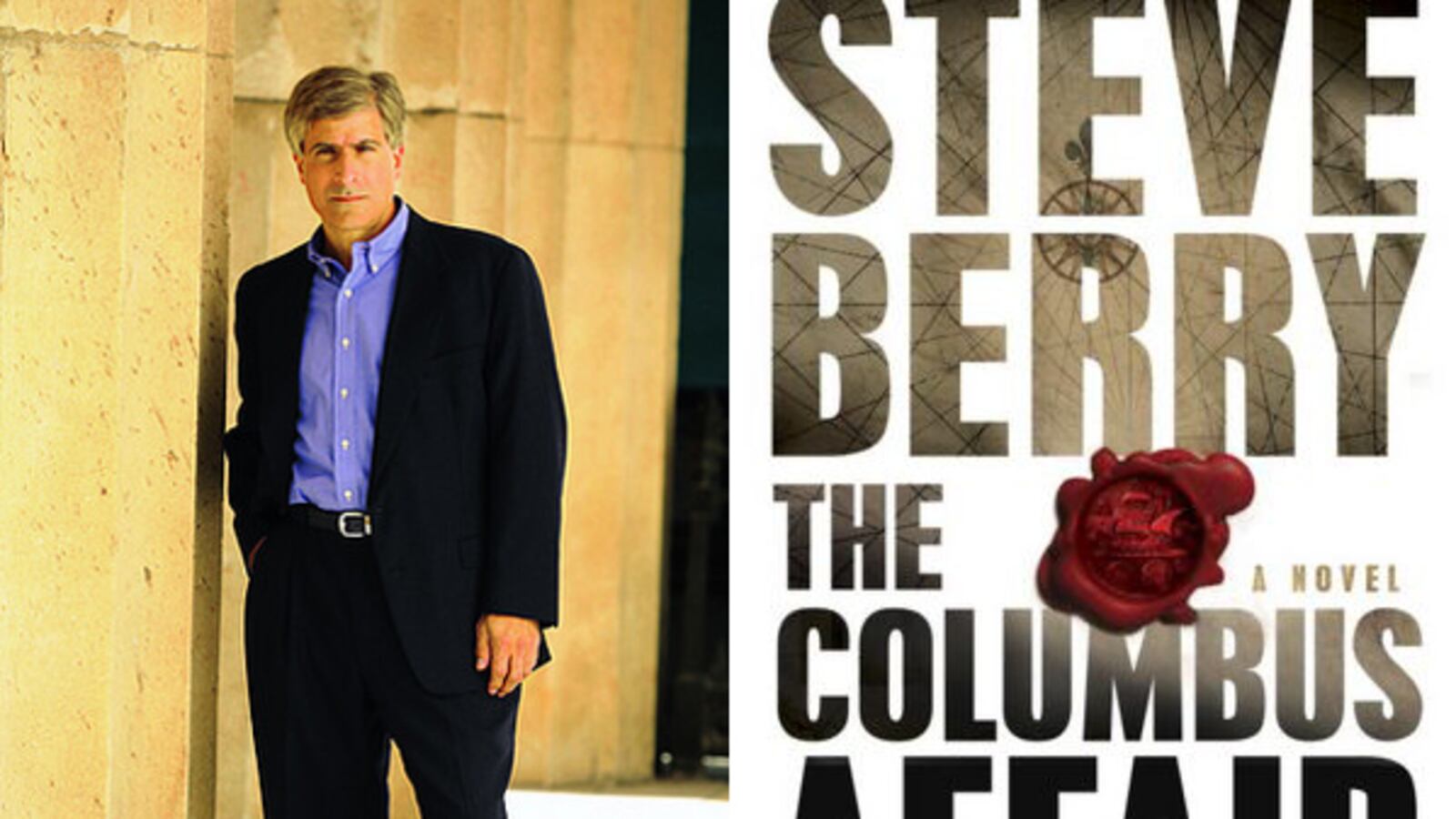
With the addition of a new book, The Columbus Affair, Steve Berry now has over 14 million thrillers in print, available in 51 countries. There are seven novels alone in a series featuring his hero, Cotton Malone. But before success was possible, he had five separate novels rejected a total of 85 times before his first book sold, a process that took him 12 years: six years to find an agent, and then six years before his first novel came out. If anyone knows the value of hard work in writing, it is Berry.
Of which of your books or projects are you most proud?
I love all of my children equally, all of my printed books, and each one bears a special piece of me. But the one I’m most proud of is the one no one will ever see—the very first manuscript I ever wrote, back in 1990. It took me a year to do it. It’s 170,000 words long, and is the most horrible thing you've ever read. But what makes me proud of that book is that I started it and finished it.
I keep it on a shelf not far from where I’m sitting right now. I gave it a title, Till Death Do Us Part. It’s a legal thriller, because I was then relying on the rule that you should write what you know. I hence learned that’s bad advice. Instead you should write what you love. If what you know and what you love are the same thing, that’s great. But if not, write what you love. I love history, secrets, conspiracies, action, adventure, international settings. So that’s what I eventually wrote.

Tell us about your new book.
Cotton Malone is taking a year off. This is stand-alone novel, my first in 10 years. I’ve created a new character. He’s a disgraced newspaper reporter who gets caught up in something quite extraordinary dealing with Christopher Columbus. It’s the same kind of tale as the Cotton Malone series: secrets, conspiracies, history, international settings. But he’s not Cotton Malone. He has other ways he gets himself in and out of trouble. If people like him, and I hope they do, I’ve left it open so he could return one day. Cotton Malone’s coming back next year. I’m writing that adventure right now.
What’s your writing routine like?
I’m a morning person because I learned to write my novels while still practicing law. I would get to the office at 6:30 a.m. and write until other people arrived, around 9. Now I still do that. I start at 6:30 or 7, and I’ll write until 11, then take an hour off, then work until about 2 p.m. By then my brain has had enough. Then I’ll deal with the business side of writing—marketing, publicity. I’ll do interviews like this one with you. That’s one to two hours a day, sometimes more when we’re getting closer to a book release. I usually stop around 4 p.m., and from 4 to 6:30 or so I just relax. I’ll take a walk, play nine holes of golf. Evenings are my research time, to prepare for the next day.
I can only write new words at my desk, the one I’ve owned for 25 years. When we moved to our new house I designed my office around it. I’ve written everything I’ve ever written at this desk.
I’m not one of those people who can write on the road. I can edit on the road. I can research or plot on the road. But I can’t write new words on the road. The desk is just one that I bought at Sam’s Club back in the late 1980s, and I’ve had it ever since.
Do you plot things out ahead of time, or do your plots grown more organically?
I definitely have an outline to get started. The first 100 pages are laid out, and, as I write, I stay about 100 pages ahead of myself outlining. But I don’t adhere rigidly to the outline; it just sort of keeps me on track. I’ve found that it’s much better to have some idea as to where you’re going. Otherwise you’ll waste time.
What is guaranteed to make you laugh?
I love The Daily Show. I watch it every day, that’s a guaranteed laugh. Terrific humor.
What is your favorite snack?
When I write I tend to eat M&Ms. I sort of switch around: M&Ms, Reese’s Pieces, Milk Duds. But I always go come back to M&Ms.
Was there a specific moment when you felt you had “made it” as an author?
I was published in 2003 with The Amber Room. And then The Romanov Prophecy came in 2004, and The Third Secret in 2005. The Third Secret was the first book of mine that made the top 15 of The New York Times bestseller list. So that was kind of special for me. By that time I had been writing for 15 years, 12 of which I was not published. If someone asked me, I would always say that I’m a lawyer. I’d never mentioned writing.
I was at Bouchercon 2005, the great mystery conference they have every year. That year was the first time that all the thriller writers gathered together to form ITW [International Thriller Writers]. There were about 75 there, a lot of writers from across many sub-genres. They kept asking me what do you think, what do you write, and we were talking a lot about thrillers. It suddenly occurred to me—and I remember the moment—that I’m a writer, not a lawyer anymore. I’m one of them. It was the first time I ever called myself a writer, and I’ve called myself one ever since.
There was a lady at an event one day who stood up and asked, “Do you sweat when you write?” I didn’t know what to say, it kind of threw me off guard. I thought of a few humorous responses that I couldn’t say in public, so I looked at her and just said, “No.”
What do you need to have produced/completed in order to feel that you’ve had a productive writing day?
The perfect advice every writer has to follow on a daily basis: you have to write. There’s no one on the planet who can teach you how to write. Writing is an acquired skill and you have to teach yourself, and the only way to teach yourself is to do it every day.
One thousand to 1,500 words is a good day for me. There are magical days when I can do 2,500, and that’s quite remarkable. Then there are days when it’s a struggle just to get something out. But 1,000 to 1,500 words is about all my brain can take. I always say that the first draft of a book is the “less hard draft.” I never say “easy,” because nothing here is easy. But draft one can be a bit “less hard” because you just slop it down. Then again, it can also be the hardest because you have to make up every word, and each one has to relate with every other word.
What would you like carved onto your tombstone?
Husband. Father. Good man.
More “How I Write” Interviews:Jennifer Finney BoylanAntony BeevorLev GrossmanDavid EaglemanChad HarbachJodi Picoult