Book Bag: Kurt Andersen’s Favorite ’60s Books
The writer and Studio 360 host creates a character haunted by her political actions in the late ’60s and early ’70s in his new novel, True Believers. He picks his favorite books from the era.
‘True Believers’ by Kurt Andersen. 448 pp. Random House. $27.
All five of these books (except Mailer's) were written when their authors were in their mid-30s—old enough to write masterfully and have some grown-up distance on what was going on, but still just young enough to viscerally feel what was happening in real time. I read each one between the ages of 14 and 24.
By Tom Wolfe
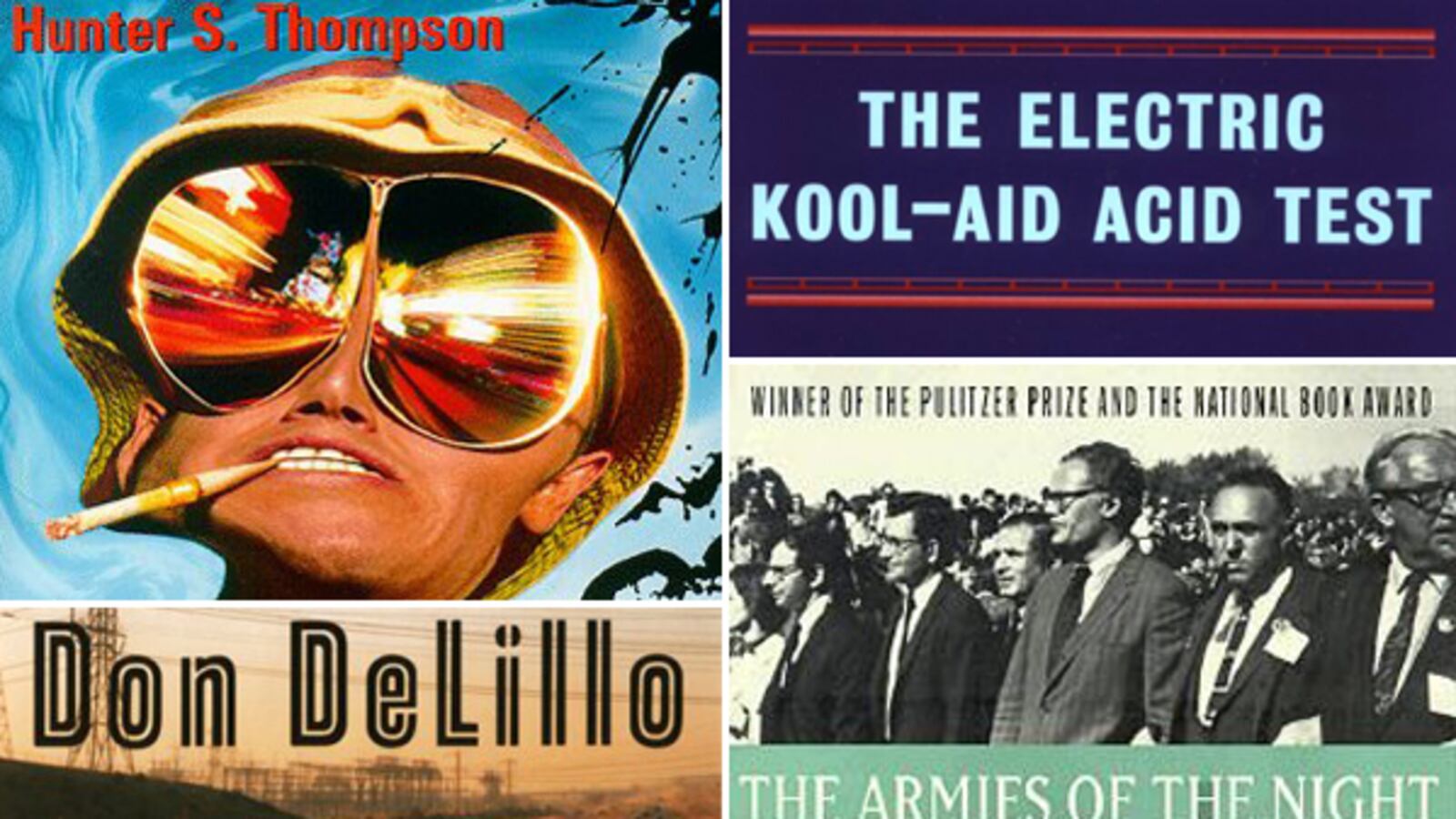
‘The Electric Kool-Aid Acid Test’ by Tom Wolfe. 432 pp. Picador. $16.
I checked out this book from the Omaha Public Library in 1969, the summer of Woodstock, just after I'd first smoked marijuana for the first time, before I turned 15. It doubly or triply astounded and thrilled me. It's a you-are-there account of Ken Kesey and his Merry Pranksters' transcontinental trip on a bus they called Further, and the spawning of the counterculture in San Francisco right afterward. It's thick with crazed gusto, but also has a precision and irony that almost no one else brought to the ’60s. More than any other single book it made me want to be a writer. I was a little apprehensive to re-read it as an adult, but like all of Wolfe's early journalism, it totally holds up.
Slouching Towards Bethlehem (1968)
By Joan Didion
‘Slouching Towards Bethlehem’ by Joan Didion. 256 pp. FSG. $15.
At age 33, Didion was astonishingly clear-eyed about the discombobulated culture going on around her. Everything was in flux, it seemed, except her unflinching, even-keeled powers of observation and moral analysis. So much written then seems so dated today. But not these essays:
“One of the mixed blessings of being 20 and 21 and even 23 is the conviction that nothing like this, all evidence to the contrary notwithstanding, has ever happened before.”
"[W]hen we start deceiving ourselves into thinking not that we want something or need something, not that it is a pragmatic necessity for us to have it, but that it is a moral imperative that we have it, then is when we join the fashionable madmen, and then is when the thin whine of hysteria is heard in the land, and then is when we are in bad trouble. And I suspect we are already there.”
By Norman Mailer
‘The Armies of the Night’ by Norman Mailer. 288 pp. Weidenfeld and Nicolson.
This is nominally a book of reportage about the huge and unprecedented antiwar march on the Pentagon one weekend in the fall of 1967. Yet despite its pretention—the subtitle, the third-person references to the author as "Mailer"—there is no better nonfiction portrayal of America at its 20th-century moment of unraveling. He sees and dissects the cultural and political transmutation suddenly underway even as (unlike Wolfe or Didion) he embodies it.
By Hunter S. Thompson
‘Fear and Loathing in Las Vegas’ by Hunter S. Thompson. 204 pp. Vintage. $15.
When I was 17, two years after Tom Wolfe had rewired my sensibility, Hunter Thompson provided a tune-up with his magical-realist chronicle of a journalistic expedition to Las Vegas to a) report on a National District Attorneys Association conference on drugs, and b) consume huge quantities of drugs (LSD, mescaline, cocaine, ether, etc.). Thompson went all in, and then further still. If Mailer embodied a certain Northeastern middle-aged male variant of the ’60s, Thompson was its iconic Western cowboy iteration. An inscribed copy of the book (like my copy of Catch-22, signed by Joseph Heller) is one of my treasures.
Americana (1971)
By Don DeLillo
‘Americana’ by Don DeLillo. 384 pp. Penguin. $16.
I read DeLillo's first book some years after it came out and some years before he'd become a literary household name. Like the novel's protagonist, David Bell, I was in my 20s and working in the midtown Manhattan media business. The book is set in the '60s, when Bell quits his job and—in perfect ’60s fashion—lights out for the territories to try to figure out himself and America. It is very much a DeLillo novel, except shaggier, less solemn, more youthful, fun, and funnier.
About Book Bag
Need a book recommendation? We get asked all the time. But look no further, because here's our answer. We've left the task to the experts: every week, great writers pick their favorite books and tell you why they are must-reads. What are you waiting for?
Latest From
Book Beast
Animal Planet
Why do we use enormous resources to save some species and let others die? Melissa Holbrook Pierson on the strange ways of humans.
Storytellers
Khaled Hosseini’s Book Bag
East Egg
Gatsby in Chengdu
Constructive Criticism
Reviewing the Reviewers
T.J. English on Whitey Bulger
The author of Whitey’s Payback: and Other Stories on what you need to know about the downfall of the notorious Boston gangster. From Open Road Media.
Latest
Hot Reads
-
This Week’s Hot Reads
From Chimamanda Ngozi Adichie’s tale of reassimilation back into Nigeria to a road-trip... More
-
This Week’s Hot Reads
This week, from a childhood interrupted by war in Sri Lanka to the glory days of food... More
-
This Week’s Hot Reads
This week, stories of human endurance and persistence, whether in the courtroom or behind... More
Latest
Book Bag
-
Khaled Hosseini’s Book Bag
The author of ‘The Kite Runner’ picks his favorite short-story collections.... More
-
Paul Theroux’s Inner Journey
The best travel writing is about the voyage into the space within.... More
-
10 Advice Books for Graduates
As students leave school and enter their next stage in life, what books can they turn to... More
Latest
How I Write
-
Burt Bacharach: How I Write
The great American songwriter, responsible for 73 Top 40 hits on the U.S.... More
-
Susan Cain: How I Write
Introverts of the world unite!... More
-
Patrick Flanery: How I Write
Why is the author of the novel ‘Absolution,’ set in a contemporary South Africa dealing... More
Latest
Longreads
-
The Week’s Best Reads
From the epic fraud behind the popular drug Lipitor to higher education’s new internet... More
-
The Week’s Best Reads
From the White House’s intense internal debate on Syria to a Spanish village that won the... More
-
The Week’s Best Reads
From the harrowing memoirs of a Guantánamo detainee to a year without the Internet, The... More
Latest
The Big Idea
-
Big Idea: Our Global Cost
How do we measure and predict the human cost of climate change? Andrew T.... More
-
Paul Farmer: The Big Idea
The charismatic doctor and social activist, known for his work in Haiti and co-founding... More
-
Temple Grandin: My Big Idea
The animal-science pioneer and autistic activist looks inside her own brain to learn... More
Latest
American Dreams
-
Lonelyhearts Be Free Tonight
In the midst of the Great Depression, Nathanael West took real letters from desperate... More
-
Dead on the Dance Floor
As the Jazz Age entered full swing in 1923, the bestselling novel in America was by... More
-
Insane in the Plains
In the early 1900s people in the prairie states started going insane, literally.... More
Latest
The City
-
Bristol, Bridge to the Wide World
Travel writer Sara Wheeler, famous for her stories of polar expeditions, returns home to... More
-
Australia's Outpost at the Edge
Writer Barry Lopez has had a long affection for Australia's lone west-coast city, which... More
-
Please Call It Bombay
The city might have a new name, but King George's colonial legacy is still everywhere.... More


Comments